

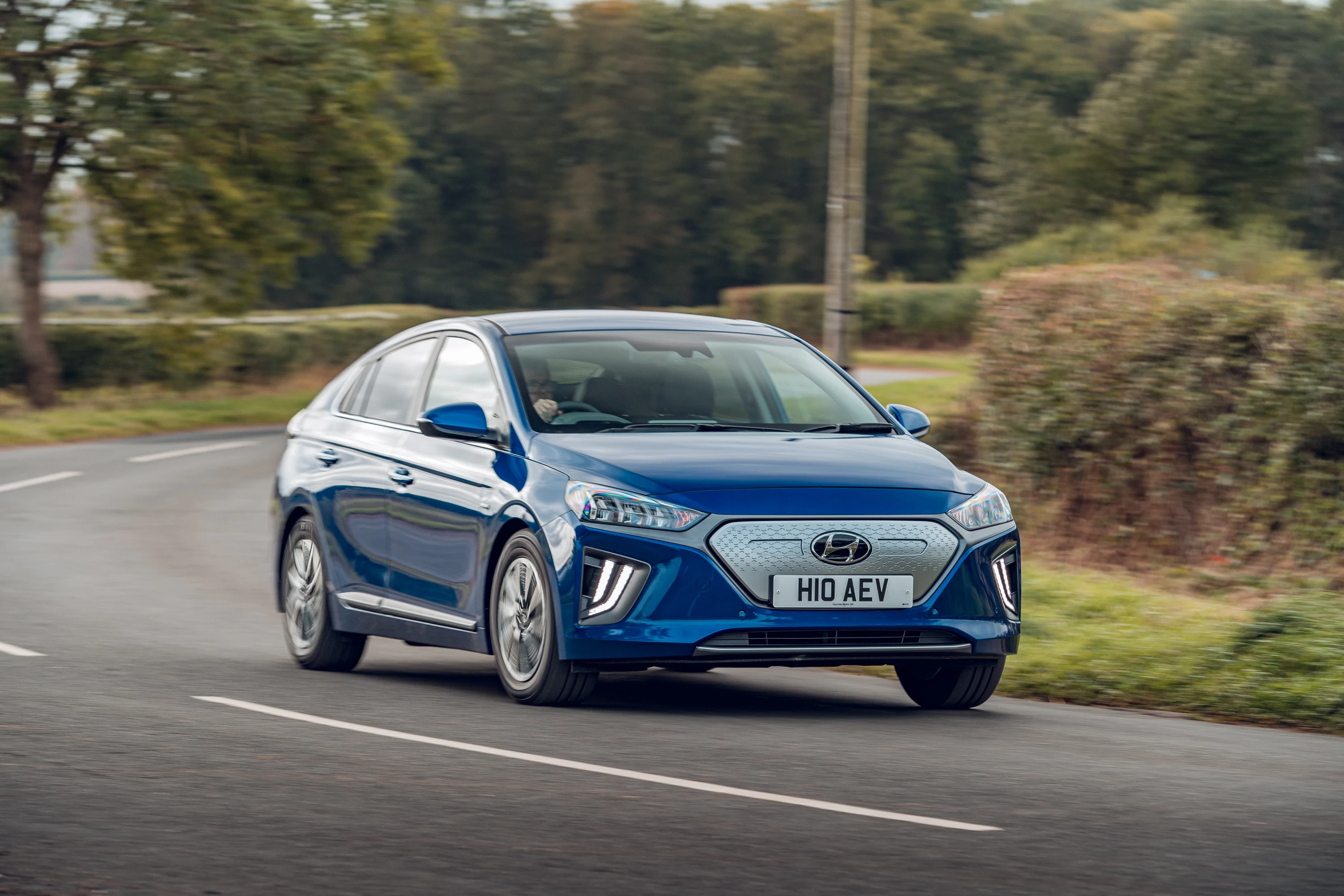
Use the links below to jump to a section, or continue reading for the full article. You can also view the full specifications, image gallery, charging performance, and online reviews. Sections:
Performance
Battery, Range, and Charging
The battery has a gross capacity of 40.4 kWh and a net usable capacity of 38.3 kWh, with a 2.1 kWh buffer (5.2%) for battery protection. With a nominal voltage of 319.4 volts, the system is classified as a 400-volt battery system.
The lithium-ion battery uses NMC (nickel manganese cobalt) chemistry.
According to the WLTP (Worldwide Harmonized Light Vehicles Test Procedure) standard, the vehicle's range is 311 km (193 miles), with an energy consumption rate of 12.3 kWh/100 km (5.0 mi/kWh).
For more details about the range, see real-world data and range listings on this model’s range and consumption page.
The vehicle supports fast DC charging with a maximum power of 44 kW. A 0–100% charge takes approximately 191 minutes. A typical 10–80% session takes about 52 minutes at an average power of 31 kW.
With five minutes of overhead per stop, the optimal charging window is 1–65%. Effective average power, including overhead, is 36 kW over a session lasting about 40 minutes and 21 seconds.
Onboard Charger
The standard onboard charger supports AC charging at up to 7.2 kW. A full 0–100% charge takes about 5 hours and 19 minutes with a suitable home charging setup.
Charge Port
The charge port is on the left rear side. This position suits charging bays where the vehicle reverses toward the charging point.
Drivetrain
The Hyundai IONIQ Electric 38 kWh has a front-wheel drive system supported by one motor on the front axle.
The motor used is Permanent Magnet Synchronous Motor.
Suspension
The Hyundai IONIQ Electric 38 kWh has MacPherson-strut front suspension and a torsion-beam rear suspension, with gas-pressurized dampers and coil springs on both axles.
The Standard suspension has a fixed height and damping characteristics.
Ground clearance with this setup is 140 mm.
Drive Modes
The Hyundai IONIQ Electric 38 kWh lets the user select different drive modes that affect the car's handling.
The driver can choose between 4 modes:
- Eco+: Comfort steering and efficient throttle.
- Eco: Comfort steering and efficient throttle.
- Normal: Balanced steering and throttle.
- Sport: Dynamic steering and throttle.
Brakes
The Hyundai IONIQ Electric 38 kWh is equipped with cast-iron disc brakes on both the front and rear.
The front discs measure 280 mm, while the rear discs are 284 mm.
Regenerative Braking
The regenerative braking system in this model offers several modes. The most efficient option is the Automatic Regeneration Mode, where the vehicle coasts when possible and employs regenerative braking to reduce speed as needed.
Manual regeneration is another mode, where regenerative braking is controlled by pressing the brake pedal. The brake system blends in physical brakes only when necessary.
Another option is the Regen on Accelerator Pedal mode where regenerative braking is activated when the driver eases off the accelerator pedal. This system allows the vehicle to slow down and recover energy without the driver needing to press the brake pedal, a feature often referred to as one-pedal driving.
Drivers can also adjust the regenerative braking strength when lifting off the accelerator. There are four levels of regenerative braking to choose from, allowing you to customize the driving experience to your preference.
The maximum regenerative braking power is 50 kW.
Exterior
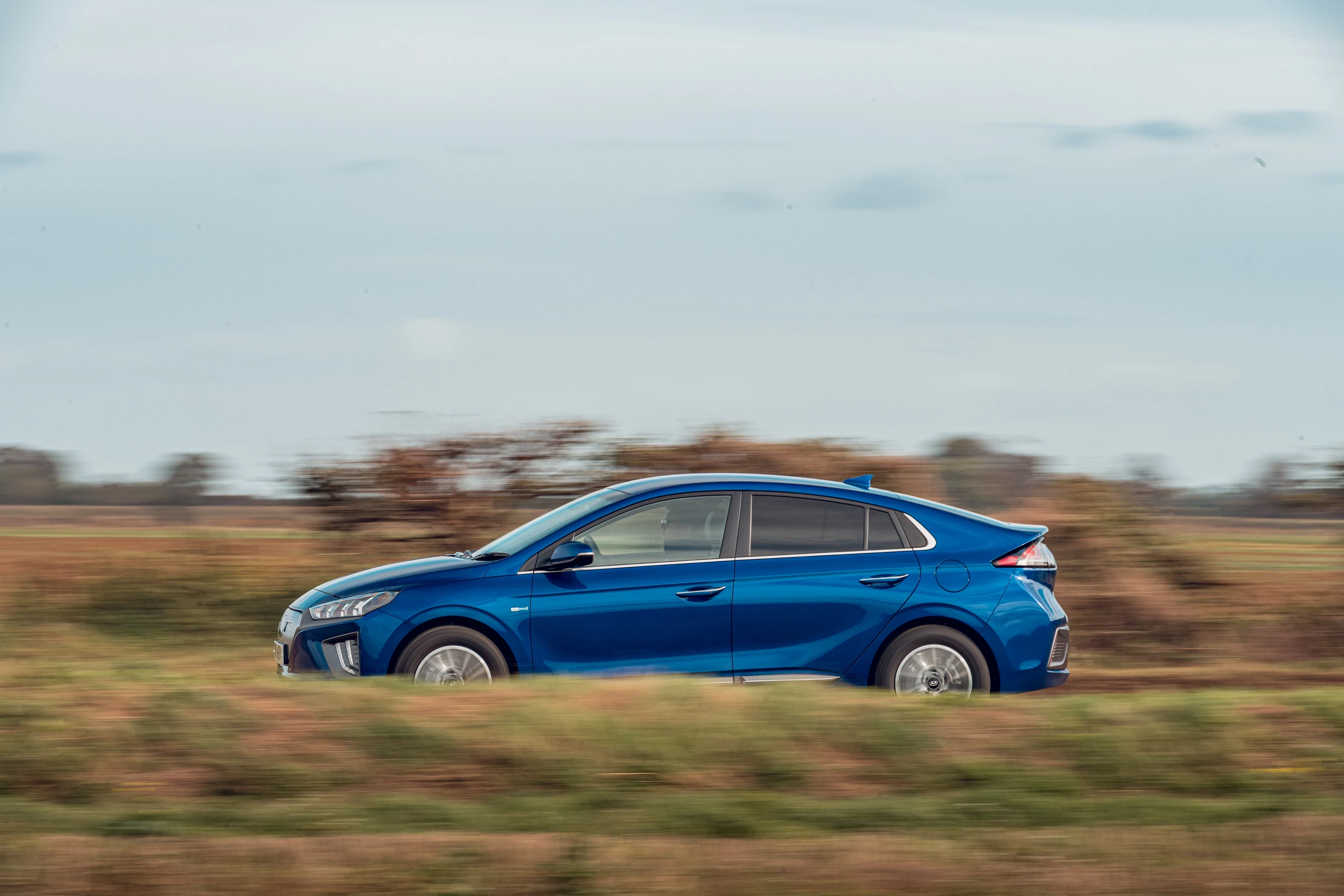
The Hyundai IONIQ Electric 38 kWh, with dimensions of 4470 mm in length, 1820 mm in width, and 1450 mm in height, falls into the C-segment, also known as compact cars.
The Hyundai IONIQ Electric 38 kWh is available in 5 paint colors, including both solid and metallic options.
You can select from multiple wheel designs, all available in the same size, on the Hyundai IONIQ Electric 38 kWh. The available tire and wheel combinations include:
- 205/60 tires on 16" rims
The car has four regular doors and a hatchback-style liftgate.
There are two different roof options to select from.
A conventional roof is standard.
Privacy glass from the B-pillar rearward is optional. It reduces glare and solar heat.
Hyundai IONIQ Electric 38 kWh
Interior
You can choose between different types of seat materials and interior styling.
You can choose between several interior designs.
Seats
The Hyundai IONIQ Electric 38 kWh accommodates five passengers with two front seats and a three-seat bench in the rear.
First Row Seats
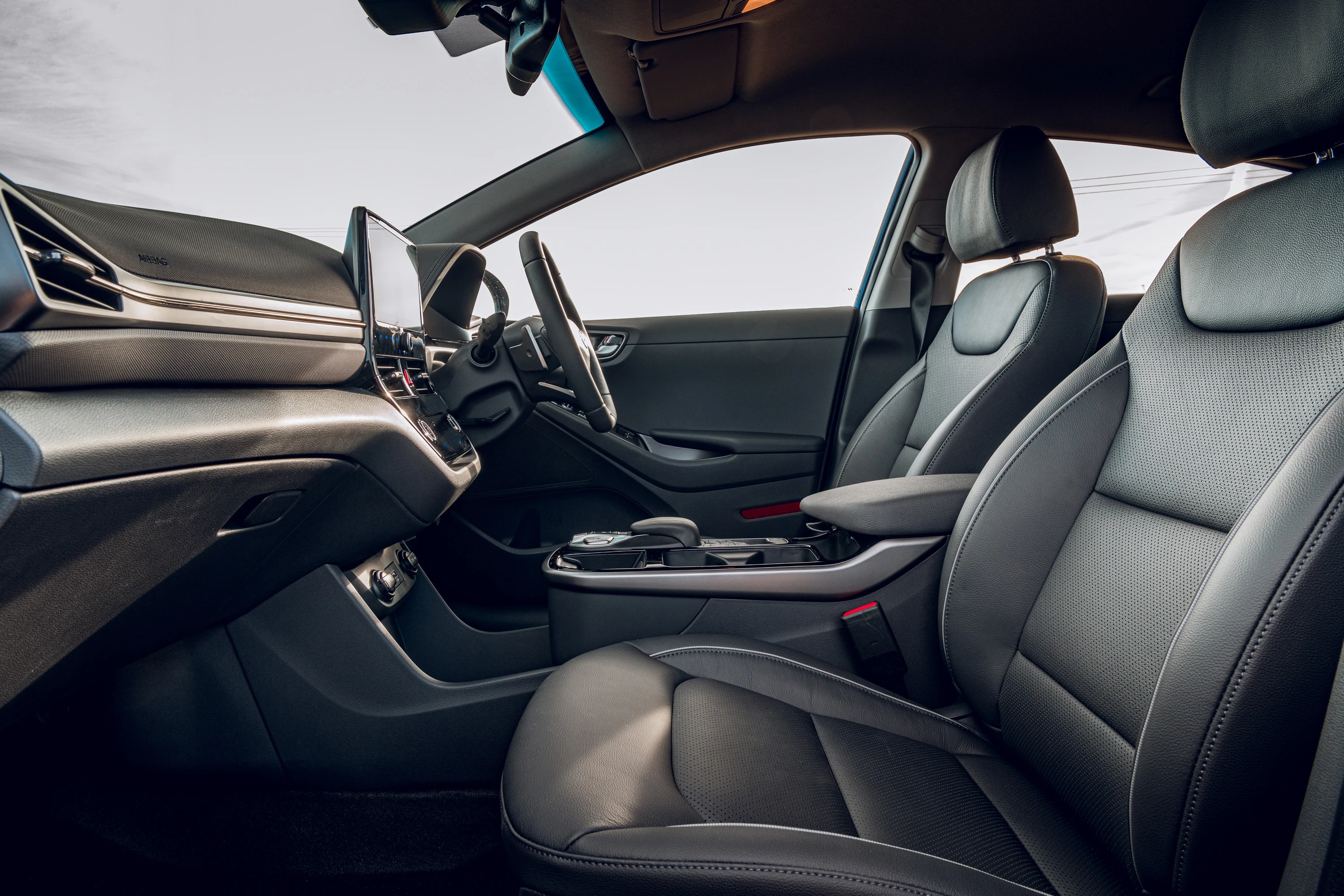
The Hyundai IONIQ Electric 38 kWh offers a single type of front seat.
The following functionalities are available on the seat:
- Fore-and-aft adjustment (electrically adjustable for driver, manually adjustable for passenger)
- Recline adjustment (electrically adjustable for driver, manually adjustable for passenger)
- Height adjustment (electrically adjustable for driver, not available for passenger)
- Height adjustable headrest
- Heating
- Adjustable lumbar support (electrically adjustable for driver, not available for passenger)
Available in:
- Black/Gray fabric upholstery
- Black leather upholstery
Hyundai IONIQ Electric 38 kWh
Second-Row Seats
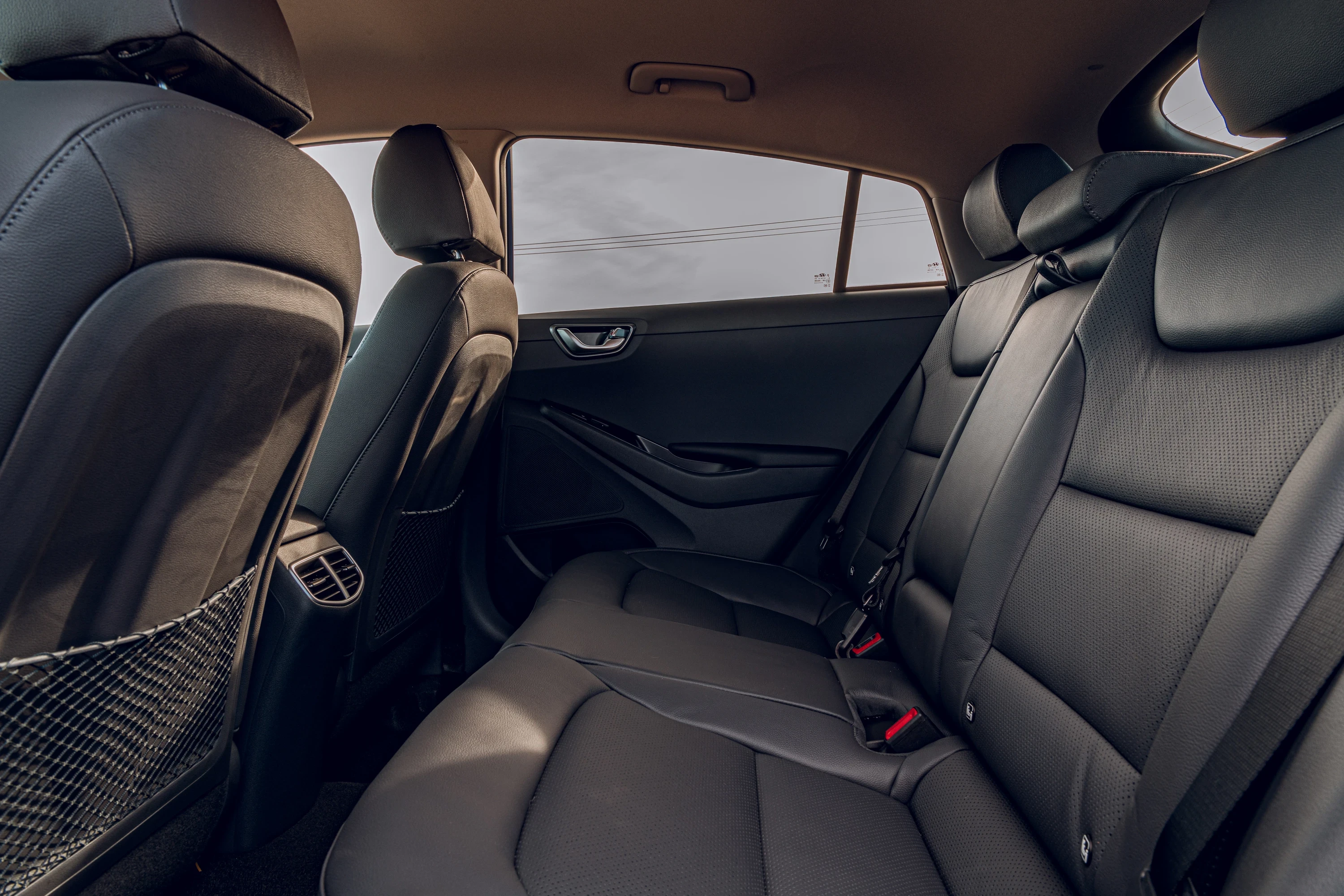
The second row features a standard three-seat bench with a SixtyForty split, allowing each section to fold separately to increase cargo space.
Additional second-row features include:
- Height adjustable headrest (standard for outer seats)
- Heating (optional for outer seats)
- ISOFIX (standard for outer seats)
Hyundai IONIQ Electric 38 kWh
Interior Storage
The Hyundai IONIQ Electric 38 kWh has the following interior storage:
- Glove Compartment: Located in the dashboard in front of the passenger.
- Center Console: A storage compartment is located beneath the front center armrest.
- Door Pockets: The front and rear doors include integrated storage pockets.
Climate System
There is one climate system available:
- 1-zone climate system: Controls a single zone for the whole cabin.
A heat pump is available as an option and can reduce the energy needed to heat the cabin in cold weather.
User Interface and Control
The Hyundai IONIQ Electric 38 kWh features a screen-focused control interface with limited physical buttons and no stalks, providing a minimalist approach to vehicle controls. This design prioritizes touchscreen interaction, which may appeal to tech-savvy users but could be less intuitive for those accustomed to traditional controls.
Two different screen setups are available on the Hyundai IONIQ Electric 38 kWh.
The standard layout has the following configuration.
This model features a dual-screen configuration, with a dedicated digital instrument cluster for the driver and a central infotainment display integrated into the center console.
Key screen details:
- Driver Information Display: The 7.0-inch screen is integrated into the dashboard behind the steering wheel. It provides essential driving data such as speed, range, and navigation prompts.
- Center Dashboard Touchscreen: A 8.0-inch touchscreen located in the center of the dashboard. It serves as the main interface for infotainment, navigation, and vehicle settings.
The optional layout has the following configuration.
This model features a dual-screen configuration, with a dedicated digital instrument cluster for the driver and a central infotainment display integrated into the center console.
Key screen details:
- Driver Information Display: The 7.0-inch screen is integrated into the dashboard behind the steering wheel. It provides essential driving data such as speed, range, and navigation prompts.
- Center Dashboard Touchscreen (optional): A 10.3-inch touchscreen located in the center of the dashboard. It serves as the main interface for infotainment, navigation, and vehicle settings.
The Hyundai IONIQ Electric 38 kWh does not have a head-up display. Speed and navigation information remain on the vehicle's other displays.
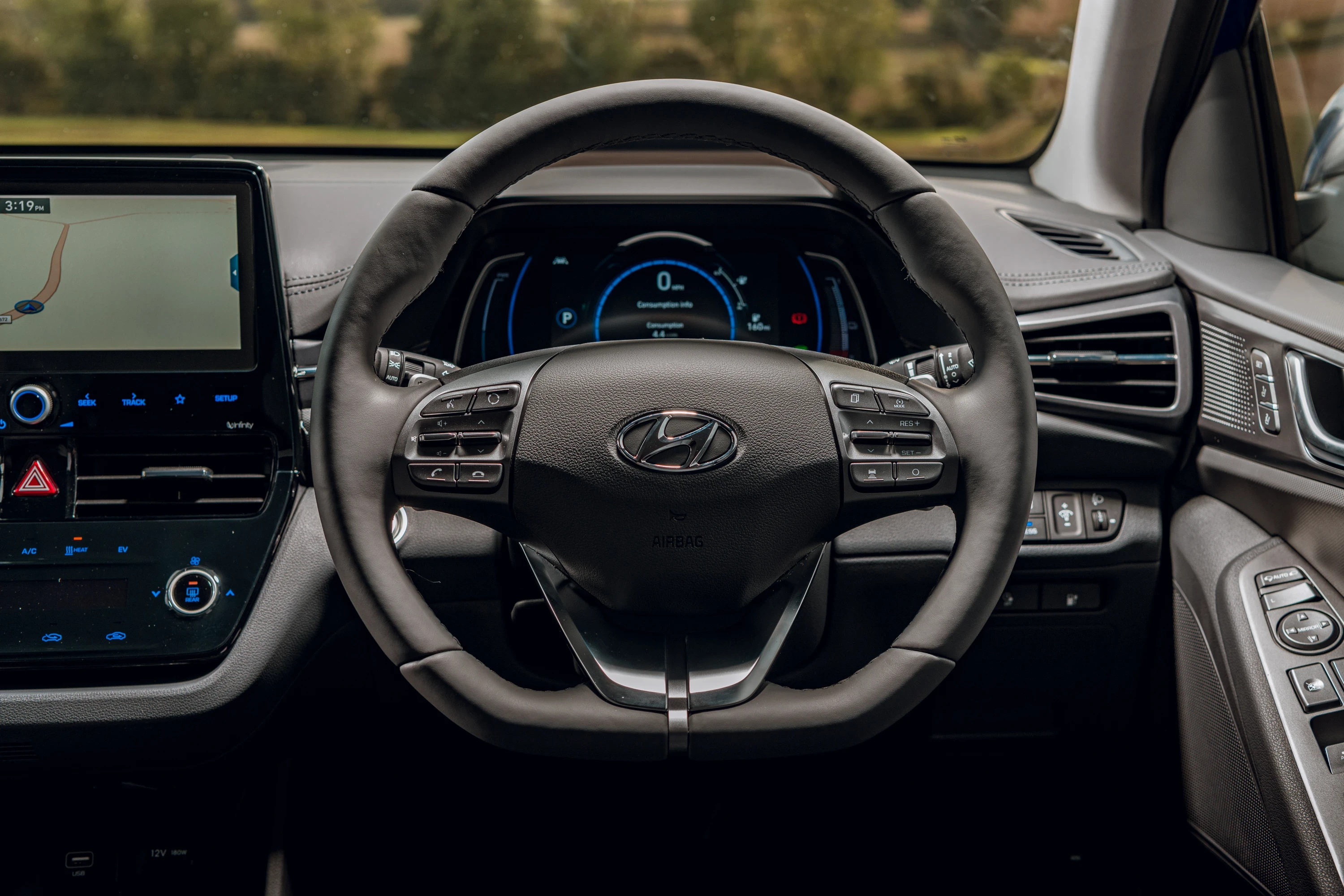
Hyundai IONIQ Electric 38 kWh
Steering Wheel
The Hyundai IONIQ Electric 38 kWh is equipped with a single type of steering wheel:
The steering wheel adjusts for tilt and reach. The adjustment is manual.
Design: Circular flat-bottom
Controls: Physical buttons, Scroll wheels
Heating: Heated (standard)
From the steering wheel you can control:
- Media Controls: Steering-wheel controls provide access to audio and media functions.
- Phone Controls: Buttons on the steering wheel allow you to answer, end, and manage phone calls.
- Cruise Control: A stalk or button on the steering wheel allows you to set and adjust the cruise control speed.
- Voice Control: A button on the steering wheel activates the voice control system.
- Drive Mode Selector: A dedicated control allows you to switch between different drive modes.
Mirrors
Both the exterior and interior mirrors use conventional mirror technology to provide a clear view of the area behind the vehicle.
Voice control is standard.
Infotainment
Proprietary
Navigation System
The built-in navigation system uses detailed maps and offers advanced route planning. It provides real-time traffic information to support an efficient and stress-free journey.
Phone Mirroring
The Hyundai IONIQ Electric 38 kWh supports Android Auto and Apple CarPlay, providing access to compatible phone apps such as Google Maps and Waze on the car's display.
Sound System
You can choose between two sound systems for the Hyundai IONIQ Electric 38 kWh:
- Standard Audio: Features six speakers.
- Infinity Premium Audio: The system has eight speakers and a maximum output of 315 watts.
The model includes USB-A connectivity as standard (total: 3).
Mobile App
The Hyundai IONIQ Electric 38 kWh has a mobile app for Android and iOS to manage and monitor the vehicle remotely. Features:
- Locate Your Vehicle: Check the current location of your car.
- Preconditioning: Preheat or cool your car before you start your journey.
- Lock and unlock: Lock or unlock the doors remotely.
- Charge Target: Set the battery's target state of charge.
- Find your car: Sound the horn or flash the lights to locate the car.
Lights
You can choose between two types of headlights for the Hyundai IONIQ Electric 38 kWh.
- The Hyundai IONIQ Electric 38 kWh comes equipped with standard halogen headlights.
- The optional LED headlights include corner lights that illuminate the side when turning.
The taillights use LED technology.
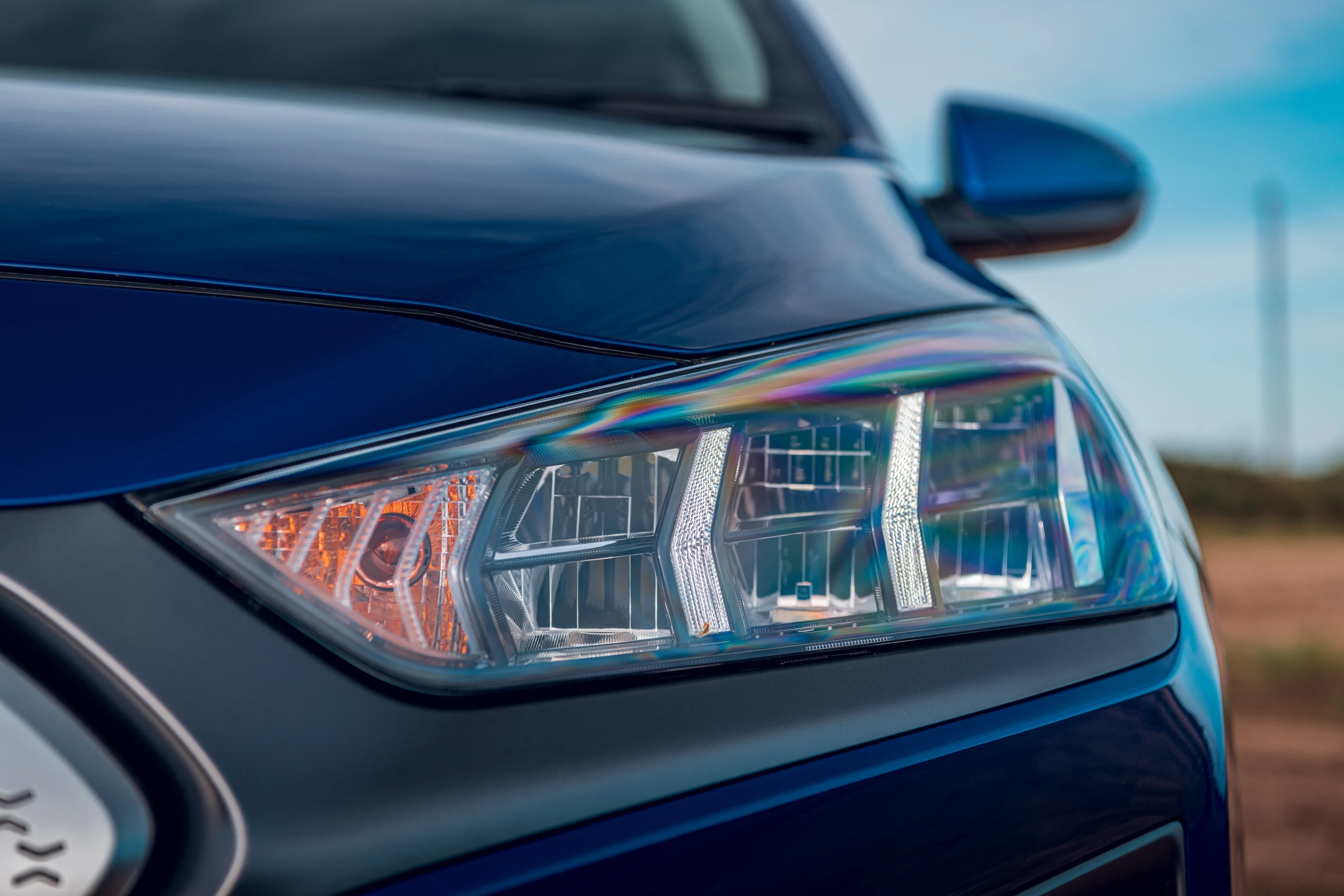
Hyundai IONIQ Electric 38 kWh
Advanced Driver Assistance Systems
The Hyundai IONIQ Electric 38 kWh offers standard and optional advanced driver assistance systems (ADAS).
Safety Systems
Anti-lock Braking System (ABS): Standard on the Hyundai IONIQ Electric 38 kWh. It prevents the wheels from locking during braking.
Electronic Stability Control (ESC): Standard on the Hyundai IONIQ Electric 38 kWh. It improves stability during sudden maneuvers and on slippery roads.
Lane-Keeping Assist (LKA): Standard on the Hyundai IONIQ Electric 38 kWh. It applies steering corrections if the vehicle begins to leave its lane.
The Lane Departure Warning alerts the driver if the vehicle begins to leave its lane.
Rear Cross Traffic Alert (RCTA): Optional on the Hyundai IONIQ Electric 38 kWh. It detects vehicles approaching from the side while reversing out of a parking space or driveway.
Forward Collision Warning (FCW): Standard on the Hyundai IONIQ Electric 38 kWh. It warns the driver of a potential frontal collision.
Automatic Emergency Braking (AEB): Standard on the Hyundai IONIQ Electric 38 kWh. It applies the brakes automatically if the driver does not respond to an imminent collision.
Blind-spot Monitoring (BSM): Optional on the Hyundai IONIQ Electric 38 kWh. It detects traffic in the vehicle's blind spots.
Driving Automation
The Hyundai IONIQ Electric 38 kWh offers driving automation at level 1, depending on the equipment level.
The Level 1 Hyundai SmartSense system provides the following driving automation features.
- Adaptive Cruise Control (ACC)
- Lane Centering Assist (LCA) / AutoSteer: Centers the vehicle in its lane and adjusts speed in traffic. The driver must keep their hands on the steering wheel and remain attentive.
Safety
The Hyundai IONIQ Electric 38 kWh is equipped with the following airbags:
- Front airbags for the driver and front passenger
- Side curtain airbags for both the first and second rows
Security and Access Technologies
The Hyundai IONIQ Electric 38 kWh includes the following security and access features:
- Keyless Entry and Start: Unlock and start the car with the key in your pocket or bag.
- Alarm System: Monitors for unauthorized entry or tampering and sounds the alarm when triggered.
Cargo Capacity and Towing Ability
The trunk offers a cargo capacity of 357 liters (12.6 cu ft). With the rear seat folded down, this expands to 1417 liters (50.0 cu ft).
The maximum permitted vehicle weight is 1970 kg (4343 lbs), and the base curb weight is 1535 kg (3384 lbs). This leaves a payload of 435 kg (959 lbs), including occupants. Options can increase curb weight and reduce payload.
This model is not available with a towbar and cannot tow a trailer.