


Use the links below to jump to a section, or continue reading for the full article. You can also view the full specifications, image gallery, charging performance, and online reviews. Sections:
Alternative Models
Compare the Toyota C-HR+ 77 kWh with these alternatives:
Performance
The Toyota C-HR+ 77 kWh has a maximum power of 165 kW (224 hp / 221 bhp) and a total torque of 269 Nm (199 lb-ft). It accelerates from 0 to 100 km/h (0 to 62 mph) in 7.3 seconds and reaches a top speed of 160 km/h (99 mph).
Battery, Range, and Charging
The battery has a gross capacity of 77.0 kWh and a net usable capacity of 72.0 kWh, with a 5.0 kWh buffer (6.5%) for battery protection. With a nominal voltage of 392 volts, the system is classified as a 400-volt battery system.
The lithium-ion battery uses NMC (nickel manganese cobalt) chemistry.
According to the WLTP (Worldwide Harmonized Light Vehicles Test Procedure) standard, the vehicle's range is 609 km (379 miles), with an energy consumption rate of 11.8 kWh/100 km (5.3 mi/kWh).
For more details about the range, see real-world data and range listings on this model’s range and consumption page.
The vehicle supports fast DC charging with a maximum power of 150 kW. A 0–100% charge takes approximately 69 minutes. A typical 10–80% session takes about 34 minutes at an average power of 89 kW.
With five minutes of overhead per stop, the optimal charging window is 8–53%. Effective average power, including overhead, is 87 kW over a session lasting about 22 minutes and 14 seconds.
In a 1000 km challenge at a constant speed of 120 km/h (75 mph) with an assumed consumption rate of 22 kWh/100 km, the trip would take about 10 hours and 3 minutes, needing four charging stops from 7% to 59%, totaling 103 minutes of charging time.
Onboard Charger
The standard onboard charger supports AC charging at up to 11 kW. A full 0–100% charge takes about 6 hours and 32 minutes with a suitable home charging setup.
An optional 22 kW onboard charger reduces the full charge time to approximately 3 hours and 16 minutes.
Charge Port
The location of the charge port is on the left front side. This location makes it easy to charge stations where you park side into the charger.
Drivetrain
The Toyota C-HR+ 77 kWh has a front-wheel drive system supported by one motor on the front axle.
The motor used is Permanent Magnet Synchronous Motor.
Suspension
The suspension system features a MacPherson strut front construction and a multi-link rear construction. Both the front and rear dampers are monotube dampers. The front and rear springs are coil springs.
The Standard suspension has a fixed height and damping characteristics.
Ground clearance with this setup is 185 mm.
Steering
Progressive steering is standard on the Toyota C-HR+ 77 kWh. It adjusts the steering ratio according to vehicle speed.
Drive Modes
The Toyota C-HR+ 77 kWh lets the user select different drive modes that affect the car's handling.
The driver can choose between 2 modes:
- Normal: Balanced steering and throttle.
- Eco: Balanced steering and efficient throttle.
Brakes
The Toyota C-HR+ 77 kWh is equipped with cast-iron disc brakes on both the front and rear.
The front discs measure 328 mm, while the rear discs are 317 mm.
Regenerative Braking
The regenerative braking system in this model offers several modes. The most efficient option is the Automatic Regeneration Mode, where the vehicle coasts when possible and employs regenerative braking to reduce speed as needed.
Manual regeneration is another mode, where regenerative braking is controlled by pressing the brake pedal. The brake system blends in physical brakes only when necessary.
Another option is the Regen on Accelerator Pedal mode where regenerative braking is activated when the driver eases off the accelerator pedal. This system allows the vehicle to slow down and recover energy without the driver needing to press the brake pedal, a feature often referred to as one-pedal driving.
Drivers can also adjust the regenerative braking strength when lifting off the accelerator. There are four levels of regenerative braking to choose from, allowing you to customize the driving experience to your preference.
The maximum regenerative braking power is 100 kW.
Exterior
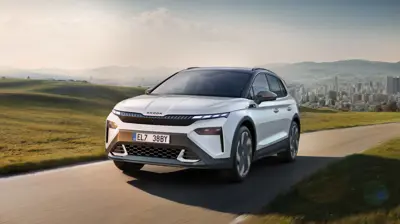
The Toyota C-HR+ 77 kWh is classified as a compact SUV (C-SUV). It measures 4520 mm long, 1870 mm wide, and 1595 mm tall.
The Toyota C-HR+ 77 kWh is available in 5 paint colors, including both solid and metallic options.
The Toyota C-HR+ 77 kWh offers multiple wheel options in different sizes. The available tire and wheel combinations include:
- 235/60 tires on 18" rims
- 235/50 tires on 20" rims
Narrower wheels reduce energy consumption and can increase range, while wider wheels can improve traction and handling.
The car has four regular doors and a liftgate.
The tailgate is electrically powered.
There are two different roof options to select from.
A conventional roof is standard.
An optional fixed panoramic glass roof covers most of the roof area, making the cabin feel brighter and more spacious. An electric sunshade helps protect occupants from direct sunlight.
The windows behind the B-pillar are tinted for privacy and to reduce glare and solar heat gain.

Toyota C-HR+ 77 kWh
Interior
The interior of the Toyota C-HR+ 77 kWh is functional, featuring high-quality materials in several areas instead of hard plastic. A standout feature is the split-level center console, which separates the driver and passenger with added storage.
There is one seat type you can select in different materials.
Seats
The Toyota C-HR+ 77 kWh accommodates five passengers with two front seats and a three-seat bench in the rear.
First Row Seats
The Toyota C-HR+ 77 kWh offers a single type of front seat.
The following functionalities are available on the seat:
- Seat cushion angle adjustment (manually adjustable, electrically adjustable as an option)
- Height adjustable headrest (manually adjustable)
- Heating
Available in:
Second-Row Seats
The second row features a standard three-seat bench with a split, allowing each section to fold separately to increase cargo space.
Additional second-row features include:
- Height adjustable headrest (manually adjustable)
- ISOFIX (standard for outer seats)
Interior Storage
The Toyota C-HR+ 77 kWh has the following interior storage:
Interior Lighting
The Toyota C-HR+ 77 kWh offers several interior lighting options.
- Multicolor Ambient Lighting: Across the dashboard, door panels, and footwell, with selectable colors.
Climate System
There is one climate system available:
- 2-zone climate system: Supports different temperatures for the driver and passenger.
A standard heat pump reduces heating energy use in cold weather.
User Interface and Control
The control interface of the Toyota C-HR+ 77 kWh combines physical buttons, steering column stalks, and touchscreen displays.
Behind the steering wheel is a digital instrument cluster, and on the right part, there is an infotainment screen.
Key screen details:
- Driver Information Display: A 7.0-inch screen mounted directly on the dashboard behind the steering wheel. This compact display shows essential driving information such as speed, range, and navigation prompts.
- Center Dashboard Touchscreen: The 14.0-inch touchscreen is located at the center of the dashboard. It serves as the main interface for infotainment, navigation, and vehicle settings.
The Toyota C-HR+ 77 kWh does not have a head-up display. Speed and navigation information remain on the vehicle's other displays.

Toyota C-HR+ 77 kWh
Steering Wheel
The Toyota C-HR+ 77 kWh is equipped with a single type of steering wheel:
Design: Circular
Controls: Physical buttons
Heating: Heated (standard)
From the steering wheel you can control:
- Media volume
- Cruise control on/off
Voice control is standard.
Infotainment
CUSTOM
Navigation System
The built-in navigation system uses detailed maps and offers advanced route planning. It provides real-time traffic information to support an efficient and stress-free journey.
Phone Mirroring
The Toyota C-HR+ 77 kWh supports Android Auto and Apple CarPlay, providing access to compatible phone apps such as Google Maps and Waze on the car's display.
Sound System
You can choose between two sound systems for the Toyota C-HR+ 77 kWh:
- Toyota 6 speaker: Features six speakers.
- JBL,Sound System: Features nine speakers.
The model includes USB-C connectivity as standard (total: 4).
Mobile App
The Toyota C-HR+ 77 kWh has a mobile app for Android and iOS to manage and monitor the vehicle remotely. Features:
- Locate Your Vehicle: Check the current location of your car.
- Preconditioning: Preheat or cool your car before you start your journey.
- Lock and unlock: Lock or unlock the doors remotely.
- Window Control: Open or close the windows remotely.
- Find your car: Sound the horn or flash the lights to locate the car.
- Driving History: Review the details of your past trips.
Lights
The Toyota C-HR+ 77 kWh uses matrix LED headlights with individually controlled beam segments that reduce glare for other road users.
The taillights use LED technology.

Toyota C-HR+ 77 kWh
Advanced Driver Assistance Systems
The Toyota C-HR+ 77 kWh offers standard and optional advanced driver assistance systems (ADAS).
Safety Systems
Anti-lock Braking System (ABS): Standard on the Toyota C-HR+ 77 kWh. It prevents the wheels from locking during braking.
Electronic Stability Control (ESC): Standard on the Toyota C-HR+ 77 kWh. It improves stability during sudden maneuvers and on slippery roads.
Lane-Keeping Assist (LKA): Standard on the Toyota C-HR+ 77 kWh. It applies steering corrections if the vehicle begins to leave its lane.
The Lane Departure Warning alerts the driver if the vehicle begins to leave its lane.
Front Cross Traffic Assist (FCTA): Standard on the Toyota C-HR+ 77 kWh. It detects traffic crossing ahead when entering an intersection or pulling away from a stop.
Rear Cross Traffic Alert (RCTA): Standard on the Toyota C-HR+ 77 kWh. It detects vehicles approaching from the side while reversing out of a parking space or driveway.
Forward Collision Warning (FCW): Standard on the Toyota C-HR+ 77 kWh. It warns the driver of a potential frontal collision.
Automatic Emergency Braking (AEB): Standard on the Toyota C-HR+ 77 kWh. It applies the brakes automatically if the driver does not respond to an imminent collision.
Automatic Emergency Steering (AES): Standard on the Toyota C-HR+ 77 kWh. The system can steer automatically to help avoid an imminent collision.
Blind-spot Monitoring (BSM): Standard on the Toyota C-HR+ 77 kWh. It detects traffic in the vehicle's blind spots.
Exit Warning: Standard on the Toyota C-HR+ 77 kWh. It warns occupants not to open a door when it detects approaching traffic or another hazard.
Driving Automation
The standard Lane Tracing Assist SAE Level 2 system includes the following driving automation features:
- Adaptive Cruise Control (ACC)
- Lane Centering Assist (LCA) / AutoSteer: Centers the vehicle in its lane and adjusts speed in traffic. The driver must keep their hands on the steering wheel and remain attentive.
- Automatic parking
- Automatic Lane Change (ALC)
Sensors & Cameras
This model uses cameras, radar, and ultrasonic sensors for its driver assist systems.
Up to five radar sensors, five cameras, and 12 ultrasonic sensors monitor the vehicle’s surroundings.
Safety
The Toyota C-HR+ 77 kWh is equipped with the following airbags:
- Front airbags for the driver and front passenger
- Side curtain airbags for both the first and second rows
- Side airbags for the driver and front passenger
Security and Access Technologies
The Toyota C-HR+ 77 kWh includes the following security and access features:
- Keyless Entry and Start: Unlock and start the car with the key in your pocket or bag.
- Phone-as-Key Functionality: The optional phone-as-key feature lets you use your smartphone to unlock and start the vehicle.
- Alarm System: Monitors for unauthorized entry or tampering and sounds the alarm when triggered.
Cargo Capacity and Towing Ability
The trunk offers a cargo capacity of 416 liters (14.7 cu ft). With the rear seat folded down, this expands to 1207 liters (42.6 cu ft).
The maximum roof load is 85 kg (187.4 lb).
The maximum permitted vehicle weight is 2520 kg (5556 lbs), and the base curb weight is 1865 kg (4112 lbs). This leaves a payload of 655 kg (1444 lbs), including occupants. Options can increase curb weight and reduce payload.
A towbar can be added to the vehicle. The maximum permissible weight for a braked trailer is 750 kg (1653 lbs), while for an unbraked trailer, it is 750 kg (1653 lbs).
Availability & Pricing
The Toyota C-HR+ 77 kWh had its world premiere on 3/12/2025, with deliveries starting in March 2026.
This model is available exclusively in Europe.
Pricing
Pricing may vary depending on local conditions, incentives, and promotions. Below are the starting prices for select countries:
- United Kingdom £36,995 Updated October 2026
Other markets (16)
- €45,390 (Austria)
- €46,850 (Belgium)
- 1,099,000 CZK (Czech Republic)
- 299,990 DKK (Denmark)
- €44,990 (Finland)
- €43,900 (France)
- €45,990 (Germany)
- 17,400,000 HUF (Hungary)
- €43,800 (Italy)
- €46,070 (Luxembourg)
- €43,995 (Netherlands)
- 446,500 NOK (Norway)
- 165,900 PLN (Poland)
- €45,300 (Portugal)
- 519,900 SEK (Sweden)
- CHF 39,900 (Switzerland)
Alternatives to Toyota C-HR+ 77 kWh
Compare These Vehicles
Get detailed side-by-side comparisons of specifications, range, charging performance, and travel capabilities.
Complete Specs
Compare all technical specifications side-by-side
Range Analysis
Real-world range and charging performance
Travel Calculator
Plan trips and compare travel times