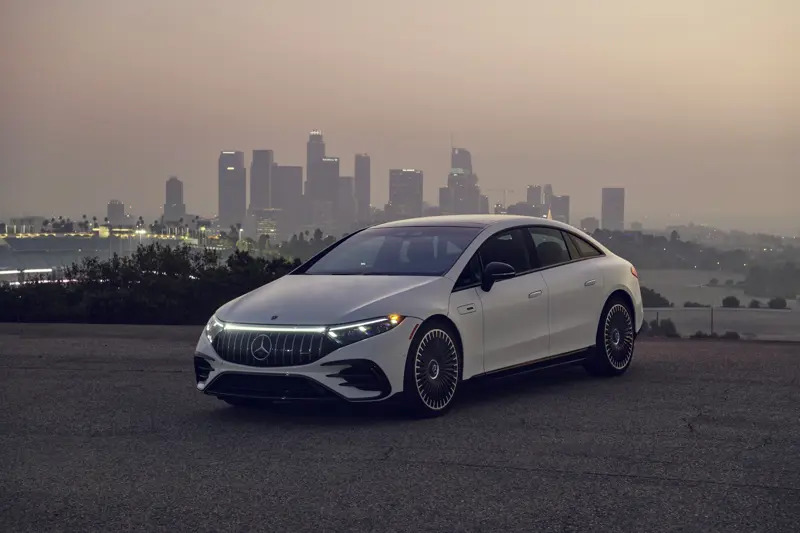
The new Mercedes-Benz EQS: 926 km range, 800V architecture and steer-by-wire
Mercedes-Benz has revealed the most extensive update the EQS has received since it launched in 2021. The car keeps its familiar silhouette, but Mercedes says more than a quarter of its components are new — and the changes sit where they matter most. The EQS now runs on an 800-volt electrical architecture, pairs a new two-speed rear transmission with larger batteries, and introduces steer-by-wire as the first German series-production car to offer the technology. The headline figure is a WLTP range of up to 926 kilometres in the new EQS 450+, a 13 per cent jump over the outgoing model.
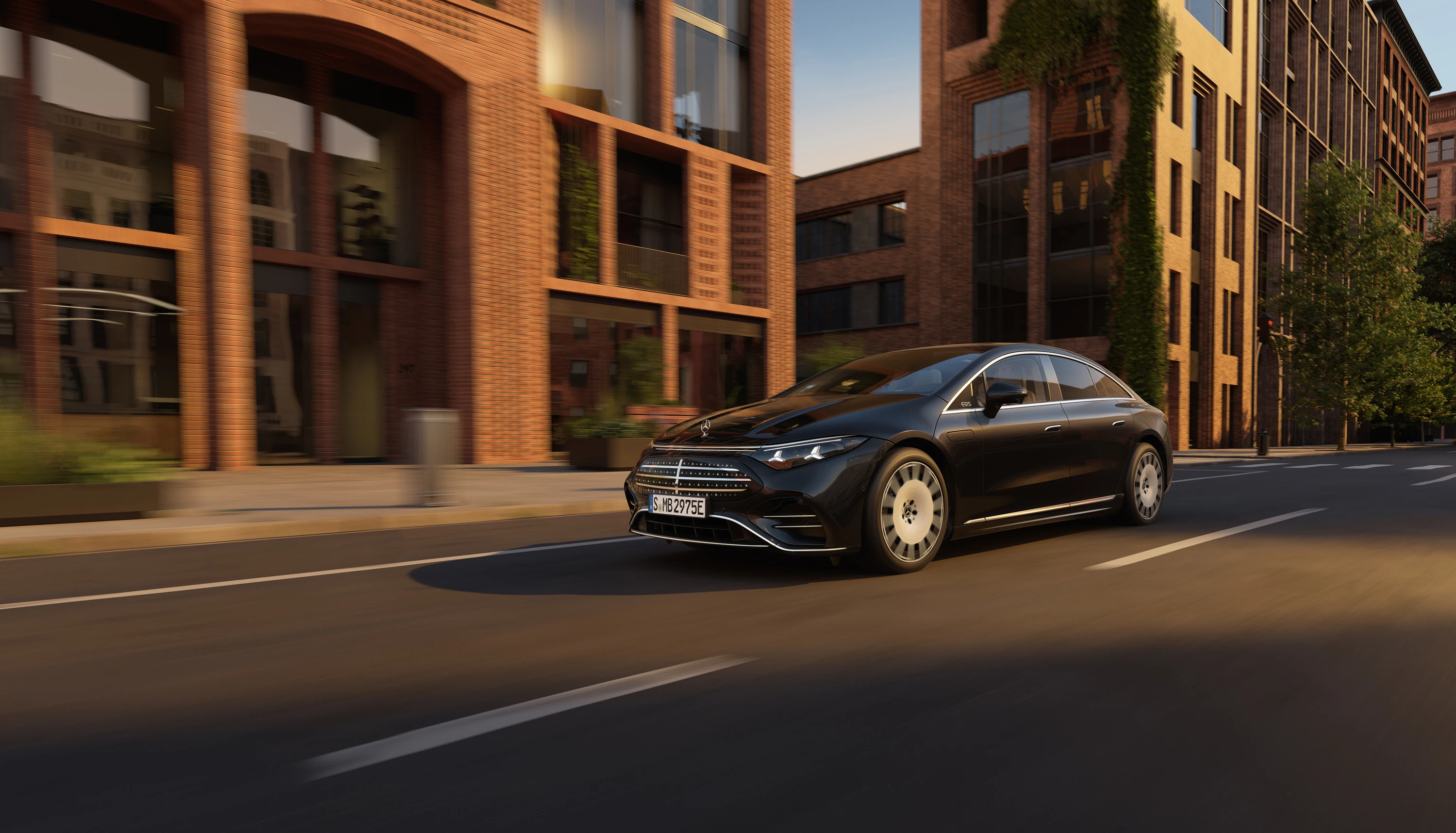
Order books opened in Germany on 14 April 2026. Series production begins the same month at Mercedes-Benz's Sindelfingen plant in Factory 56, with deliveries starting in the second half of the year.
What is new under the skin
The 2021-generation EQS used a 400-volt architecture and charged at a peak of 200 kW — competitive when it launched, but long overtaken by 800-volt rivals from Hyundai, Kia, Porsche and the Chinese luxury brands. The facelift closes that gap in one move. The EQS 450+, EQS 500 4MATIC and EQS 580 4MATIC all run an 800-volt high-voltage system and charge at up to 350 kW on compatible DC stations. Mercedes quotes up to 320 km of WLTP range added in ten minutes under the ISO/SAE 12906 test protocol.
The 800-volt jump also brings a clever side-effect for everyday charging. When plugged into a 400V station, the battery splits virtually into two halves, each charged at up to 175 kW. For drivers who still rely on older infrastructure, that is a meaningful uplift over the outgoing car.
Two of the four batteries are new. The EQS 450+, 500 4MATIC and 580 4MATIC share a 122 kWh usable pack, up from 118 kWh in the outgoing generation — in the same installation space. Mercedes has moved to a silicon oxide-and-graphite anode blend with reduced cobalt content, which it says improves both gravimetric and volumetric energy density. The entry-level EQS 400 uses a smaller 112 kWh usable pack.
Regenerative braking has also had a major upgrade. Peak recuperation power rises from 290 kW to 385 kW — a 33 per cent increase — which Mercedes says is strong enough to handle almost all everyday deceleration through recuperation alone. Drivers can still adjust the intensity with the steering-column paddles or the selector.
The four variants
The facelift launches with a broader line-up than before. The new EQS 400 is the entry point, with a single rear motor producing 270 kW and a 112 kWh usable battery. Mercedes has not confirmed its peak DC charging speed; only the three 122 kWh models are quoted at 350 kW.
The EQS 450+ sits at the heart of the range. It is the headline car of the launch, with the 926 km WLTP range figure and a combined consumption of 15.4–19.3 kWh per 100 km. Mercedes has not published motor power or 0–100 km/h figures for this or any of the other three variants in the main press material — only the EQS 400's 270 kW output is officially confirmed at launch.
The EQS 500 4MATIC and EQS 580 4MATIC sit at the top of the range. Both pair the 122 kWh pack with a front booster motor, fitted with a Disconnect Unit (DCU) that switches the front axle in or out at "lightning speed" to improve efficiency on steady cruising. Combined consumption for the 4MATIC models is quoted at 16.2–19.5 kWh per 100 km. As on the rear-wheel-drive cars, Mercedes has held back the full performance figures.
Pricing in Germany starts at 94,403 euros (or 79,330 euros net for business customers) for the EQS 400. Prices for the 450+, 500 and 580 4MATIC variants have not yet been officially confirmed in the press release.
A new rear transmission
One of the more interesting mechanical changes is the addition of a two-speed transmission on the rear axle. First gear is a short ratio for strong launches, while a long-ratio second gear — using only one engaged planetary set, Mercedes notes, for minimum losses — handles motorway cruising and top speed. The idea is familiar from the Porsche Taycan, but this is the first time Mercedes has used it in a production EV. Combined with the new front disconnect unit on 4MATIC models, it is a clear signal that Mercedes is now prioritising highway efficiency and long-haul range over headline power figures.
All four models keep a governed 210 km/h top speed.
Steer-by-wire, Car-to-X damping and a 0.20 drag coefficient
Mercedes-Benz will be the first German carmaker to offer a fully steer-by-wire system on a production car. It arrives as an option "a few months after market launch" rather than at day one, and is available in combination with every powertrain variant as well as the optional rear-axle steering (up to 10 degrees). The physical connection between the wheel and the steering rack is replaced by redundant electronic signal paths. Lock-to-lock takes 170 degrees, so drivers never need to re-grip at parking speeds, and Mercedes has designed the system to filter out the small vibrations normally transmitted from the road surface. If the primary path fails, rear-axle steering and wheel-specific brake intervention via ESP can keep the car under control.
The AIRMATIC air suspension has also been upgraded with a new cloud-based damper control. The car anonymously receives Car-to-X data from other Mercedes-Benz vehicles ahead on the route, and electronically adjusts damping shortly before known speed bumps for a smoother ride — a feature Mercedes has applied for a patent on.
On the aerodynamics side, the EQS 450+ still reaches a drag coefficient of 0.20 with the 19-inch AMG wheel and AMG Line exterior in Sport mode, with a frontal area of 2.51 square metres. That keeps it among the most aerodynamic production cars ever built.
Towing capacity is another quiet but useful gain. The rear-wheel-drive models can now tow 1,600 kg on a braked trailer — more than double the outgoing car — and the 4MATIC models are rated at 1,700 kg. Mercedes explicitly mentions a horse trailer as the use case.
MB.OS, MBUX Hyperscreen and a new sound system
The EQS becomes the first S-Class-adjacent car to run the new Mercedes-Benz Operating System (MB.OS) with over-the-air updates. The new MBUX generation integrates an AI-driven Virtual Assistant — built with Microsoft among others — that handles complex multi-part dialogue and can take one of three avatar styles on the central display.
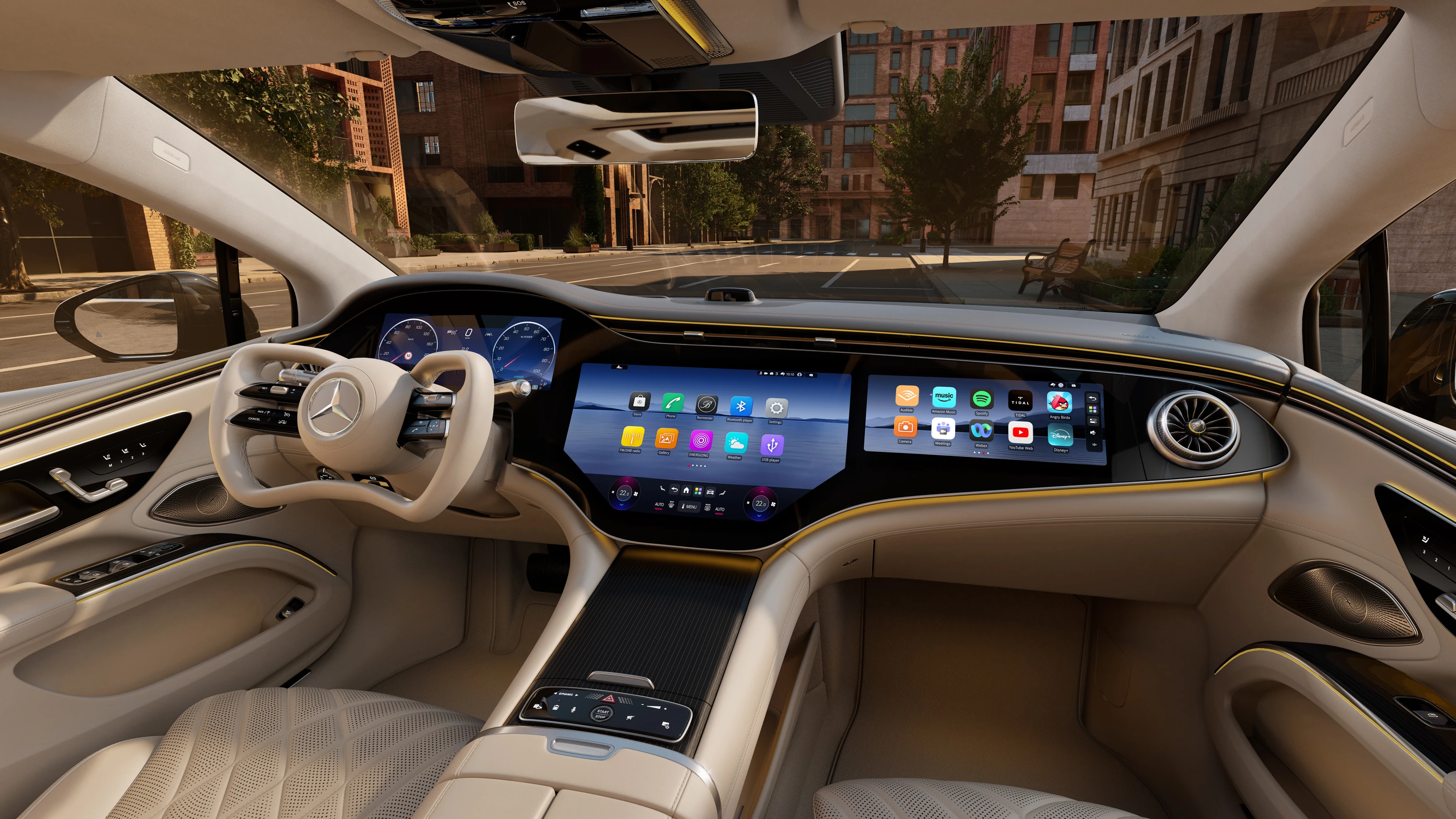
The MBUX Hyperscreen is still standard: a single glass surface spanning more than 55 inches and merging a 12.3-inch driver display, a 17.7-inch central touchscreen and a 12.3-inch front-passenger display. The passenger display can show dynamic video content while driving, with a camera-based driver-monitoring system masking it if the driver glances over.
Navigation switches to a Google Maps-based stack with real-time traffic, online map updates, voice control and Mercedes' Navigation with Electric Intelligence for energy-aware routing, charging-stop planning and battery preconditioning. MBUX Surround Navigation renders a 3D real-time view of the surroundings using 3D game-engine graphics, with other road users, indicators, wheels and assistance-system state all visualised on the driver display.
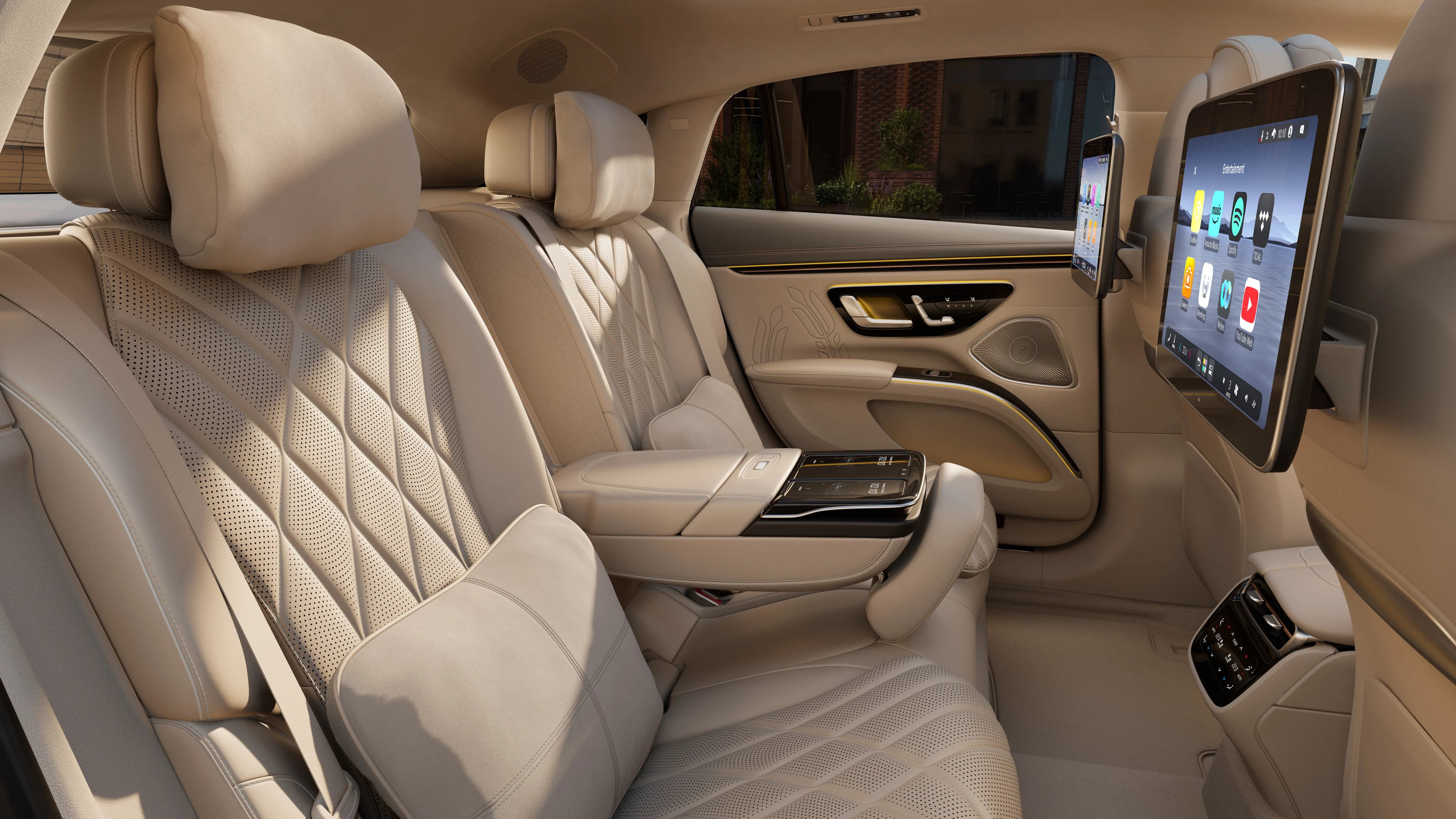
Audio is handled by a new Burmester High-End 3D Surround system with 15 speakers, 710 W of power and Dolby Atmos support. In the rear, two 13.1-inch screens with integrated HD cameras support Microsoft Teams, Zoom and Webex video conferencing, operated through new portable MBUX remote controls.
Lighting, cabin and safety touches
DIGITAL LIGHT with micro-LED technology is now standard. Mercedes says the high-resolution light field is 40 per cent larger than before, with up to 50 per cent lower energy consumption. The ULTRA RANGE high beam reaches 600 metres — about six football pitches — and can now swivel with the cornering light, which in turn uses combined camera and map data to anticipate the road ahead.
Inside, Mercedes has added heated seat belts at the front, a feature first shown in the 2019 ESF concept. The webbing quickly warms to 44 °C in cold weather, and Mercedes notes a secondary safety benefit: passengers are encouraged to take off thick jackets before buckling up, which means the belt sits closer to the body in a collision. The rear outer seat belts use inflatable beltbags — triple the effective surface area of a conventional belt during a severe frontal impact.
A 9.82 dm³ HEPA filter is integrated into ENERGIZING AIR CONTROL Plus, with about 600 g of activated carbon coating filtering out "up to 99.65 per cent" of particles in outside air. The anthracite open-pored poplar trim, iconic laurel stitching in macchiato beige and space grey, and a new leather-free interior option join the interior customisation list. MANUFAKTUR Made to Measure now offers around 125 paint colours.
For driver assistance, Mercedes has fitted up to 27 sensors — 10 exterior cameras, up to 5 radars, and 12 ultrasonic sensors — feeding a high-performance control unit running on MB.OS. The MB.DRIVE range covers DISTRONIC, Steering Assist, Lane Change Assist, Evasive Steering Function Plus and Proactive Lane Change Assist. The redesigned MB.DRIVE PARKING ASSIST can now park diagonally, works in unmarked spaces, helps the driver exit a parking spot even if the car was parked manually, and runs at up to 5 km/h — Mercedes says this is about 60 per cent faster than the previous system.
Bidirectional charging and V2G/V2H
Another post-launch addition is bidirectional charging. The EQS can feed battery power into the public grid (V2G) or directly into the owner's home (V2H), with rollout subject to market-specific energy-supplier and legislative conditions. This will arrive via an OTA update after launch rather than at day one, and turns the 122 kWh pack into a flexible household energy source.
Made in Sindelfingen
Series production begins in April 2026 at Factory 56 in Sindelfingen, the same ultra-modern flexible line that already builds the Mercedes-Benz S-Class and Mercedes-Maybach S-Class. Mercedes calls this a "local-for-local" approach: the high-voltage battery for the new EQS is assembled at the battery factory in the Hedelfingen section of the Stuttgart plant — roughly 20 km from Sindelfingen — and delivered to the line by automated guided vehicles. The Untertürkheim plant supplies the electric drive units, with the electric axles coming from the Mettingen plant part.
[evimg:mercedes-eqs-2026]
What is still missing
Despite the depth of the press release, several core numbers are not yet public. Mercedes has not confirmed 0–100 km/h times, top-speed figures beyond the 210 km/h governor, motor power or torque for the 450+, 500 4MATIC or 580 4MATIC variants, or the gross battery capacity, weight and cell producer for any of the four cars. There is no detailed DC charge curve, no WLTP range figure for the EQS 400, 500 or 580, and no pricing for any variant outside the EQS 400 in Germany. A full technical data sheet from Mercedes-Benz is expected in the coming weeks, at which point the database entries will be backfilled.
The four new variants are already in the EVKX database as drafts pending that technical data:
The timing of the launch is also notable. Mercedes explicitly frames the EQS update as part of its 140-year anniversary programme, and the company has said the new S-Class — where "more than 50 per cent" of components are new — is the next big step. The facelift EQS, then, is positioned as a bridge: a significant technical upgrade that brings the 2021 flagship back up to current luxury-EV standards, while the brand prepares for its next-generation S-Class platform. For now, though, a 926 km WLTP figure, a 350 kW charging peak and the first steer-by-wire system on a German production car make it a serious update to an already capable luxury EV.
This article will be updated as Mercedes-Benz publishes the full technical data sheet.
More information