
The new Mercedes-AMG GT 4-Door Coupé: three axial-flux motors, 600 kW charging and 700 km WLTP
Mercedes-AMG revealed the new GT 4-Door Coupé in Affalterbach on 20 May 2026. It is the first model on the new AMG.EA performance electric architecture, and it arrives with two variants at launch — the GT 63 4MATIC+ and the GT 55 4MATIC+ — both built around three axial-flux motors and a newly developed cylindrical-cell battery.
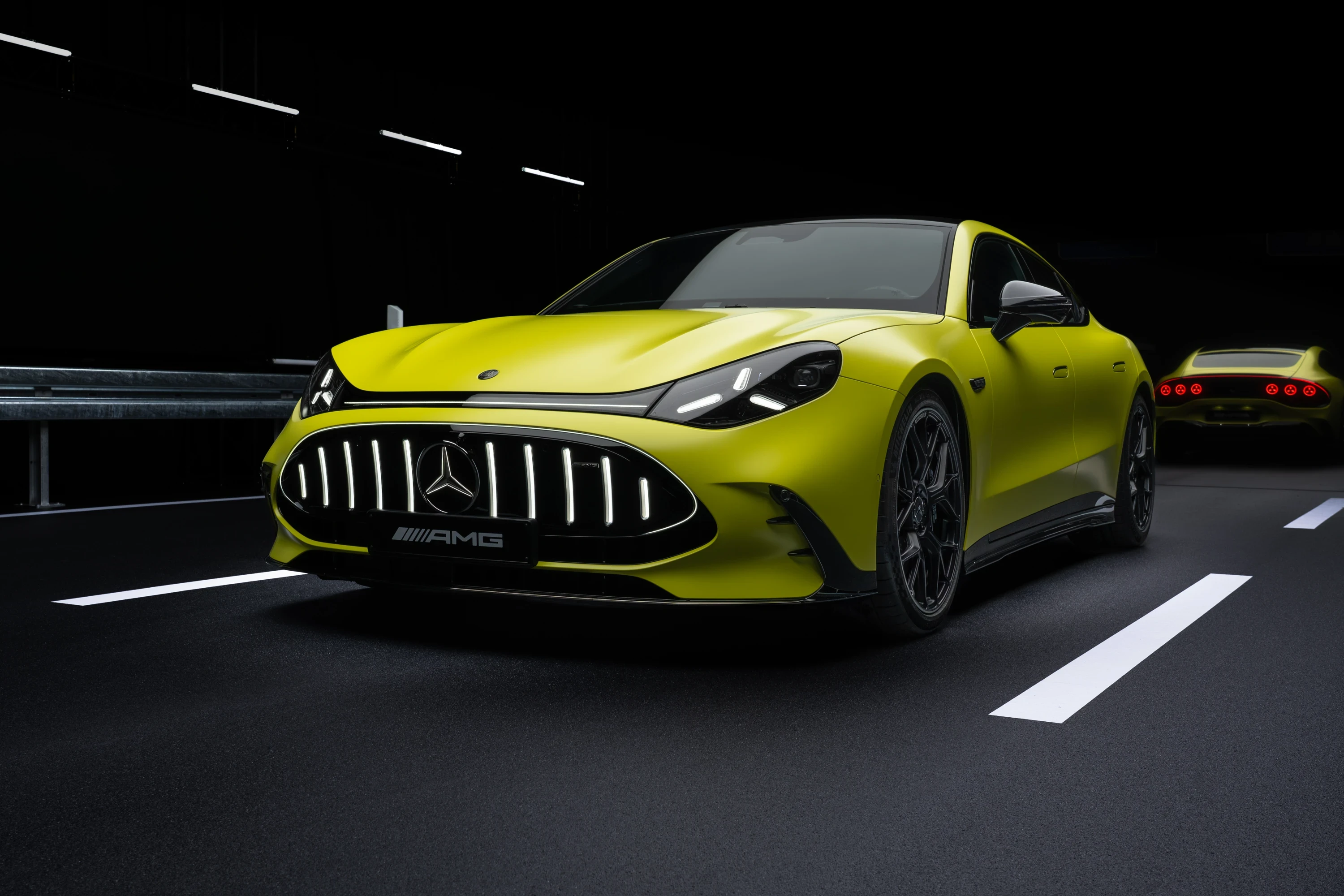
Ordering opens "in the coming days", with deliveries from late 2026. The car is built at the Mercedes-Benz plant in Sindelfingen in Hall 32, which has been reconfigured specifically for AMG.EA, while the axial-flux motors come from the Berlin-Marienfelde plant.
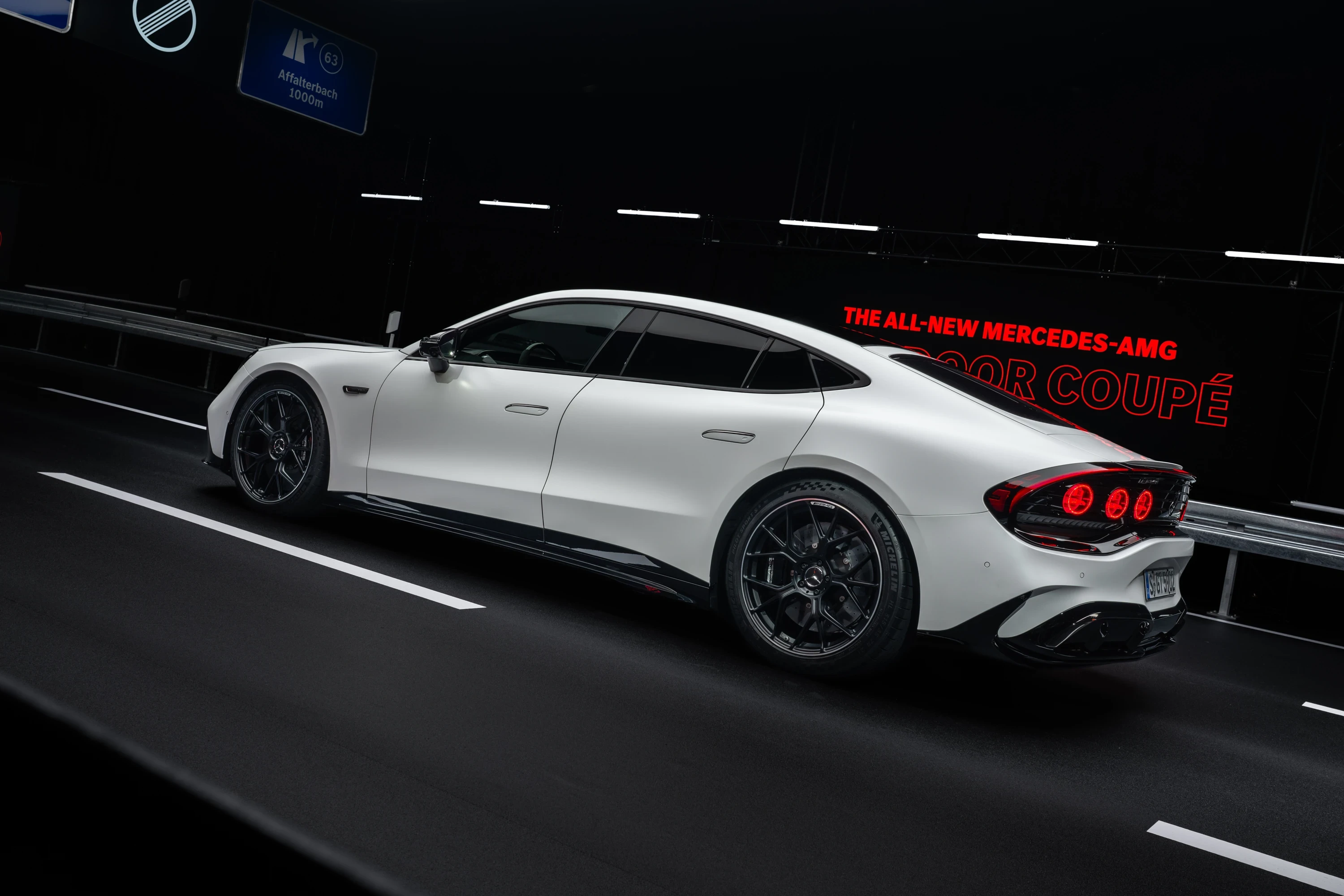
The two variants at launch
The GT63 sits at the top. Peak system output is 860 kW (1,169 PS), with 530 kW of continuous output and 2,000 Nm of torque. Mercedes quotes 0–100 km/h at 2.4 seconds (or 2.1 s with the one-foot rollout method used in the US), 0–200 km/h in 6.8 seconds, and a top speed of 300 km/h with the optional Driver's Package. Peak power is held for 63 seconds during a Launch Control run from 80 % state of charge.
The GT55 drops to 600 kW (816 PS), 375 kW continuous, and 1,800 Nm. 0–100 km/h is 2.8 seconds and the top speed is the same 300 km/h. Boost duration falls to 55 seconds. Both cars use the same battery, the same dimensions and the same chassis hardware — Mercedes is differentiating through power, not through battery size or wheelbase. The AMG.EA architecture is engineered for outputs above 1,000 kW, leaving clear headroom above the GT 63 for future variants.
WLTP figures land at 596–696 km on the GT 63 and 597–700 km on the GT 55, with combined consumption of 21.0–17.9 and 21.0–17.8 kWh per 100 km respectively. Curb weight is 2,460 kg.
Three axial-flux motors and a new electric drive unit
The drivetrain is the most unusual aspect of the car. Both variants run three axial-flux motors — one on the front axle, two on the rear — using technology developed by YASA, the British motor specialist Mercedes-Benz acquired in 2021. A single YASA-derived motor is rated up to 348 kW (474 PS), and Mercedes has also disclosed an improved unit weighing just 13.1 kg that delivers up to 758 PS.
The rear High-Performance Electric Drive Unit (HP.EDU) holds both rear motors inside a shared housing, paired with a single-stage planetary gearbox, two water-cooled silicon-carbide inverters, oil cooling and the pump control unit — all in roughly the same width as a single conventional motor. Each rear motor is about 8 cm wide. The rear unit spins to more than 13,000 rpm.
The front HP.EDU carries a single axial-flux motor of about 9 cm width, spinning to more than 15,000 rpm. It acts as a booster motor and is decoupled by a Disconnect Unit (DCU) within milliseconds during steady-state cruising or coasting, to cut drag losses. The DCU closes again under acceleration or recuperation. The same disconnect concept appeared on the facelifted EQS earlier this year.
A new 800 V battery built around cylindrical NCMA cells
The battery is a fresh development. Net usable capacity is 106 kWh on both variants, with the system running at over 800 volts. Mercedes packs 2,660 cells into 18 laser-welded plastic modules. The cells themselves are tall and slim — 105 mm by 26 mm — built with an NCMA cathode, a silicon-bearing anode, a full-tab pole design and a laser-welded aluminium can. Cell-level energy density is given as more than 298 Wh/kg and 732 Wh/l.
Cooling is direct. A non-conductive oil flows around each cell inside the module, with a special line system feeding all 2,660 cells uniformly. The central cooling module integrates the coolant pump, the oil-water heat exchanger and the connectors for direct cell cooling in one housing. Mercedes quotes a sustained cooling capacity of at least 20 kW for the battery, against 5–8 kW for conventional EV battery systems.
DC charging peaks at more than 600 kW, with a current of over 800 amperes — the kind of figure that today only works at Alpitronic's new megawatt-class chargers. Mercedes quotes 10 to 80 % state of charge in 11 minutes, with around 460 km of WLTP range added in the first ten minutes (about 70 kWh of energy). For older infrastructure, the high-voltage system can switch between 800 V and 400 V, and the car is configured for five regional DC standards: CCS2 in Europe, CCS1 in South Korea, NACS in the US, GB/T in China and CHAdeMO in Japan. The on-board AC charger is 11 kW.
Chassis, aero and active rear-axle steering
The car uses multi-link suspension front and rear. The front links, steering knuckles and wheel carriers are forged aluminium; the rear axle is mostly steel with aluminium spring links. AMG ACTIVE RIDE CONTROL air suspension is standard on both variants, with triple-rate air springs, an 8.2-litre pressure reservoir for fast height changes, and semi-active hydraulically interconnected dampers that replace conventional anti-roll bars. Ride height drops automatically in two stages with speed.
Rear-axle steering is standard. Up to 80 km/h the rear wheels turn opposite to the fronts by up to 6 degrees, virtually shortening the wheelbase; above 80 km/h they turn with the fronts by up to 1 degree, virtually lengthening it.
Braking is a hydraulic composite system — carbon-ceramic discs at the front, steel discs at the rear. Mercedes has not yet published disc diameters or piston counts.
The aerodynamic package is unusually active for a Mercedes-AMG. Two AEROKINETICS Venturi flow plates sit in the underbody and deploy at 120 km/h (front) and 140 km/h (centre) respectively, creating a low-pressure zone that adds downforce. A separately controlled rear diffuser is also active. The rear spoiler integrates into the boot lid and adjusts angle from 80 km/h up to its steepest setting under heavy dynamic driving, and a button on the steering wheel can deploy it manually. The front grille and the side brake-cooling intakes both use AEROKINETICS Airpanel louvres operating in nine stages — Mercedes says this is the first production car in the wider Mercedes-Benz Group with both a wheelarch cooler and a main cooling package on one car. Drag coefficient is 0.22 with a frontal area of 2.44 m².
Wheel options run from 19 to 21 inches. The aero-optimised 21-inch design adds up to 14 km of WLTP range on its own, with aero tyres adding a further 30 km.
The cabin, MB.OS and the AMG Race Engineer
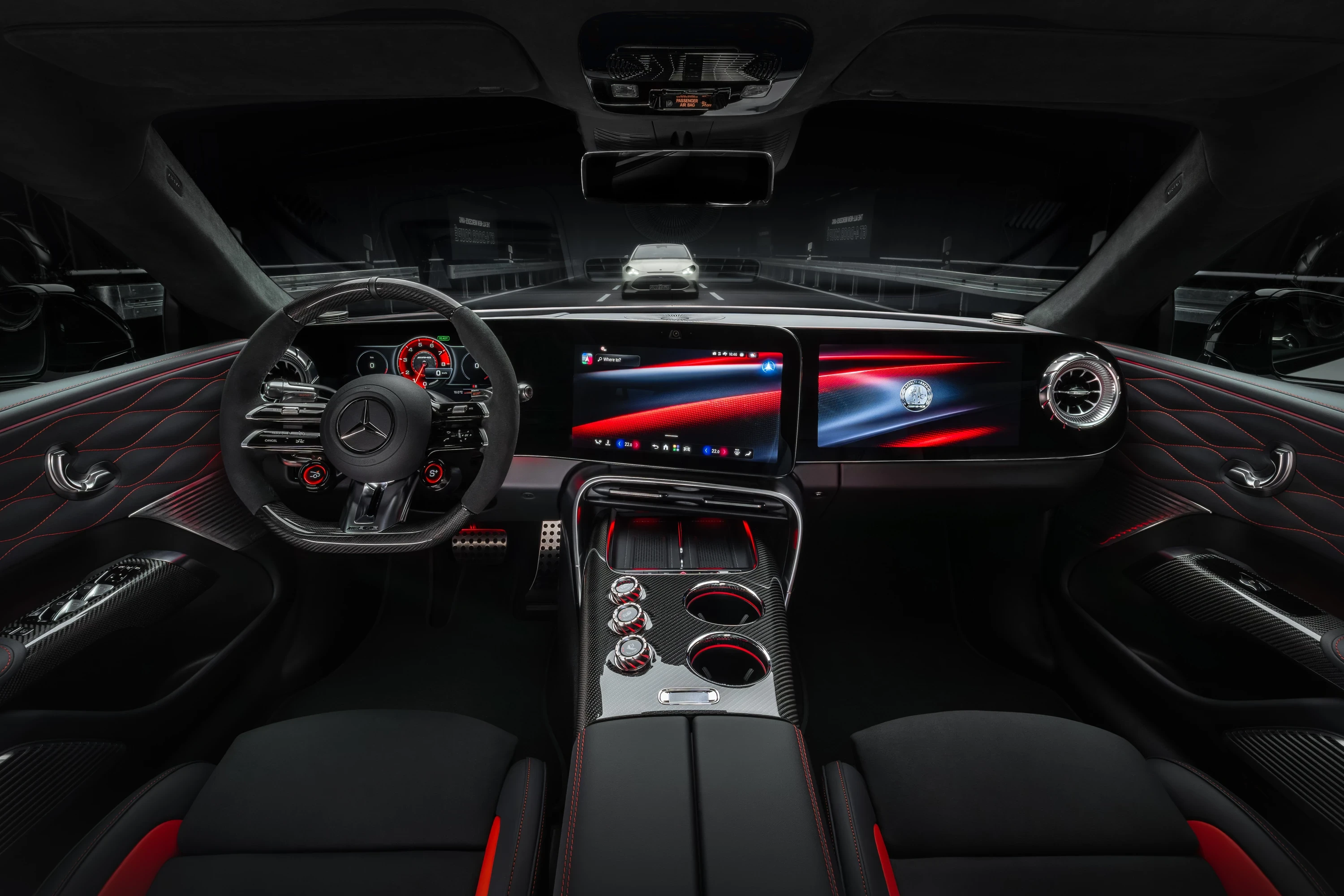
The cockpit uses a triple-display layout in a single glass surface: a 10.2-inch instrument cluster, a 14-inch central touchscreen angled toward the driver, and an optional 14-inch front-passenger display. The system runs on MB.OS with MBUX and integrates three AI services — ChatGPT, Microsoft Bing and Google Gemini — behind a single MBUX Virtual Assistant.
The most distinctive cabin element is the AMG RACE ENGINEER Control Unit in the centre console: three haptic rotary knobs that adjust Response (throttle), Agility (yaw via torque vectoring) and Traction (in nine stages). Two of the three operate only in Race, Sport+ and Sport modes with ESP off. A dedicated high-performance chip — Mercedes calls it the AMG RACE ENGINEER Core — handles drive, charge, energy and thermal control as a single closed loop.
There are seven drive modes, including Eco for the first time on a Mercedes-AMG. AMGFORCE Sport+ activates a synthesised V8 sound spectacle with simulated gear changes, simulated traction interruption and a redesigned central-tube driver display, using more than 1,600 audio samples mixed in real time. Mercedes has filed patents on the system. A separate Sound Slider lets the driver tune cabin sound between Powerful, Balanced and Minimal, and between Classic and Futuristic.
Three AMG apps sit inside MBUX. AMG Performance Menu shows live power flow between the axial-flux motors, the state of the active aero surfaces, drivetrain and tyre temperatures, and battery status. AMG TRACK PACE records more than 80 vehicle data points ten times a second on track, with pre-loaded layouts for the Nürburgring Nordschleife and Spa-Francorchamps and the option to record private circuits, and projects a racing line onto the multimedia display and head-up display. The Predictive Performance Manager — first run on the Concept GT XX during its 40,000 km Nardò endurance record — manages power output around a lap to optimise total lap time rather than peak power.
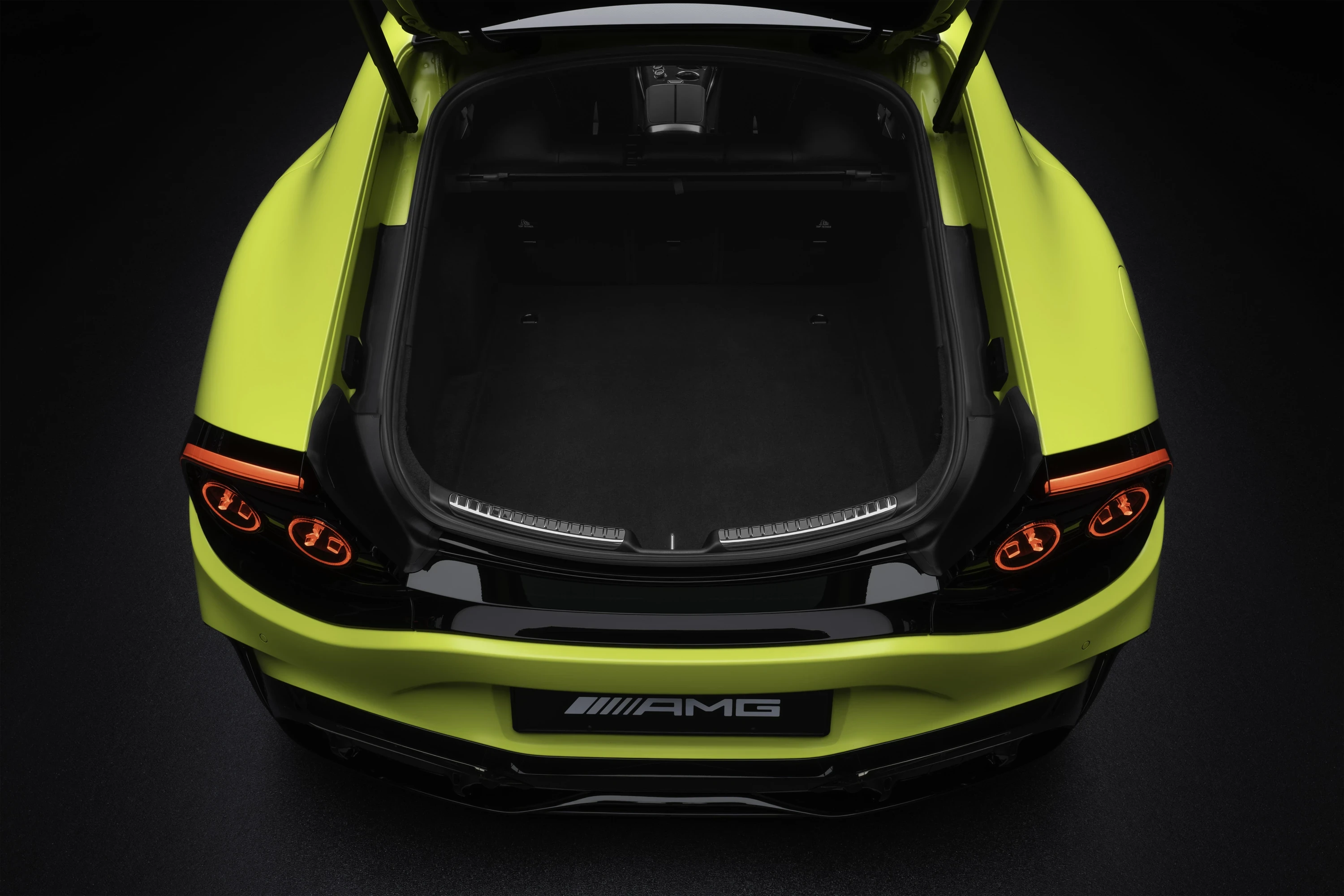
The cabin packages four seats as standard — two front sports seats and two individual rear seats with shaped foot "garages" in the floor for legroom — and a conventional three-seat rear bench as an option. Boot volume is 507 litres (415 VDA), with a 62-litre frunk under the bonnet (41 VDA). A switchable SKY CONTROL panoramic glass roof is standard, with individually addressable segments that toggle between transparent and opaque. A carbon-fibre ultralight roof is offered for performance markets.
A Burmester High-End 4D Surround system with stainless-steel speaker grilles is the top audio option. Mercedes has not yet detailed the standard sound system.
Production, ordering and pricing
Series production starts at the Mercedes-Benz plant in Sindelfingen in summer 2026, in Hall 32, which has been reconfigured for AMG.EA. The plant handles the pressed parts, body-in-white and paintwork as well as final assembly. The axial-flux motors come from the Berlin-Marienfelde plant, where Mercedes says about 65 of the roughly 100 production steps used to make them are new for the company and 35 are world firsts. The development has resulted in more than 30 patent applications.
Ordering opens "in the coming days", and Mercedes has only said pricing will be "based on comparable predecessor vehicles" — meaning the outgoing X290 GT 4-Door Coupé.
What is still missing
The press release is unusually detailed for a Mercedes-AMG launch, but several practical numbers are still open. There is no confirmed price for either variant, no Euro NCAP rating (the car has not been tested), no published DC charge curve, no full driver-assistance package detail, and no breakdown of individual motor peak power between the front booster and the two rear motors. Mercedes has also not disclosed the cell supplier, the exact pack weight or the on-board AC charging speed for markets outside Europe.
Both variants are already in the EVKX database as drafts:
This article will be updated as Mercedes-AMG publishes the full technical data sheet and as ordering opens in individual markets.
More information
Mercedes
Explore all Mercedes electric vehicles with detailed specs, photos, and reviews.
View Mercedes EVs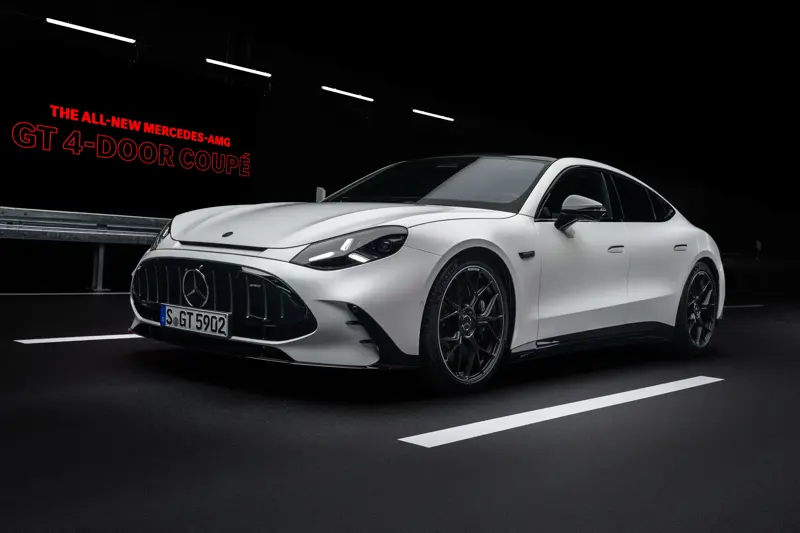
GT 55 4-Door Coupé 4MATIC+