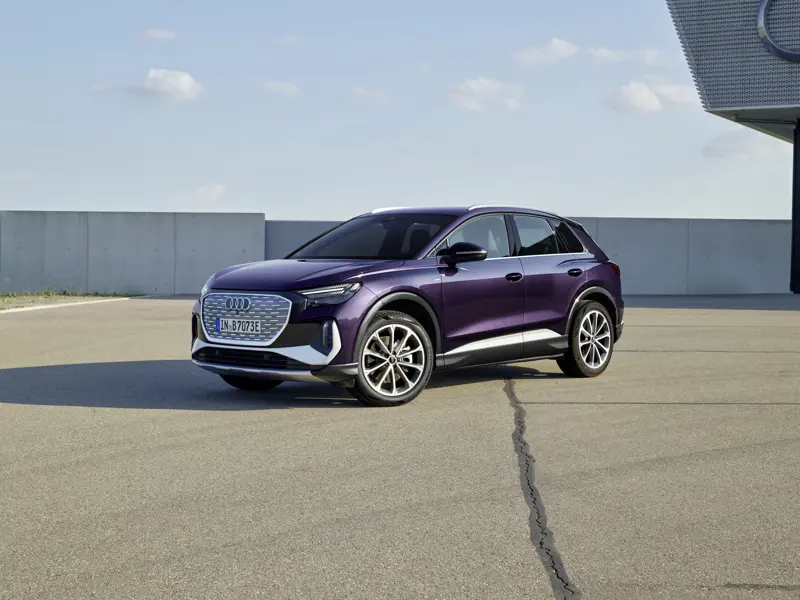
Audi Q4 e-tron 2026 update brings a new motor, 185 kW charging and bidirectional power
Audi has rolled out a mid-cycle update for the Q4 e-tron and Q4 Sportback e-tron. The headline changes are a new APP350 rear motor, 185 kW DC charging on the long-range pack, and bidirectional charging — Audi's first V2L and V2H system on a production car.

What has been confirmed
Audi unveiled the updated Q4 e-tron on 27 April 2026. European orders open in May 2026, with deliveries starting in summer 2026. The line-up keeps both the SUV and the Sportback body, paired with two battery sizes (63 kWh and 82 kWh gross) and four powertrains: a 150 kW rear-drive base, a 210 kW rear-drive performance, a 220 kW quattro and a 250 kW quattro performance flagship. Trailer capacity on quattro versions is up by 400 kg to 1,800 kg, and the electric tailgate is now standard.
German starting prices are €47,500 for the Q4 SUV e-tron with the 63 kWh pack and €53,500 with the 82 kWh pack. The Sportback adds €1,950 across the range.
Drivetrain and battery
The drive update is the technically interesting part. The new APP350 rear motor uses a silicon carbide pulse inverter, revised modulation software and a low-viscosity transmission oil. Audi quotes around 10 percent better efficiency than the outgoing motor, with the new lubricant adding up to 12 km of cold-weather range on its own.
Battery sizes carry over — 63 kWh gross / 59 kWh net and 82 kWh gross / 77 kWh net — but range is up across the board. WLTP gains land at +30 km for the 63 kWh rear-drive cars and +16 to +32 km for the all-wheel-drive variants. The headline figure is 592 km for the Q4 Sportback e-tron with the 82 kWh pack and rear drive. The 250 kW quattro performance, with both batteries available depending on body, returns 541 km as an SUV and 554 km as a Sportback.
Performance figures are unchanged in spirit: 0–100 km/h ranges from 8.1 seconds for the 150 kW base car to 5.4 seconds for the quattro performance, with top speeds of 160 km/h on the entry version and 180 km/h on everything else.
Charging and bidirectional power
DC charging on the 82 kWh pack rises from 175 kW to 185 kW. Audi quotes a 10–80 percent fast-charge in roughly 27 minutes and up to 185 km of range added in 10 minutes on the quattro performance. The 63 kWh pack peaks at 160 to 165 kW depending on variant. The platform stays on 400-volt architecture — there is no jump to 800 volts here.
The bigger news is bidirectional charging, a first for Audi. V2L delivers 2.3 kW from a socket in the trunk or via a 2.3 kW / 3.6 kW adapter on the charge port — enough for tools, e-bikes or a camping setup. V2H is offered first in Germany, Austria and Switzerland, with the car operating as a home battery between 20 and 80 percent state of charge. Plug & Charge is now standard.
Exterior and interior
The exterior changes are restrained. Audi adds a colour-matched Singleframe grille, a redesigned roof spoiler and rear diffuser on the SUV, and a new spoiler treatment on the Sportback. There are three new exterior colours and five new wheel designs. An S line trim joins the range with its own front, rear and interior styling.
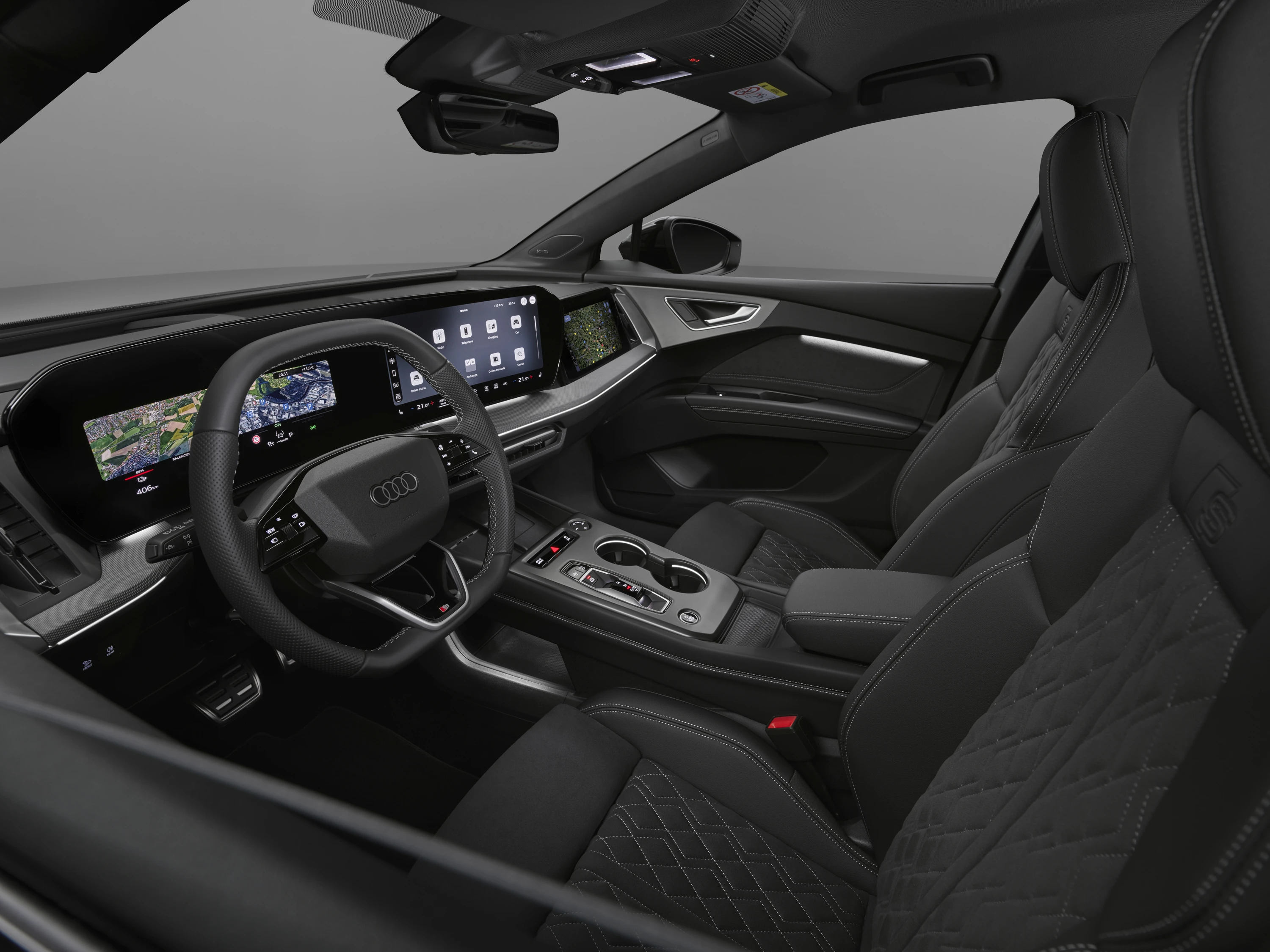
The cabin is the more substantial rework. The dashboard moves to Audi's "digital stage" panoramic layout: an 11.9-inch driver display and a 12.8-inch MMI touchscreen, with an optional 12-inch passenger display — the largest screen of its kind Audi offers in the segment. A new augmented-reality head-up display projects turn arrows and assistance prompts roughly 10 metres ahead of the car, with a claimed 70-inch virtual diagonal. The dash is wrapped in Audi's full-width Softwrap material, vertical air vents stretch the visual width of the cockpit, and there are two cooled 15 W inductive charging pads in the centre console.
Lighting also gets a meaningful upgrade. Segmented digital LED daytime running lights offer four selectable signatures, and the second-generation digital OLED rear lights are made up of 284 segments across six OLED panels, with optional proximity warning patterns for following traffic.
Infotainment and driver assistance
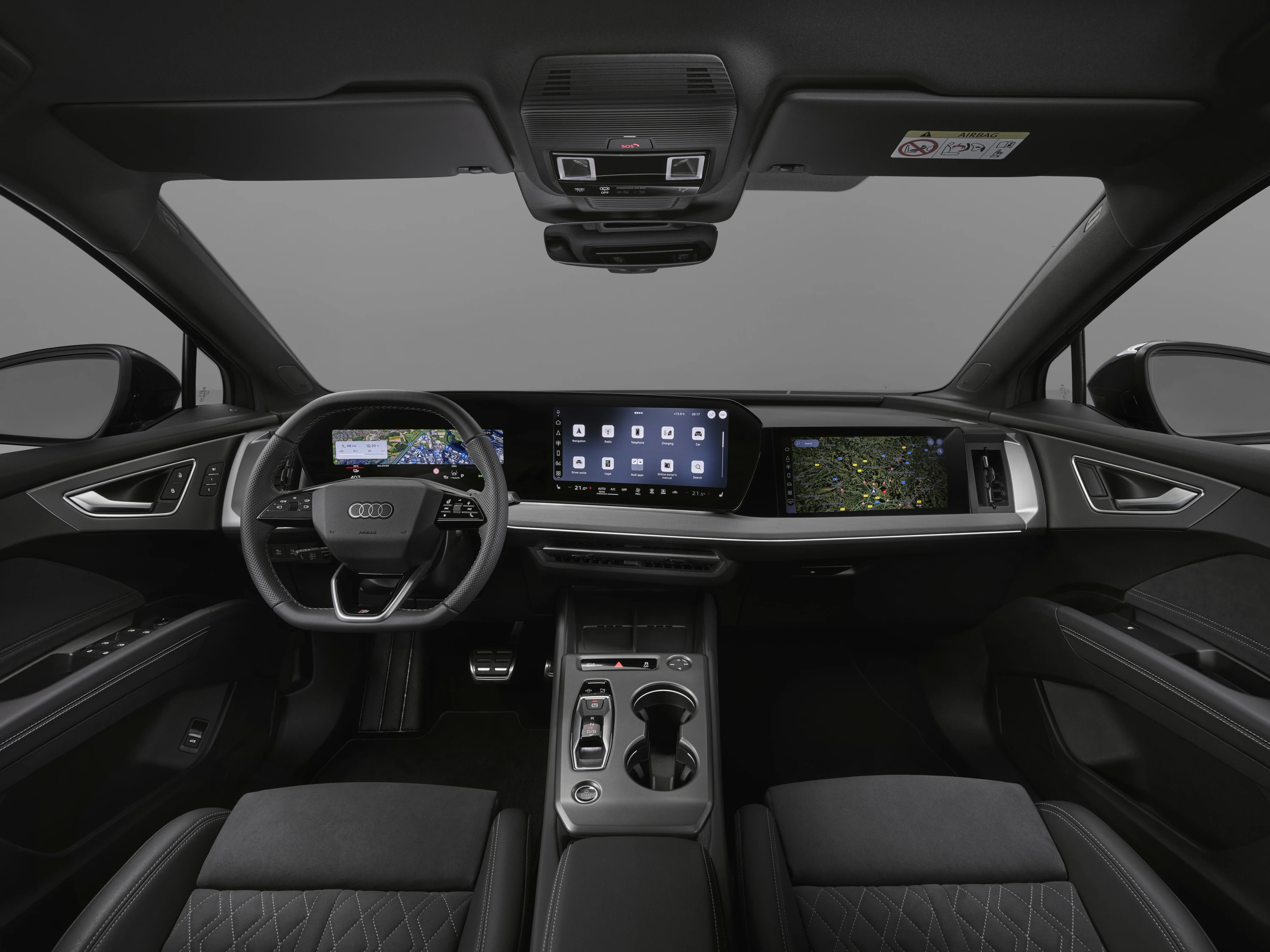
The Q4 e-tron runs Audi's One Connected Infotainment system on Android Automotive, with the Audi Application Store for third-party apps and ChatGPT integration in the voice assistant. Standard driver assistance now includes parking system plus, lane departure warning with emergency assist, traffic sign recognition, attention and fatigue warning with driver monitoring, active front assist with evasion and turn assist, and front cross traffic alert. The optional adaptive driving assistant plus adds lane-change assist above 90 km/h and bundles three years of online data after delivery. Optional surround cameras and trained parking are part of the same upgrade pack.
How it lines up against EVKX data
The naming carries over from the outgoing range, so the EVKX entries for the Q4 e-tron quattro performance and the Q4 Sportback e-tron quattro performance continue to apply on paper. The technical headline numbers — 185 kW DC charging, the APP350 motor and the WLTP gains — are model-year changes that should land on the variant pages once Audi publishes the full homologation set.
What is still unknown
- Final 10–80 percent charge times for the 63 kWh pack and the rear-drive 82 kWh cars
- EPA range and US market timing
- Exact curb weight and aero numbers for the updated body
- Pricing outside Germany
This article will be updated as more details are released.
More information
Audi
Explore all Audi electric vehicles with detailed specs, photos, and reviews.
View Audi EVs