

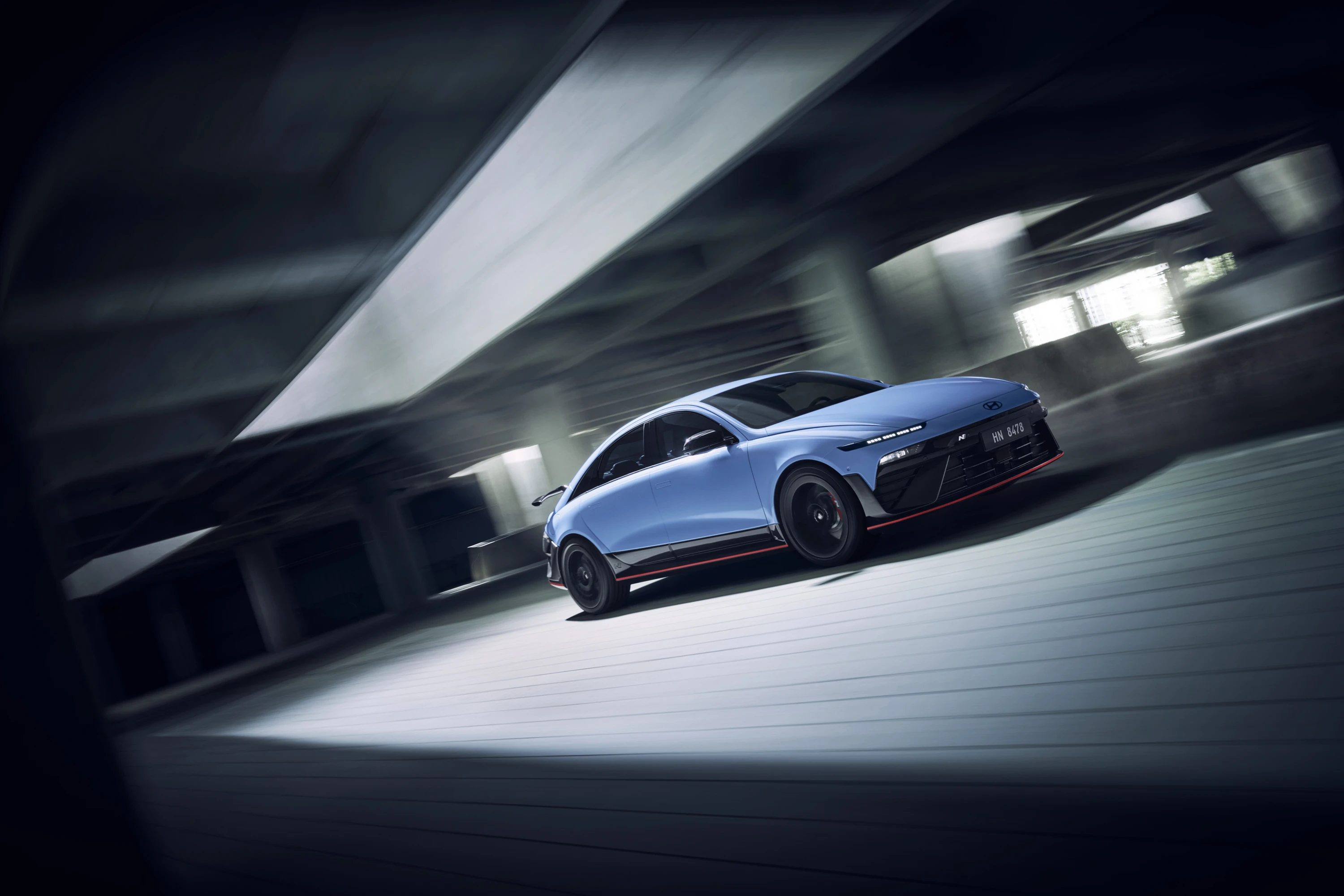
Use the links below to jump to a section, or continue reading for the full article. You can also view the full specifications, image gallery, charging performance, and online reviews. Sections:
Alternative Models
Compare the Hyundai IONIQ 6 N with these alternatives:
Performance
The Hyundai IONIQ 6 N delivers a maximum power of 448 kW (609 hp / 601 bhp) and a total torque of 605 Nm (446 lb-ft). It accelerates from 0 to 100 km/h (0 to 62 mph) in 3.2 seconds and reaches a top speed of 257 km/h (160 mph).
Battery, Range, and Charging
The battery has a gross capacity of 84.0 kWh and a net usable capacity of 80.0 kWh, with a 4.0 kWh buffer (4.8%) for battery protection. The battery operates at a nominal voltage of 697 V, supporting high-power DC charging.
The lithium-ion battery uses NMC (nickel manganese cobalt) chemistry.
Under the WLTP (Worldwide Harmonized Light Vehicles Test Procedure) standard, the maximum rated range is 583 km (362 miles). Depending on the configuration and options such as wheel size, the rated range can be as low as 519 km (323 miles). Larger wheels generally increase energy consumption and reduce range.
WLTP energy consumption is 13.7 kWh/100 km for the base configuration and 15.4 kWh/100 km for the highest-consumption configuration.
For more details about the range, see real-world data and range listings on this model’s range and consumption page.
The vehicle supports fast DC charging with a maximum power of 257 kW. A 0–100% charge takes approximately 74 minutes. A typical 10–80% session takes about 19 minutes at an average power of 176 kW.
With five minutes of overhead per stop, the optimal charging window is 1–63%. Effective average power, including overhead, is 158 kW over a session lasting about 19 minutes and 48 seconds.
This efficient charging capability makes the Hyundai IONIQ 6 N a convenient option for long-distance travel.
In a 1000 km challenge at a constant speed of 120 km/h (75 mph) with an assumed consumption rate of 21 kWh/100 km, the trip would take about 9 hours and 10 minutes, needing three charging stops from 1% to 56%, totaling 51 minutes of charging time.
Onboard Charger
The standard onboard charger supports AC charging at up to 11 kW. A full 0–100% charge takes about 7 hours and 16 minutes with a suitable home charging setup.
Charge Port
The location of the charge port is on the right rear side. This placement makes it easy to use charging stations that require backing up to connect.
Connector types vary by market: this model uses CCS Combo 1 in North America and CCS Combo 2 in Europe. For complete specifications for all markets, refer to the full specifications.
Bidirectional Charging
This model supports V2L (Vehicle to Load), allowing you to power electrical equipment requiring up to 3.6 kW of power, and even charge other electric vehicles.
Drivetrain
The Hyundai IONIQ 6 N features an all-wheel drive system powered by two motors, one on each axle.
The motors used are Permanent Magnet Synchronous Motors.
Suspension
The suspension system features a MacPherson strut front construction and a multi-link rear construction. Both the front and rear dampers are monotube dampers. The front and rear springs are coil springs.
The N Sport suspension has a fixed height and damping characteristics.
Ground clearance with this setup is 141 mm.
Steering
Progressive steering is standard on the Hyundai IONIQ 6 N. It adjusts the steering ratio according to vehicle speed.
Drive Modes
The Hyundai IONIQ 6 N lets the user select different drive modes that affect the car's handling.
The driver can choose between 4 modes:
- Normal: Balanced steering and throttle.
- Sport: Dynamic steering and throttle.
- N: Heavier steering effort and dynamic throttle response.
- My Drive: Custom steering and throttle.
Brakes
The Hyundai IONIQ 6 N is equipped with cast-iron disc brakes on both the front and rear.
The front discs measure 345 mm, while the rear discs are 345 mm.
Regenerative Braking
Regenerative braking works in two ways: through one-pedal driving, or through the brake pedal using blended braking while coasting.
The system stops the car completely using friction brakes.Drivers can also adjust the regenerative braking strength when lifting off the accelerator. There are four levels of regenerative braking to choose from, allowing you to customize the driving experience to your preference.
The maximum regenerative braking power is 150 kW.
Exterior
The Hyundai IONIQ 6 N, with dimensions of 4935 mm in length, 1940 mm in width, and 1495 mm in height, falls into the E-segment, also known as executive cars.
The Hyundai IONIQ 6 N is available in a total of 9 paint colors, including metallic and matte options.
The Hyundai IONIQ 6 N offers multiple wheel options in different sizes. The available tire and wheel combinations include:
- 225/55 tires on 18" rims
- 245/40 tires on 20" rims
Narrower wheels reduce energy consumption and can increase range, while wider wheels can improve traction and handling.
The car has four regular doors and a boot lid for the trunk.
There are two different roof options to select from.
A conventional roof is standard.
An optional glass sunroof above the front row can be opened to provide more light and fresh air. An electric sunshade helps protect occupants from direct sunlight.
Privacy glass from the B-pillar rearward is optional. It reduces glare and solar heat.
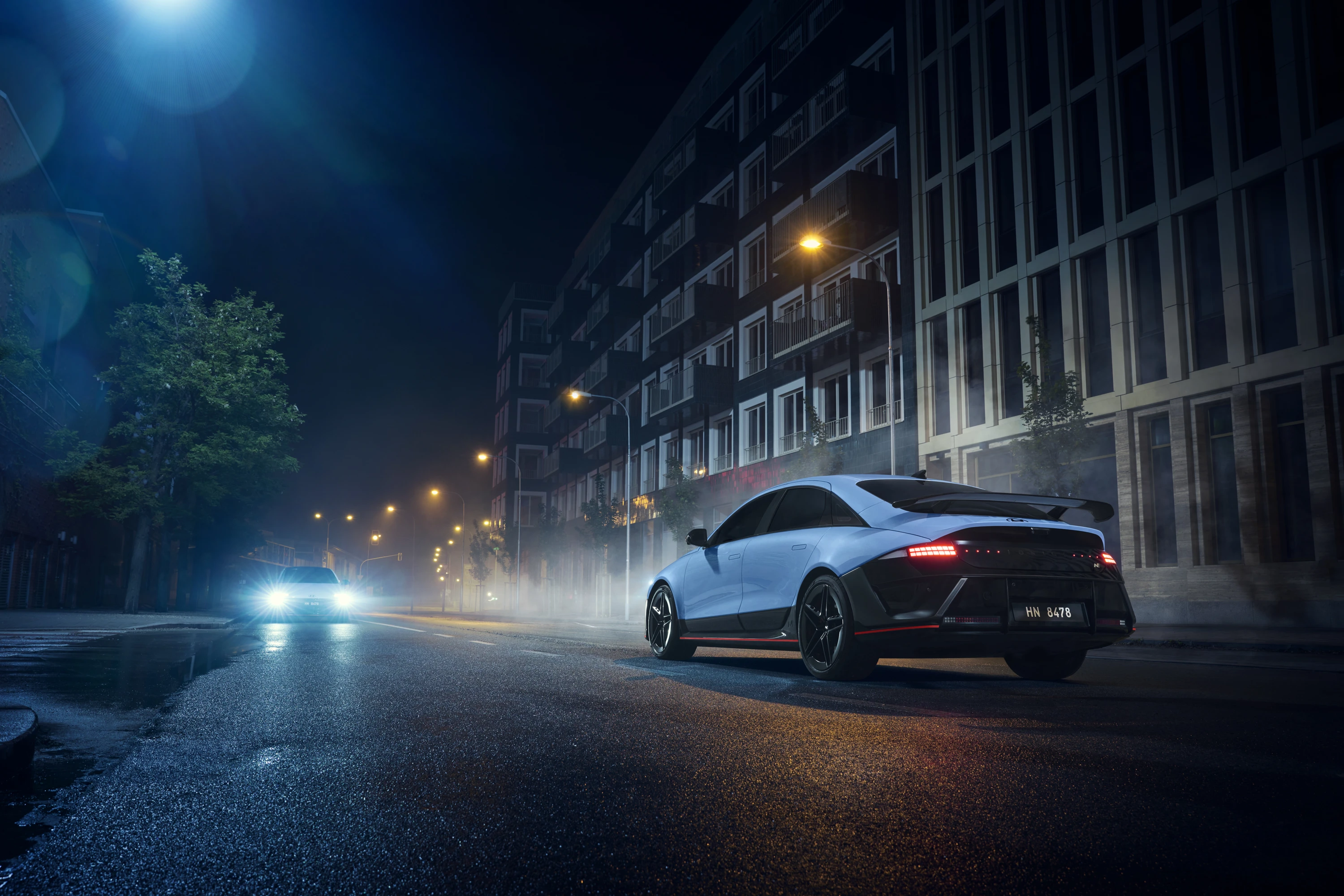
Hyundai IONIQ 6 N
Interior
Seats
The Hyundai IONIQ 6 N accommodates five passengers with two front seats and a three-seat bench in the rear.
First Row Seats
The Hyundai IONIQ 6 N offers a single type of front seat.
The following functionalities are available on the seat:
- Fore-and-aft adjustment (electrically adjustable)
- Recline adjustment (electrically adjustable)
- Height adjustment (electrically adjustable)
- Height adjustable headrest
- Heating
- Memory (standard for driver, not available for passenger)
- Adjustable lumbar support (electrically adjustable as an option)
- Ventilation (optional)
Available in:
- Black leatherette upholstery
- Gray leatherette upholstery
Second-Row Seats
The second row features a standard three-seat bench with a 60:40 split, allowing each section to fold separately to increase cargo space.
Additional second-row features include:
Interior Storage
The Hyundai IONIQ 6 N has the following interior storage:
- Glove Compartment: Located in the dashboard in front of the passenger.
- Door Pockets: The front and rear doors include integrated storage pockets.
Interior Lighting
The Hyundai IONIQ 6 N offers several interior lighting options.
- Ambient lighting: Selectable colors. Locations: dashboard, footwells.
Climate System
There is one climate system available:
- 2-zone climate system: Supports different temperatures for the driver and passenger.
A heat pump is available as an option and can reduce the energy needed to heat the cabin in cold weather.
User Interface and Control
The control interface of the Hyundai IONIQ 6 N combines physical buttons, steering column stalks, and touchscreen displays.
This model features a dual-screen setup integrated into a shared horizontal frame on the dashboard, clearly separating driver and infotainment functions while maintaining a unified visual design.
Key screen details:
- Driver Information Display: A 12.3-inch screen positioned behind the steering wheel on the left side of the shared dashboard frame. It provides essential driving data such as speed, range, and navigation prompts.
- Infotainment Screen: A 12.3-inch touchscreen located on the right side of the same shared frame. It serves as the main interface for infotainment, navigation, and vehicle settings.
An optional head-up display projects key driving information such as speed and navigation cues onto the windshield.
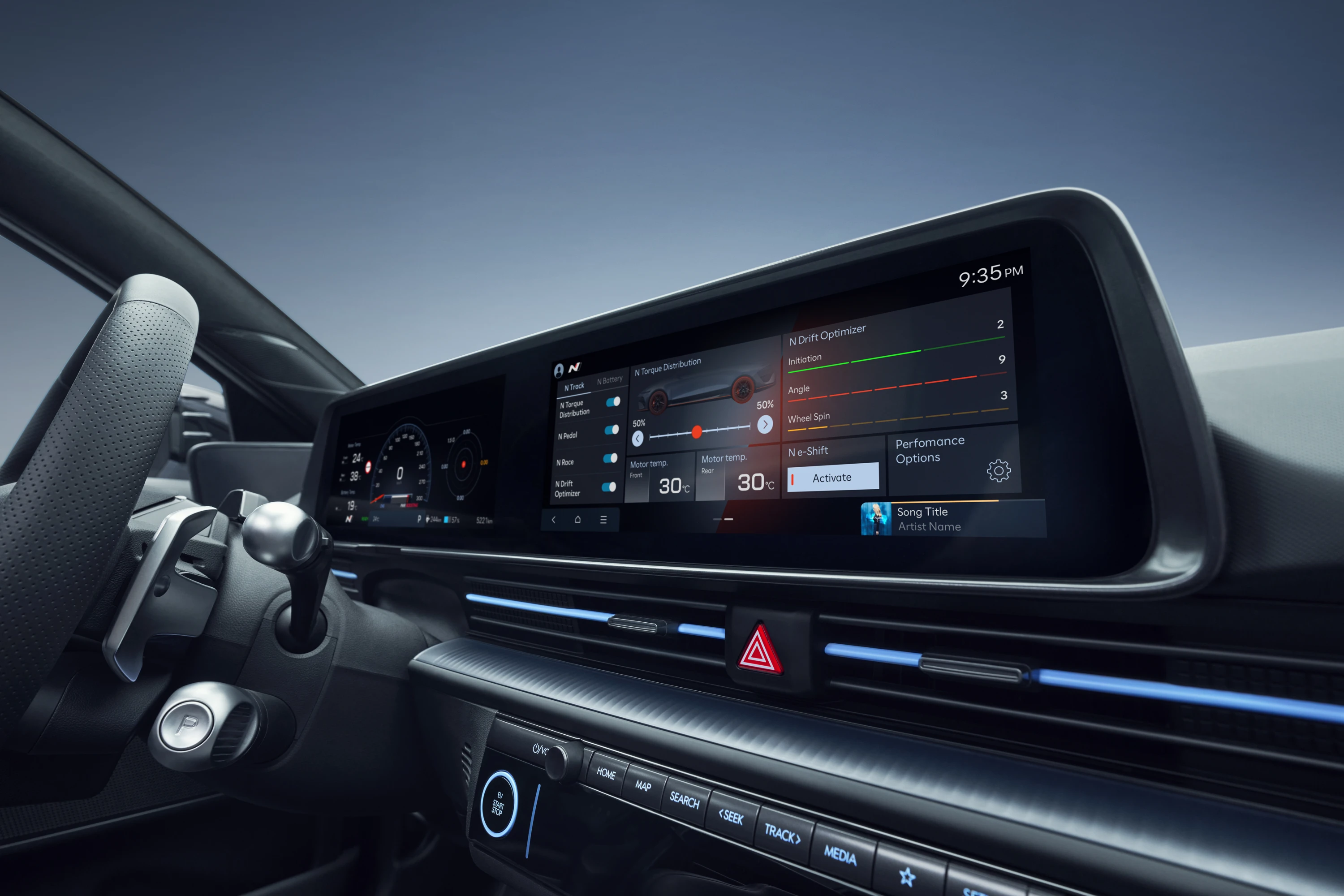
Hyundai IONIQ 6 N
Steering Wheel
The Hyundai IONIQ 6 N is equipped with a single type of steering wheel:
The steering wheel adjusts for tilt and reach. The adjustment is manual.
The standard easy-entry function retracts the steering wheel automatically when entering or exiting the vehicle.
Design: Circular
Controls: Physical buttons, Scroll wheels
Heating: Available as an option
From the steering wheel you can control:
- Media Controls: Steering-wheel controls provide access to audio and media functions.
- Phone Controls: Buttons on the steering wheel allow you to answer, end, and manage phone calls.
- Voice Control: A button on the steering wheel activates the voice control system.
- Cruise Control: A stalk or button on the steering wheel allows you to set and adjust the cruise control speed.
- Drive Mode Selector: A dedicated control allows you to switch between different drive modes.
Mirrors
Both the exterior and interior mirrors use conventional mirror technology to provide a clear view of the area behind the vehicle.
Infotainment
The Hyundai IONIQ 6 N features the ccOS infotainment system with navigation, media, and vehicle settings.
Navigation System
The built-in navigation system uses detailed maps and offers advanced route planning. It provides real-time traffic information to support an efficient and stress-free journey.
Phone Mirroring
The Hyundai IONIQ 6 N supports Android Auto and Apple CarPlay, providing access to compatible phone apps such as Google Maps and Waze on the car's display.
Sound System
The Hyundai IONIQ 6 N has one sound system option:
- Bose Premium Sound System: Features eight speakers.
The model includes USB-C connectivity as standard (total: 4).The model includes USB-A connectivity as standard (total: 1).
Mobile App
The Hyundai IONIQ 6 N has a mobile app for Android and iOS to manage and monitor the vehicle remotely. Features:
- Locate Your Vehicle: Check the current location of your car.
- Preconditioning: Preheat or cool your car before you start your journey.
- Lock and unlock: Lock or unlock the doors remotely.
- Scheduled Charging: Set a charging schedule.
- Charge Target: Set the battery's target state of charge.
- Find your car: Sound the horn or flash the lights to locate the car.
- Route Planning: Plan your route and send it directly to your car's navigation system.
- Driving History: Review the details of your past trips.
Lights
The standard headlights use LED Matrix technology. LED Matrix is an adaptive system that splits the traditional single headlight beam into dozens of smaller rays that the light controller can turn on and off individually. It includes corner lights that illuminate the side when turning. The LED headlights feature multiple LED segments, allowing you to customize your preferred daytime running light (DRL) signature.
The taillights use LED technology.
Advanced Driver Assistance Systems
The Hyundai IONIQ 6 N offers standard and optional advanced driver assistance systems (ADAS).
Efficiency Assist: A Standard feature that helps drivers anticipate driving conditions and conserve energy.
Safety Systems
Anti-lock Braking System (ABS): Standard on the Hyundai IONIQ 6 N. It prevents the wheels from locking during braking.
Electronic Stability Control (ESC): Standard on the Hyundai IONIQ 6 N. It improves stability during sudden maneuvers and on slippery roads.
Lane-Keeping Assist (LKA): Standard on the Hyundai IONIQ 6 N. It applies steering corrections if the vehicle begins to leave its lane.
The Lane Departure Warning alerts the driver if the vehicle begins to leave its lane.
Front Cross Traffic Assist (FCTA): Standard on the Hyundai IONIQ 6 N. It detects traffic crossing ahead when entering an intersection or pulling away from a stop.
Rear Cross Traffic Alert (RCTA): Standard on the Hyundai IONIQ 6 N. It detects vehicles approaching from the side while reversing out of a parking space or driveway.
Forward Collision Warning (FCW): Standard on the Hyundai IONIQ 6 N. It warns the driver of a potential frontal collision.
Automatic Emergency Braking (AEB): Standard on the Hyundai IONIQ 6 N. It applies the brakes automatically if the driver does not respond to an imminent collision.
Automatic Emergency Steering (AES): Standard on the Hyundai IONIQ 6 N. The system can steer automatically to help avoid an imminent collision.
Blind-spot Monitoring (BSM): Standard on the Hyundai IONIQ 6 N. It detects traffic in the vehicle's blind spots.
Exit Warning: Standard on the Hyundai IONIQ 6 N. It warns occupants not to open a door when it detects approaching traffic or another hazard.
Driving Automation
The standard Highway Driving Assist 2 SAE Level 2 system includes the following driving automation features:
- Adaptive Cruise Control (ACC)
- Lane Centering Assist (LCA) / AutoSteer: Centers the vehicle in its lane and adjusts speed in traffic. The driver must keep their hands on the steering wheel and remain attentive.
- Automatic parking
- Automatic Lane Change (ALC)
Safety
The Hyundai IONIQ 6 N is equipped with the following airbags:
- Front airbags for the driver and front passenger
- Side curtain airbags for both the first and second rows
- Side airbags for the driver and front passenger
- A front-center airbag that reduces the risk of the driver and front passenger colliding with each other during a side impact
Security and Access Technologies
The Hyundai IONIQ 6 N includes the following security and access features:
- Keyless Entry and Start: Unlock and start the car with the key in your pocket or bag.
- Phone-as-Key Functionality: Use your smartphone as a digital key to unlock and start the vehicle.
- Alarm System: Monitors for unauthorized entry or tampering and sounds the alarm when triggered.
Cargo Capacity and Towing Ability
The trunk offers a cargo capacity of 401 liters (14.2 cu ft). With the rear seat folded down, this expands to 1578 liters (55.7 cu ft).
The maximum roof load is 80 kg (176.4 lb).
Roof rails are standard for easy mounting of a roof box or rack.
The frunk (front trunk) has a capacity of 12 liters (0.4 cu ft).
The maximum permitted vehicle weight is 2520 kg (5556 lbs), and the base curb weight is 2166 kg (4775 lbs). This leaves a payload of 354 kg (780 lbs), including occupants. Options can increase curb weight and reduce payload.
A towbar can be added to the vehicle. The maximum permissible weight for a braked trailer is 1500 kg (3307 lbs), while for an unbraked trailer, it is 750 kg (1653 lbs).
Availability & Pricing
The Hyundai IONIQ 6 N had its world premiere on 7/10/2025, with deliveries starting in November 2025.
Pricing
Pricing may vary depending on local conditions, incentives, and promotions. Below are the starting prices for select countries:
- United Kingdom £65,800 Updated August 2026
- Australia AUD115,000 Updated August 2026
Other markets (14)
- €77,490 (Austria)
- €75,445 (Belgium)
- 1,799,990 CZK (Czech Republic)
- 539,995 DKK (Denmark)
- €74,690 (Finland)
- €76,500 (Germany)
- €78,000 (Italy)
- €72,951 (Luxembourg)
- €73,995 (Netherlands)
- 771,250 NOK (Norway)
- 343,700 PLN (Poland)
- 79,900,000 KRW (South Korea)
- €66,940 (Spain)
- CHF 75,500 (Switzerland)
Alternatives to Hyundai IONIQ 6 N


Compare These Vehicles
Get detailed side-by-side comparisons of specifications, range, charging performance, and travel capabilities.
Complete Specs
Compare all technical specifications side-by-side
Range Analysis
Real-world range and charging performance
Travel Calculator
Plan trips and compare travel times