
Battery Pack & Configuration
An EV battery pack combines cells with electrical connections, cooling hardware, control electronics, and protective structures to form a high-voltage energy system.
Its electrical configuration determines voltage, capacity, and current capability, while physical integration affects weight, cooling, crash protection, packaging, serviceability, and pack-level energy density.
What Is Inside a Battery Pack?
The cells store the energy, but they are only one part of the complete battery pack.
A typical EV battery pack contains:
- Battery cells
- Modules or other cell-grouping structures
- Busbars and high-voltage conductors
- Cell-monitoring electronics
- Main positive and negative contactors
- Fuses and pyrotechnic disconnects
- Current, voltage, and isolation sensors
- A service disconnect
- Cooling plates and coolant channels
- Thermal-interface materials
- A sealed pack enclosure
- Crash and intrusion protection
- Pressure-relief and gas-management paths
- High-voltage connectors and junctions
The main contactors disconnect the cells from the rest of the vehicle when the high-voltage system is shut down. The cells remain connected and electrically live inside the pack.
A conventional fuse protects against excessive current, while a pyrotechnic disconnect can rapidly break a high-voltage connection during a severe crash or electrical fault.
The Battery Management System monitors and controls the pack, while Battery Thermal Management explains its cooling and heating systems in more detail.
Battery Configuration
Battery configuration describes how cells are electrically connected.
The two basic connection methods are:
- Series connection, which increases voltage
- Parallel connection, which increases ampere-hour capacity and current capability
Most EV packs use a combination of both.
Series Connections
When identical cells or cell groups are connected in series, their voltages are added together.
The same current passes through every cell or parallel group in the series chain.
Pack voltage = Number of series groups × Cell voltage
Connecting 100 cells with a nominal voltage of 3.7 volts in series produces a nominal pack voltage of approximately 370 volts.
The capacity measured in ampere-hours does not increase when identical cells are connected only in series.
Parallel Connections
When identical cells are connected in parallel, the voltage remains the same while their ampere-hour capacities are added together.
Parallel-group capacity =
Number of parallel cells × Cell capacity
Four 72 Ah cells connected in parallel form a 288 Ah group.
Parallel cells also share the current. Under balanced conditions, four identical cells in parallel each carry approximately one-quarter of the group current.
The actual current division can vary slightly because of differences in:
- Internal resistance
- Temperature
- Cell age
- Electrical connections
- Manufacturing tolerances
The BMS normally monitors parallel-connected cells as one voltage group because they share the same terminal voltage.
Understanding s and p Notation
Battery configurations are commonly written using:
- s for series
- p for parallel
A 3s4p configuration contains:
- Three groups connected in series
- Four cells connected in parallel within each group
- Twelve physical cells in total
The total number of cells is:
Total cells = Series count × Parallel count
For a pack using identical cells:
Nominal pack voltage =
Series count × Nominal cell voltage
Pack capacity in Ah =
Parallel count × Cell capacity
Nominal pack energy in Wh =
Nominal pack voltage × Pack capacity
Voltage multiplied by ampere-hours gives an approximate nominal energy value.
Cell voltage changes continuously with State of Charge, so this calculation is not an exact measurement of the energy that the pack can deliver during a complete discharge. Manufacturers may also define rated or gross capacity using cell-characterisation methods that differ slightly from this simple calculation.
Example: Audi Q8 55 e-tron
The Audi Q8 55 e-tron battery contains 432 prismatic cells divided into 36 modules. Each module contains 12 cells.
Audi specifies:
- 114 kWh gross capacity
- 106 kWh usable capacity
- 396 V nominal voltage
- 36 modules
- 432 cells
Each module uses a 3s4p arrangement. The complete pack is therefore 108s4p. (Audi)
Using the nominal cell values:
- Cell voltage: Approximately 3.6667 V
- Cell capacity: 72 Ah
- Parallel-group capacity: 4 × 72 Ah = 288 Ah
- Module voltage: 3 × 3.6667 V = approximately 11 V
- Module capacity: 288 Ah
The 36 modules are connected in series:
- Full configuration: 108s4p
- Pack voltage: 36 × 11 V = 396 V
- Pack capacity: 288 Ah
- Nominal energy: 396 V × 288 Ah = 114,048 Wh
The result is approximately 114 kWh, matching Audi’s published gross capacity.
This example demonstrates two important principles:
- Connecting cells or modules in series increases voltage
- Connecting modules in series does not increase ampere-hour capacity
Example: Porsche Macan Electric
The Porsche Macan Electric uses:
- 100 kWh gross capacity
- Approximately 95 kWh usable capacity
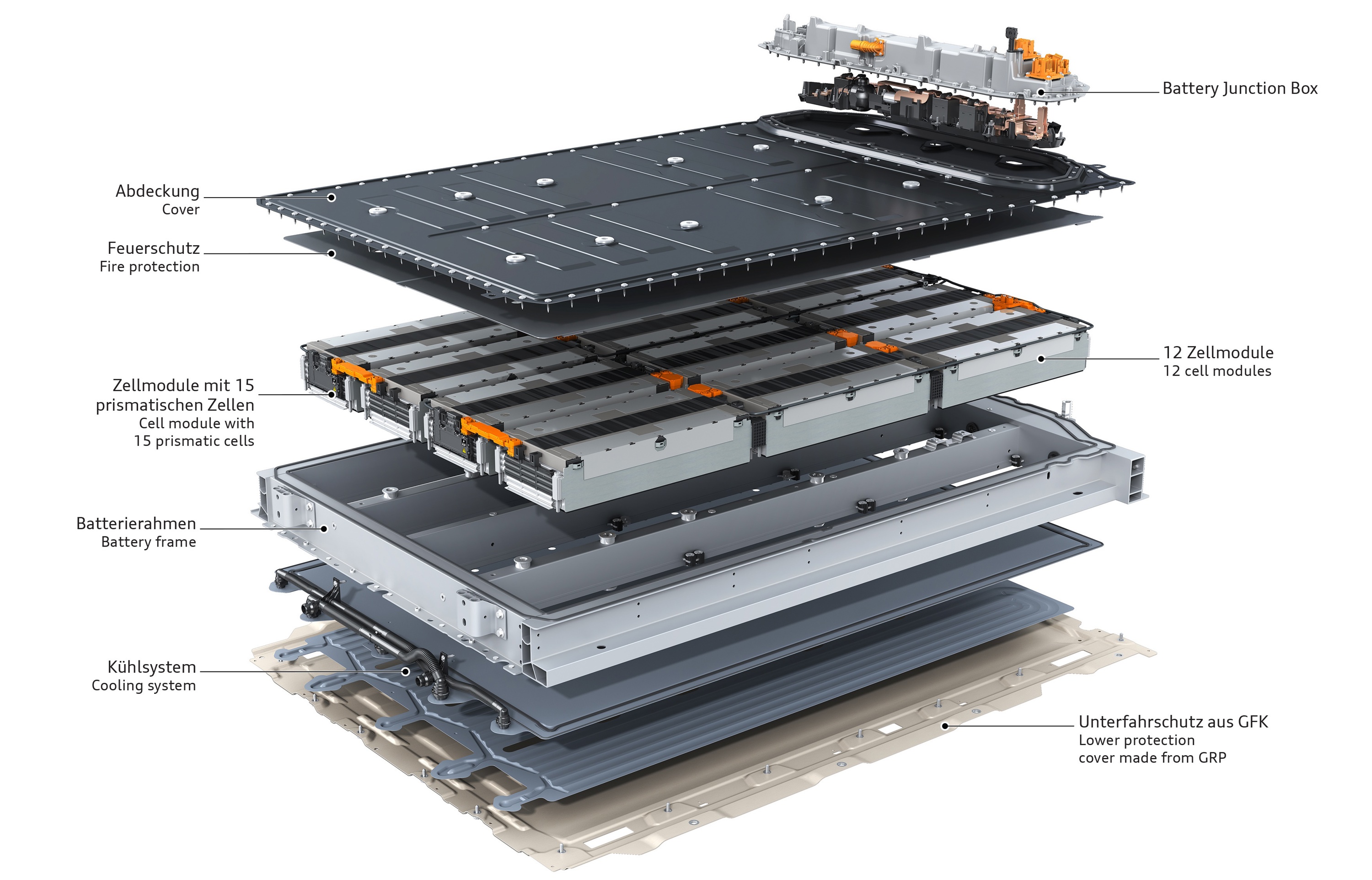
- 12 modules
- 15 prismatic cells connected in series per module
- 180 cells in total
- An 800-volt-class architecture
The complete pack can therefore be described as 180s1p. Each large prismatic cell already provides the required ampere-hour capacity, so no parallel physical cells are needed within each series position.
Porsche also states that the 12 modules and several other important pack components can be replaced individually. (Porsche Newsroom)
This is substantially different from a pack using thousands of small cylindrical cells, even though both designs perform the same basic functions.
Illustrative Small Cylindrical-Cell Pack
Consider a pack using 4,416 cylindrical cells arranged as 96s46p.
Assume each cell has:
- Nominal voltage: 3.7 V
- Capacity: 4.8 Ah
The resulting pack has:
Pack voltage = 96 × 3.7 V
             = 355.2 V
Pack capacity = 46 × 4.8 Ah
              = 220.8 Ah
Nominal energy = 355.2 V × 220.8 Ah
               = approximately 78.4 kWh
This is an illustrative configuration rather than a specification for every vehicle using a similar cell count.
Actual cylindrical packs vary by:
- Cell capacity
- Cell chemistry
- Supplier
- Factory
- Model year
- Battery version
- Usable voltage window
Example Battery Configurations
Manufacturers do not always publish complete sXp notation. Configurations marked with an asterisk are derived from published cell and module arrangements.
| Battery | Year | Gross or rated capacity | Cells / modules | Configuration | Nominal or architecture voltage |
|---|---|---|---|---|---|
| Mitsubishi i-MiEV, US specification | 2012 | 16.3 kWh | 88 cells | 88s1p* | 325.6 V |
| Volkswagen e-Golf | 2014 | 24.2 kWh | 264 cells / 27 modules | 88s3p* | 323 V |
| Volkswagen e-Golf, 35.8 kWh generation | 2017 | 35.8 kWh | 264 cells / 27 modules | 88s3p* | 323 V |
| Audi Q8 55 e-tron | 2022 | 114 kWh | 432 cells / 36 modules | 108s4p | 396 V |
| Audi Q6 e-tron / A6 e-tron PPE battery | 2024 | 100 kWh | 180 cells / 12 modules | 180s1p* | 800-volt class |
| Porsche Macan Electric | 2024 | 100 kWh | 180 cells / 12 modules | 180s1p* | 800-volt class |
| NIO 150 kWh Ultra-Long Range Battery | 2024 | 150 kWh rated | 384 cells | Not officially published | 337 V rated |
| Porsche Cayenne Electric | 2026 | 113 kWh | 192 pouch cells / 6 modules | Not officially published | 800-volt class |
The Mitsubishi i-MiEV test pack used 88 cells, had a rated capacity of 50 Ah, a rated energy of 16.3 kWh, and a nominal voltage of 325.6 V. (US Department of Energy)
The original e-Golf used 264 cells, 27 modules, 323 V, and 24.2 kWh. The later 35.8 kWh version retained the same cell count, module count, nominal voltage, and published battery mass. (VW Press)
The Audi PPE battery uses 12 modules and 180 large prismatic cells instead of the 36 modules and 432 cells used by the Q8 e-tron. (Audi)
NIO publishes 384 cells, 337 V rated voltage, 446 Ah, and 575 kg for its 150 kWh battery but does not provide enough public information to state a reliable full sXp configuration. (NIO)
The Porsche Cayenne Electric uses six modules and 192 large pouch cells in a function-integrated battery. (Porsche Newsroom)
Voltage, Current, and Power
Electrical power depends on voltage and current:
Power = Voltage × Current
The same power can be transferred using:
- Higher voltage and lower current
- Lower voltage and higher current
An idealised 300 kW transfer requires:
At 400 V:

Current = 300,000 W ÷ 400 V
        = 750 A
At 800 V:

Current = 300,000 W ÷ 800 V
        = 375 A
The 800-volt system delivers the same power at half the current.
Electrical losses in conductors can be approximated as:
Resistive loss = Current² × Resistance
If resistance remains unchanged, halving current reduces resistive loss to one-quarter.
Real vehicles are more complicated because conductor dimensions, connector resistance, semiconductors, cooling, and actual battery voltage also change. The calculation nevertheless explains why higher voltage becomes attractive as charging and drivetrain power increase.
400-Volt-Class and 800-Volt-Class Systems
The terms 400 volt and 800 volt describe broad system classes rather than fixed battery voltages.
Pack voltage changes with:
- State of Charge
- Cell chemistry
- Temperature
- Current
- Number of series-connected cells
- Manufacturer voltage limits
A battery marketed as 400 volt may operate from the low 300-volt range to above 400 V.
An 800-volt-class pack may have a nominal voltage closer to 650–750 V while approaching or exceeding 800 V near a high State of Charge.
400-Volt-Class Systems
A 400-volt-class architecture remains sufficient for many mainstream EVs.
Advantages
- Mature and widely available components
- Lower component cost
- Straightforward compatibility with existing chargers
- Less demanding insulation requirements
- Adequate power for many passenger vehicles
- Established repair and manufacturing processes
Trade-Offs
- Higher current for the same power
- Larger current-carrying conductors at very high power
- More connector and cable heating
- Greater difficulty reaching extreme charging power
- Higher current requirements for high-output drivetrains
A strong 400-volt battery can still charge very quickly when it combines high-current cells, effective cooling, and a broad charging curve.
800-Volt-Class Systems
An 800-volt-class architecture reduces the current required for a given power.
Advantages
- Lower current at high charging power
- Reduced conductor losses
- Potentially smaller or lighter high-voltage cables
- Greater power within connector-current limits
- Efficient delivery of high drivetrain power
- Strong suitability for high-power charging
Trade-Offs
- More expensive high-voltage components
- More demanding insulation and creepage distances
- Greater requirements for contactors and sensors
- More complex power electronics
- Compatibility challenges with lower-voltage chargers
- Higher development and validation cost
Higher voltage does not guarantee faster charging.
Charging performance also depends on:
- Cell chemistry
- Cell C-rate
- Battery temperature
- Charging curve
- Current limits
- Cooling capability
- State of Charge
- Charger capability
Charging an 800-Volt Battery at a Lower-Voltage Charger
A charger must provide sufficient voltage to push current into the battery.
An 800-volt-class battery cannot normally charge directly from a charger whose maximum output voltage remains well below the pack voltage.
Manufacturers solve this in several ways:
- A dedicated DC boost converter
- Use of the motor and inverter as part of a boost circuit
- Reconfiguration of the battery into lower-voltage banks
- Restricted charging capability on incompatible chargers
Bank Charging
Bank charging changes the battery’s electrical configuration during charging.
The Porsche Macan can divide its 800-volt battery into two separate 400-volt circuits. The two battery halves are then charged concurrently at up to 135 kW without a separate high-voltage booster. (Porsche Newsroom)
The cells do not move and the pack is not physically divided. High-voltage switches change how its sections are electrically connected.
This demonstrates that battery configuration does not always remain fixed in every operating mode.
Battery-Pack Architectures
Electrical configuration describes how cells are connected.
Pack architecture describes how the cells, cooling system, enclosure, modules, and vehicle structure are physically integrated.
The main approaches include:
- Module-based packs
- Cell-to-Pack
- Cell-to-Body or Cell-to-Chassis
- Structural or function-integrated packs
These categories overlap.
A structural battery can still contain modules. A Cell-to-Pack design can still use internal frames, compressed rows, banks, or other cell-grouping structures.
Module-Based Packs
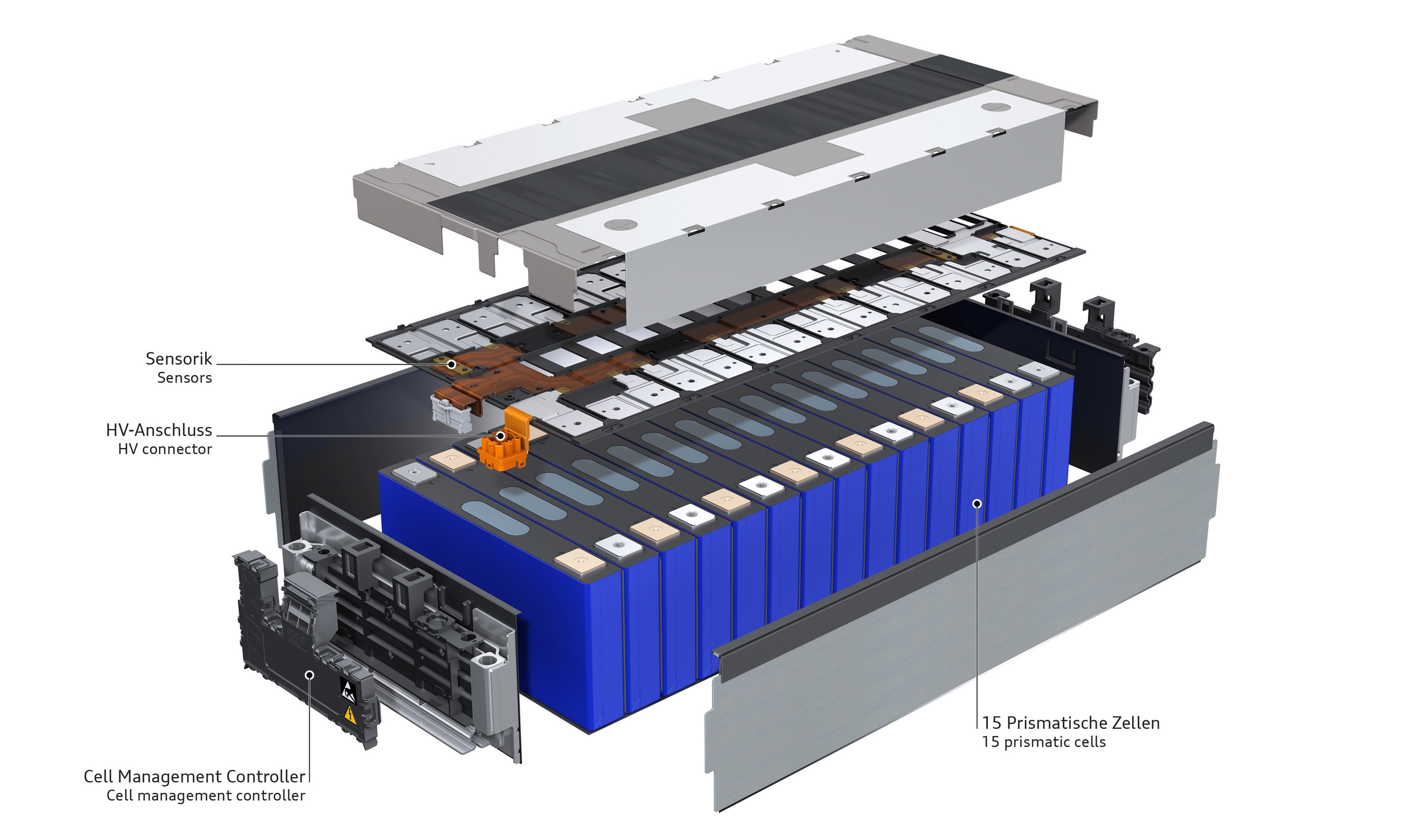
In a traditional module-based pack, cells are assembled into modules before the modules are installed in the battery enclosure.
Cell → Module → Pack → Vehicle
Modules can include:
- Cell frames
- Compression structures
- Busbars
- Cell-monitoring electronics
- Cooling interfaces
- Electrical isolation
- Mechanical protection
- Module-level connectors
Advantages of Module-Based Packs
- Scalability: Different capacities can be created using different module counts.
- Manufacturing separation: Module assembly and final pack assembly can be tested separately.
- Controlled cell groups: Compression, electrical connections, and cooling can be managed within defined units.
- Potential repairability: A defective module may be replaceable without replacing the complete pack.
- Supplier flexibility: Modules can provide an interface between cell production and vehicle assembly.
- Platform reuse: One module design can sometimes be used in several vehicles.
Trade-Offs of Module-Based Packs
- Additional inactive material: Frames, covers, fasteners, and connectors add mass.
- Higher part count: More housings, seals, busbars, and interfaces are needed.
- Reduced pack efficiency: Space is required around both cells and modules.
- More assembly stages: Modules require separate production, testing, transport, and installation.
The presence of modules does not automatically make a pack repairable.
Repairability also depends on:
- Pack access
- Adhesives and sealants
- Coolant design
- Replacement-part availability
- Diagnostic support
- BMS programming
- Manufacturer repair procedures
The Porsche Macan Electric is a modern example of a repair-focused module-based pack. Porsche states that its 12 modules and other major components can be replaced individually. (Porsche Newsroom)
Cell-to-Pack
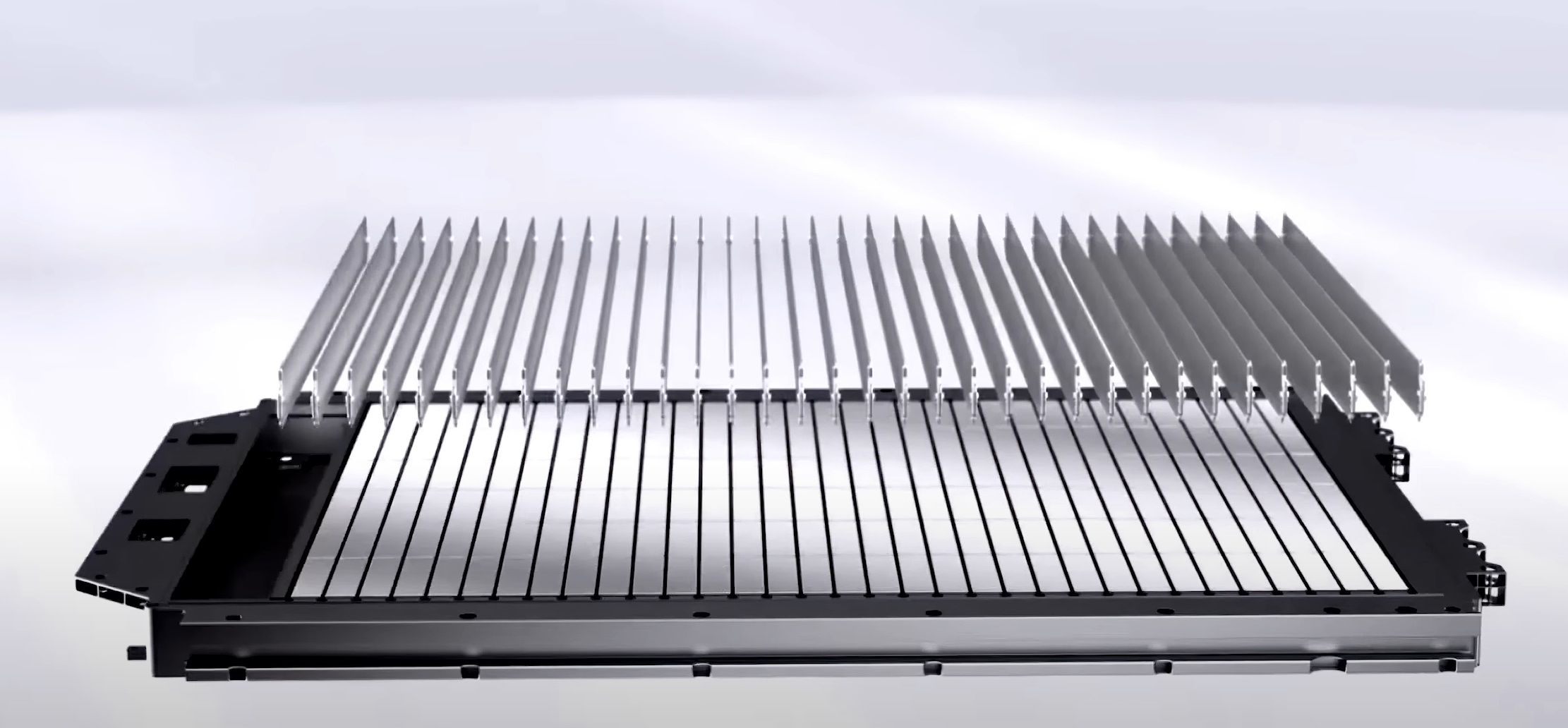
Cell-to-Pack, commonly shortened to CTP, removes or reduces the conventional intermediate module enclosure.
Cell → Pack → Vehicle
Cells can still be arranged in:
- Rows
- Compressed groups
- Internal frames
- Banks
- Structural arrays
CTP does not necessarily mean that every cell is loose inside one undivided enclosure.
Advantages of Cell-to-Pack
- Higher pack-volume utilisation: Less volume is occupied by module walls and covers.
- Lower inactive mass: Fewer intermediate housings and fasteners are required.
- Reduced part count: Electrical and structural interfaces can be consolidated.
- Potential cost reduction: Removing repeated components can simplify assembly.
- Closer cooling integration: Cells can interface directly with pack-level cooling structures.
- Fewer connections: Large cells and direct integration can reduce busbar and connector count.
Trade-Offs of Cell-to-Pack
- More pack-level responsibility: Cooling, compression, isolation, and propagation protection must be solved across larger sections.
- More integrated manufacturing: A production fault can affect a larger assembly.
- Reduced modular replacement: Cell groups may be difficult to remove independently.
- Platform dependence: Cell dimensions, cooling, pack enclosure, and vehicle floor are closely linked.
- Potential repair cost: Damage to one section can require replacement of a larger pack assembly.
CATL Qilin
CATL describes Qilin as a third-generation CTP architecture.
CATL claims 72% pack-volume utilisation for the design. This is a specification for Qilin rather than a result that applies to every CTP battery.
The significance extends beyond the removal of conventional module housings. Qilin integrates cooling, structure, thermal protection, and cells at the pack level.
Volkswagen Unified Cell and Cell-to-Pack
Volkswagen Group’s Unified Cell is a standardised prismatic-cell platform designed to work with a new Cell-to-Pack battery system.
The broad cell platform is intended to support:
- NMC
- LFP
- Sodium-ion
- Potential future solid-state technology
The first PowerCo Unified Cell produced in Salzgitter uses NMC chemistry. LFP variants are planned. (Volkswagen Group)
The Unified Cell demonstrates why cell format and pack interfaces can be standardised without committing every vehicle to the same chemistry.
BYD Blade Battery
BYD’s Blade Battery uses long prismatic LFP cells arranged directly into the pack without conventional intermediate modules.
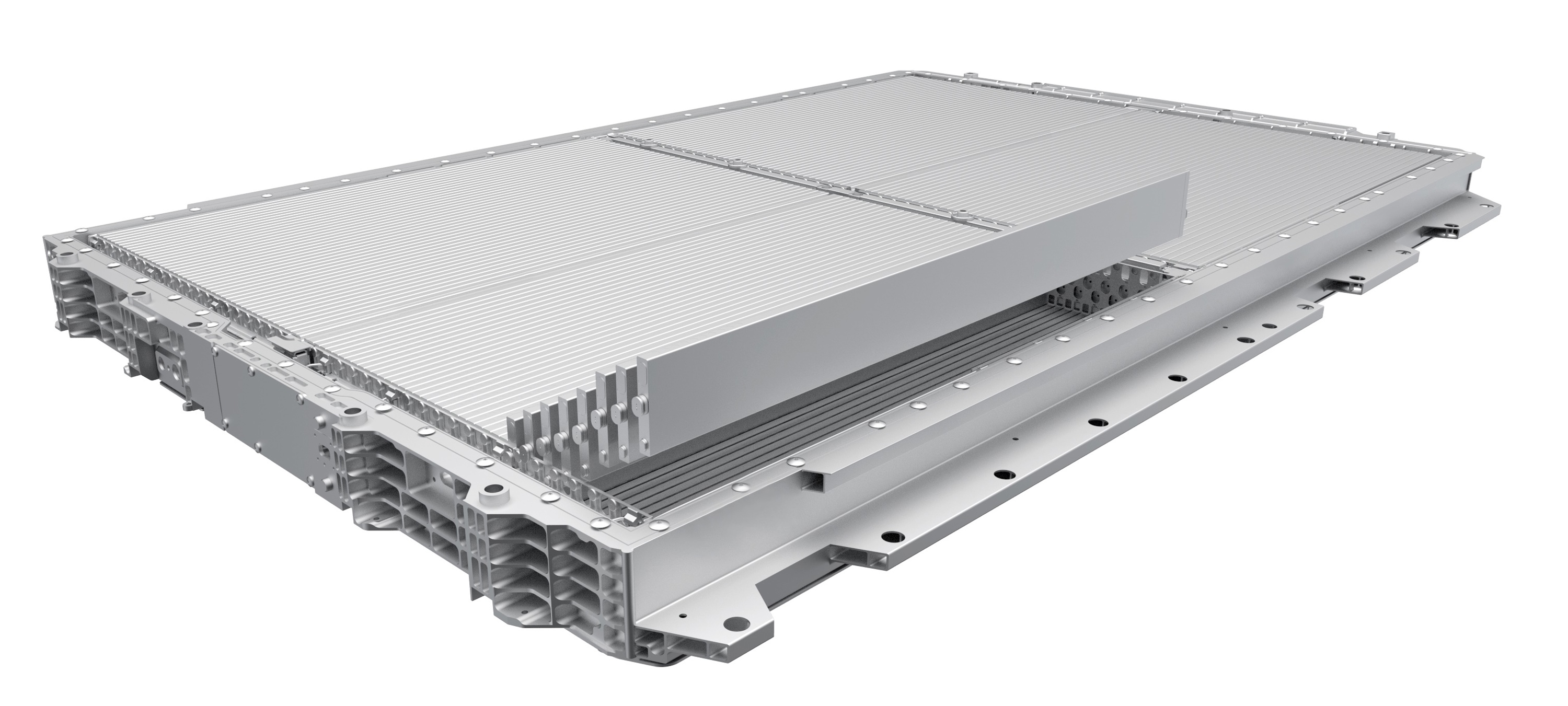
The long cells also contribute to the pack’s internal mechanical structure.
Much of the packaging benefit comes from the relationship between:
- Cell dimensions
- Pack width
- Cooling
- Structural support
- Module-free assembly
The result should not be attributed to LFP chemistry or the long cell shape alone.
Cell-to-Body and Cell-to-Chassis
Cell-to-Body, or CTB, integrates the battery more closely with the vehicle body.
Cell-to-Chassis, or CTC, is used for similar concepts, although manufacturers do not use the terms consistently.
The battery can share functions with:
- Passenger-compartment floor
- Crossmembers
- Underbody
- Side structures
- Seat mounting structures
- Crash-load paths
The dividing line between advanced CTP and CTB is not always clear. It depends on which parts and functions are shared between the pack and body.
BYD Seal Cell-to-Body
The BYD Seal uses a Cell-to-Body system in which the battery and body floor form a closely integrated sandwich-like structure.
The battery acts as both:
- An energy-storage system
- A structural element within the vehicle
Advantages of CTB and CTC
- Fewer duplicated structural layers
- More interior space for a given vehicle height
- Potential reduction in system mass
- Increased body stiffness
- Lower centre of gravity
- Improved packaging efficiency
Trade-Offs of CTB and CTC
- Battery and body engineering become tightly connected
- Collision repair may involve battery and body structures
- Pack removal can require more extensive disassembly
- Platform changes may require a redesigned battery
- Sealing and corrosion protection become more critical
- Dimensional tolerances become more demanding
Structural and Function-Integrated Packs
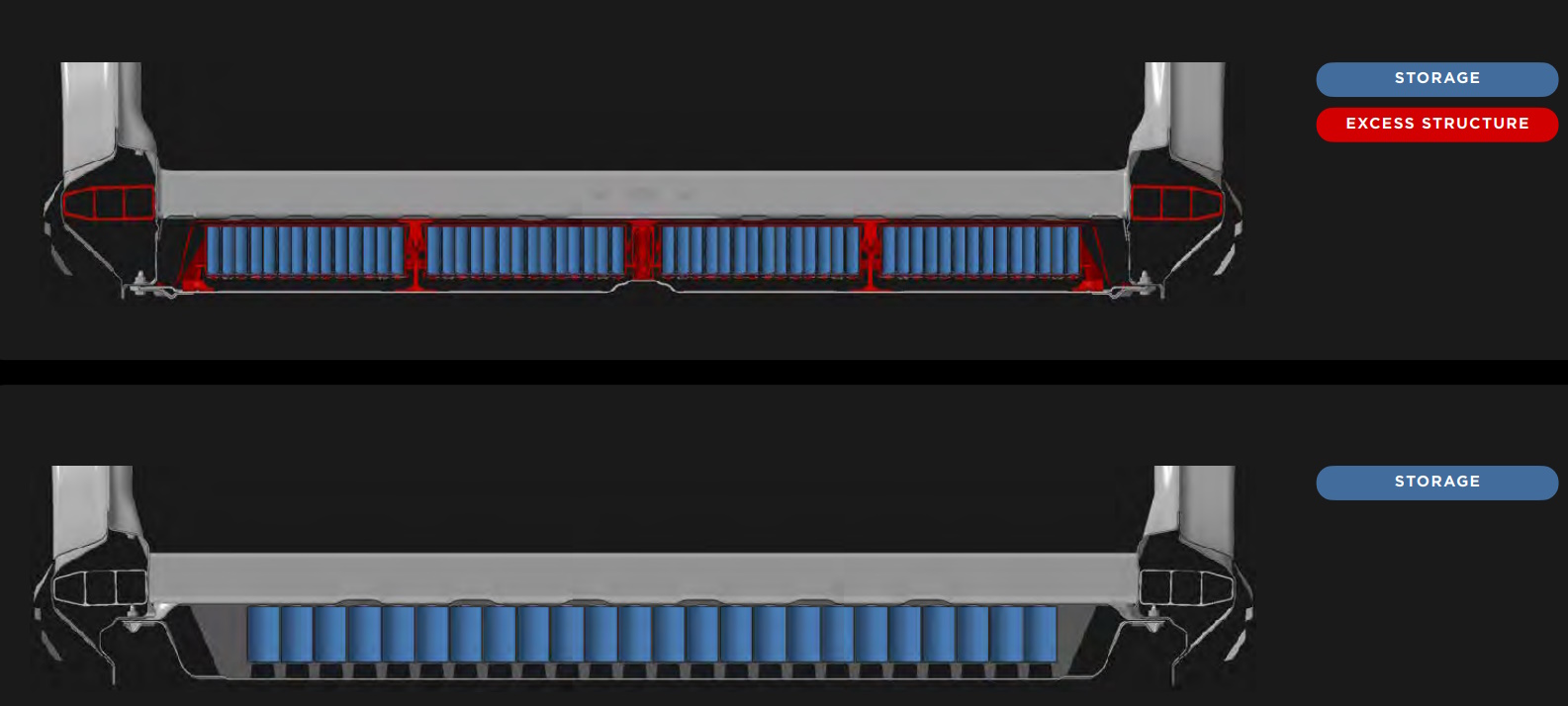
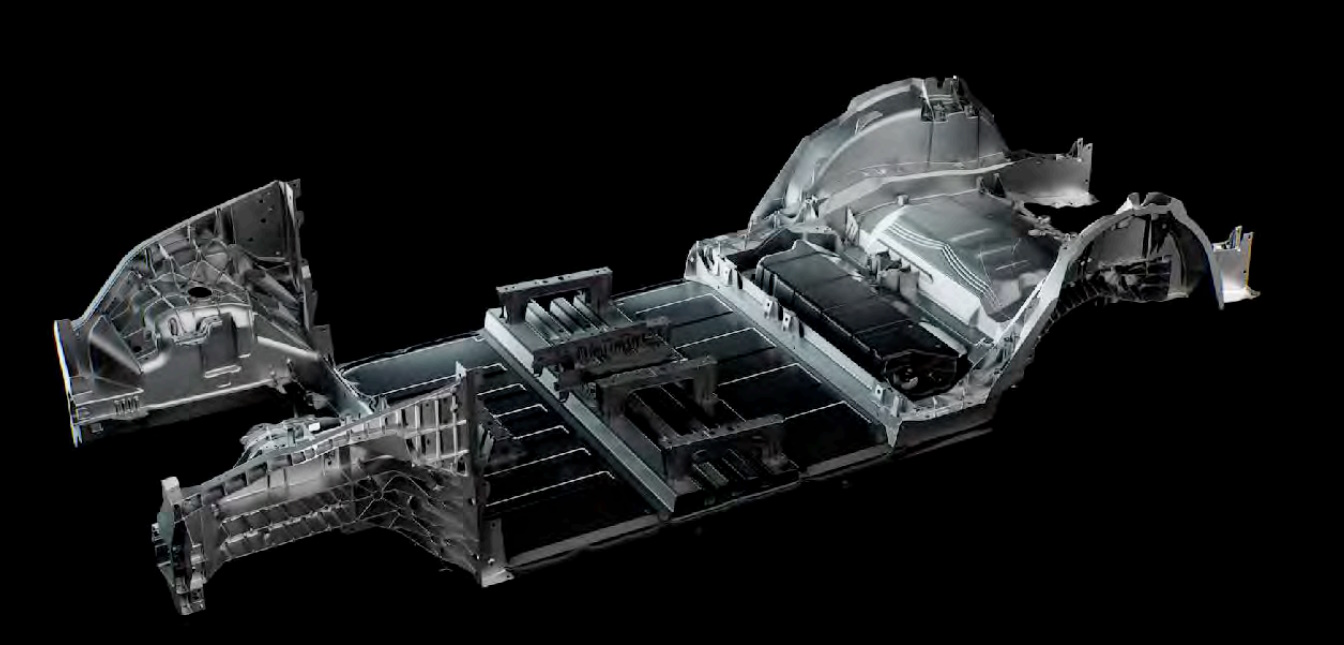
A structural battery carries significant vehicle loads instead of serving only as an energy-storage unit mounted beneath the body.
A structural pack can use:
- Cells bonded directly into a structural enclosure
- Large structural cell arrays
- Modules installed within a body-integrated battery
- A battery cover that also serves as part of the cabin floor
Structural integration and module use are separate design choices.
Tesla Structural Battery Pack
Tesla began producing selected Model Y vehicles with in-house 4680 cells, large body castings, and a structural battery pack in 2022.
Tesla has also produced Model Y variants using conventional non-structural packs with 2170 cells. The battery architecture therefore depends on the vehicle version and factory.
Porsche Cayenne Electric
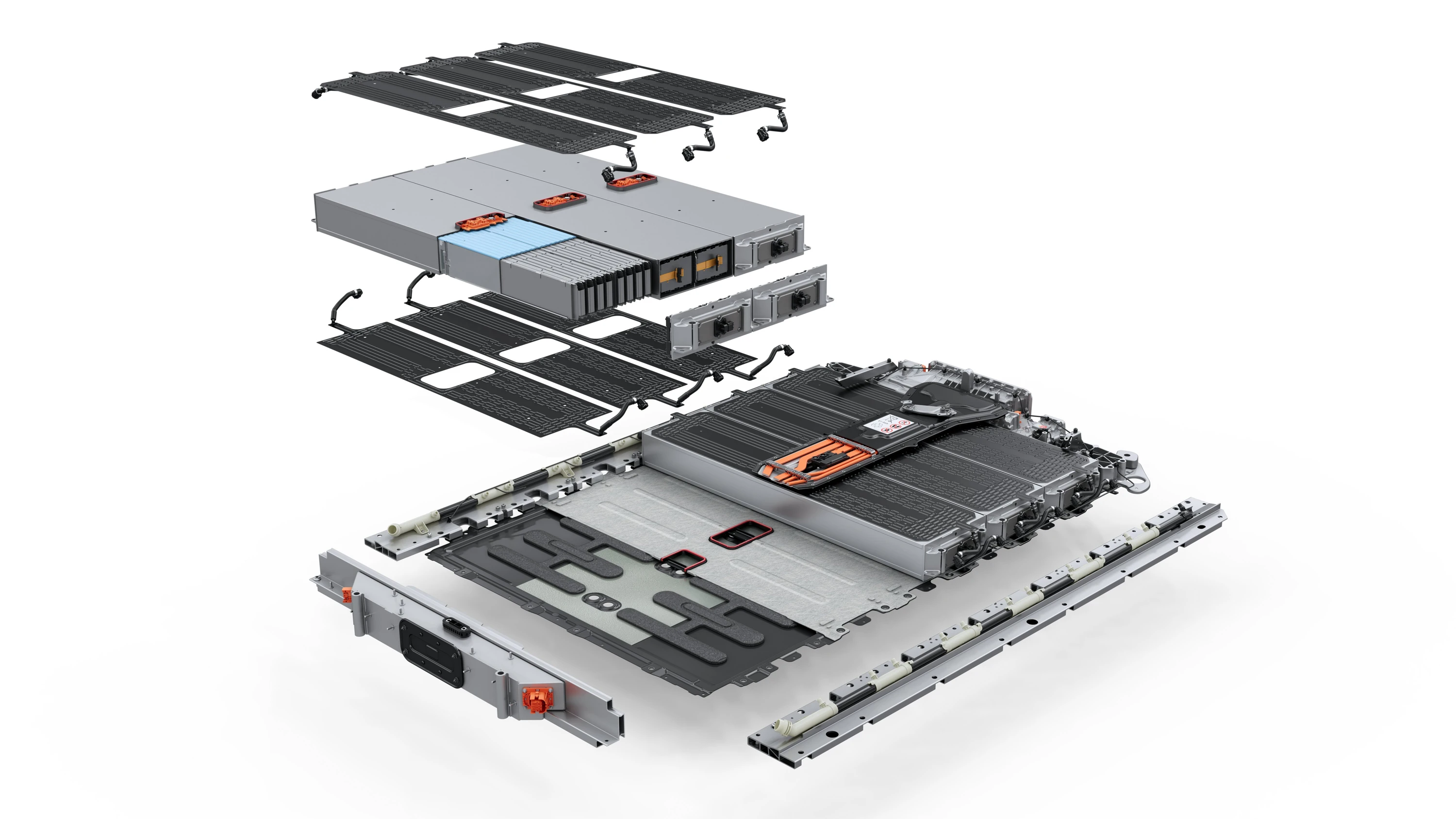
The Porsche Cayenne Electric uses what Porsche calls a function-integrated high-voltage battery.
The battery:
- Is directly integrated into the vehicle structure
- Contributes to body stiffness
- Contains six modules
- Contains 192 large pouch cells
- Has 113 kWh gross capacity
- Uses double-sided module cooling
It is a useful example of a structurally integrated battery that remains modular rather than using a module-free CTP architecture. (Porsche Newsroom)
Advantages of Structural Packs
- Reduced duplication between pack and body structures
- Potentially lower total system mass
- Improved use of vertical space
- Increased body stiffness
- Lower centre of gravity
- Fewer large vehicle components
Trade-Offs of Structural Packs
- Battery and vehicle development become inseparable
- Structural damage can affect the battery enclosure
- Pack removal and body repair can be more complicated
- Manufacturing tolerances become more demanding
- The battery may be difficult to reuse on another platform
- Repair requires detailed manufacturer procedures
The video below provides a detailed analysis of Tesla’s structural pack by Munro & Associates.
Pack Architecture and Serviceability
It is tempting to rank battery architectures like this:
Modules = repairable

Cell-to-Pack = difficult to repair

Structural pack = not repairable
The reality is more complicated.
Serviceability depends on:
- Whether the cover can be opened nondestructively
- Whether modules or cell groups can be removed
- Structural adhesives, foam, and potting compounds
- Access to cooling plates
- Coolant connections
- Availability of modules and electronics
- Diagnostic tools
- BMS programming and component pairing
- Approved repair procedures
- Damage to the pack enclosure or vehicle structure
A conventional module-based battery may still be replaced only as a complete unit if the manufacturer does not supply modules or repair instructions.
A structurally integrated battery can still contain replaceable:
- Modules
- Contactors
- Fuses
- Sensors
- Controllers
- Coolant components
The Porsche Cayenne Electric demonstrates that structural integration and modular construction can coexist.
Pack architecture influences repair possibilities, but does not determine them by itself.
Pack-Level Energy Density
Cell-level energy density describes the energy stored by the cells relative to their mass or volume.
Pack-level energy density includes everything required to operate, connect, cool, and protect the cells:
- Cell housings
- Module structures
- Pack enclosure
- Cooling system
- Busbars and wiring
- Contactors and fuses
- Control electronics
- Crash protection
- Seals and fasteners
- Thermal-interface materials
Gravimetric pack energy density is:
Gravimetric pack energy density =
Pack energy in Wh ÷ Complete pack mass in kg
Volumetric pack energy density is:
Volumetric pack energy density =
Pack energy in Wh ÷ External pack volume in litres
A cell with high energy density can still produce a relatively heavy pack if it requires extensive cooling, containment, or structural hardware.
A lower-density chemistry such as LFP can achieve a respectable pack-level result through efficient integration, but the lower cell-level density does not disappear entirely.
Pack-Level Energy Density Over Time
The table uses gross or manufacturer-rated energy rather than usable energy.
The values should be treated as representative examples rather than a laboratory comparison. Manufacturers do not always define pack mass or rated energy in exactly the same way.
| Battery pack | Year or generation | Gross or rated capacity | Pack mass | Calculated density |
|---|---|---|---|---|
| Mitsubishi i-MiEV, US specification | 2012 | 16.3 kWh | 165 kg | 99 Wh/kg |
| Tesla Model S 85 | 2012 | 85 kWh | Approximately 540 kg | Approximately 157 Wh/kg |
| Volkswagen e-Golf | 2014 | 24.2 kWh | 318 kg | 76 Wh/kg |
| Audi e-tron 55 | 2018 | 95 kWh | Approximately 699 kg | Approximately 136 Wh/kg |
| Volkswagen e-Golf, 35.8 kWh generation | 2017 | 35.8 kWh | 318 kg | 113 Wh/kg |
| Audi Q4 e-tron, large battery | 2021 | 82 kWh | Approximately 500 kg | Approximately 164 Wh/kg |
| BYD Seal Long Range, LFP | 2022 | 82.56 kWh | Approximately 558 kg | Approximately 148 Wh/kg |
| Audi Q6 e-tron / Porsche Macan Electric | 2024 | 100 kWh | Approximately 570 kg | Approximately 175 Wh/kg |
| Renault 5 E-Tech, 52 kWh version | 2024 | 55 kWh | 297 kg | 185 Wh/kg |
| Audi e-tron GT, updated battery | 2024 | 105 kWh | 625 kg | 168 Wh/kg |
| NIO 100 kWh swap battery | Current published specification | 100 kWh rated | 555 kg | 180 Wh/kg |
| NIO 150 kWh Ultra-Long Range Battery | 2024 | 150 kWh rated | 575 kg | 261 Wh/kg |
The Mitsubishi i-MiEV figures are from a US Department of Energy test report that lists 16.3 kWh rated energy and a 363 lb pack mass, equivalent to approximately 165 kg. (US Department of Energy)
Tesla officially specified the original Model S with an 85 kWh battery. The approximately 540 kg pack mass is a commonly reported technical estimate rather than a figure stated in Tesla’s original vehicle specification, so its calculated density should be treated as approximate. (Tesla)
Volkswagen officially lists 318 kg for both e-Golf battery generations. (VW Press)
The 2018 Audi e-tron used a 95 kWh battery weighing approximately 699 kg. The value provides a useful example of a pack engineered around strong cooling, structural protection, repeatable charging, and modular construction rather than minimum mass alone.
The BYD Seal figure uses an approximately 558 kg pack mass for the 82.56 kWh LFP Blade Battery. This gives roughly 148 Wh/kg and is useful as a modern LFP reference.
Renault officially publishes 52 kWh usable capacity and 297 kg pack mass for the Renault 5. The table uses 55 kWh as the EVKX working gross-capacity figure, producing approximately 185 Wh/kg. (Renault Ireland)
Audi publishes 105 kWh gross capacity and 625 kg for the updated e-tron GT battery. (Audi)
NIO publishes 555 kg for its 100 kWh batteries and 575 kg for the 150 kWh version. (NIO)
Early EV Packs Were Not All Alike
The table does not show a simple year-by-year rise.
The Mitsubishi i-MiEV and original e-Golf were conservative early battery systems with:
- Modest capacity
- Low charging power
- Substantial supporting structure
- Packaging constrained by small or multi-powertrain platforms
The first e-Golf achieved only 76 Wh/kg at pack level.
The original Tesla Model S was a major exception. Its large, purpose-built floor battery achieved approximately 157 Wh/kg in 2012 despite using:
- 7,104 small cylindrical cells
- 16 modules
- Liquid cooling
- Thousands of electrical connections
- A strong structural enclosure
The Model S showed how a high-energy cell and a vehicle designed around a large flat pack could outperform many smaller early EV batteries.
Two Generations of e-Golf Battery
The two e-Golf packs provide an unusually clear comparison because their published pack mass, cell count, module count, and nominal voltage remained the same.
| Specification | 24.2 kWh e-Golf | 35.8 kWh e-Golf |
|---|---|---|
| Rated capacity | 24.2 kWh | 35.8 kWh |
| Pack mass | 318 kg | 318 kg |
| Cell count | 264 | 264 |
| Module count | 27 | 27 |
| Nominal voltage | 323 V | 323 V |
| Calculated density | 76 Wh/kg | 113 Wh/kg |
The later battery stores approximately 48% more energy without increasing the published pack mass or number of cells.
The improvement came primarily from greater cell capacity rather than a larger battery enclosure.
Modern LFP: BYD Seal Blade Battery
The BYD Seal provides a useful example of a modern LFP pack.
Its 82.56 kWh Blade Battery weighs approximately 558 kg, giving a calculated pack density of around 148 Wh/kg.
That is lower than several modern nickel-based packs despite the Seal using an efficient Cell-to-Body architecture.
The result illustrates two separate effects:
- LFP cells normally store less energy per kilogram than leading nickel-rich cells
- Efficient pack integration reduces, but does not remove, the cell-level disadvantage
The Seal’s pack is not poorly engineered. It prioritises a different balance of:
- Material cost
- Cycle life
- Thermal stability
- Pack integration
- Structural efficiency
Pack density should therefore not be treated as a complete battery-quality ranking.
Renault 5: High Density in a Small Modular Pack
The Renault 5 E-Tech is notable because its compact battery achieves approximately 185 Wh/kg using the 55 kWh working gross figure.
| Specification | Renault 5 E-Tech |
|---|---|
| Gross capacity used by EVKX | 55 kWh |
| Official usable capacity | 52 kWh |
| Pack mass | 297 kg |
| Calculated gross density | 185 Wh/kg |
| Number of modules | 4 |
The result is particularly interesting because the Renault 5 does not use a module-free CTP design.
Its four large modules reduce repeated housings, connectors, and support components compared with packs using many smaller modules.
The Renault therefore demonstrates that strong pack density does not require removing the module level completely.
NIO’s 100 and 150 kWh Swap Batteries
NIO’s 100 and 150 kWh batteries provide another revealing comparison because both fit the company’s battery-swapping interface.
| Specification | NIO 100 kWh | NIO 150 kWh |
|---|---|---|
| Rated capacity | 100 kWh | 150 kWh |
| Pack mass | 555 kg | 575 kg |
| Calculated density | 180 Wh/kg | 261 Wh/kg |
| Difference in mass | — | 20 kg more |
| Difference in energy | — | 50% more |
The 150 kWh battery stores 50% more rated energy while adding only 20 kg compared with the published 100 kWh pack specification.
Its calculated density of approximately 261 Wh/kg is far above the mainstream examples in the table.
It should not be treated as representative of the wider EV market. The pack uses a specialised high-energy cell design and has been deployed through NIO’s upgrade and battery-swapping system.
Why Pack-Density Numbers Are Not Perfectly Comparable
Pack-density comparisons require caution.
Manufacturers may differ in how they define:
- Gross capacity
- Rated capacity
- Complete pack mass
- Coolant mass
- Junction-box mass
- Underbody protection
- Shared structural components
- Production versus prototype specification
Vehicle requirements also differ.
A performance EV may need more:
- Cooling
- Busbar capacity
- High-current hardware
- Crash protection
An SUV or off-road vehicle may require a heavier enclosure than a compact hatchback.
A swappable battery needs structural and mechanical interfaces that a permanently installed pack does not.
A lower-density pack may still provide:
- Faster and more repeatable charging
- Better cooling
- Greater crash protection
- Easier module replacement
- Higher sustained power
- Longer life
- Lower production cost
Pack-level density is useful, but it is not a complete battery-quality score.
What Pack Architecture Means for an EV Buyer
Pack configuration is not normally something a buyer needs to compare directly.
A 180s1p battery is not inherently better than a 96s46p battery.
What matters in daily use is the result of the complete design:
- Usable battery capacity
- Vehicle efficiency
- Charging curve
- Cold-weather charging
- Battery preconditioning
- Continuous and peak power
- Degradation
- Thermal management
- Warranty coverage
- Protection against thermal propagation
- Pack and module repair options
- Replacement cost after damage
Higher voltage can help an EV achieve high charging and drivetrain power, but voltage alone does not determine charging speed.
Cell-to-Pack and structural integration can reduce weight and improve packaging. They can also change repair procedures and increase the consequences of underbody or structural damage.
A modular pack can offer more repair options, but only when replacement parts, diagnostics, and approved procedures are available.
The best battery-pack architecture is the one that meets the vehicle’s targets for:
- Performance
- Range
- Charging
- Safety
- Durability
- Production cost
- Packaging
- Serviceability
The newest acronym is not automatically the best battery.
For the protection layers surrounding cells and the complete pack, see EV Battery Safety and Failure Management.
Sources
- Audi Q8 e-tron battery capacity and charging
- Porsche Macan battery and charging
- US Department of Energy Mitsubishi i-MiEV battery testing
- Volkswagen e-Golf press pack
- Audi PPE high-voltage battery
- NIO ET7 user manual
- Porsche Cayenne Electric high-voltage system
- Volkswagen Group battery and energy technologies
- Tesla Model S specifications
- Renault 5 E-Tech specifications
- Audi e-tron GT high-voltage battery