
Battery Basics
Rechargeable battery cells store energy chemically and release it as electricity by moving charged ions between two electrodes while electrons travel through an external circuit. Most EVs use lithium-ion cells; sodium-ion cells follow a similar principle but use different materials and charge-carrying ions.
From cell to battery pack
A cell is the smallest complete electrochemical energy-storage unit. One cell normally produces only a few volts, so an EV connects many cells to create the voltage and energy required by the vehicle.
Cells may be grouped into modules, and modules may then be installed in a battery pack. Some newer packs place cells directly into the pack structure without conventional module housings.
The complete pack also contains electrical connections, cooling or heating hardware, sensors, contactors, fuses, a protective enclosure, and a Battery Management System.
The Battery Pack and Configuration chapter explains how cells are connected and physically integrated.
What is inside a battery cell?
A conventional lithium-ion cell has five main component types:
- A negative electrode
- A positive electrode
- An electrolyte
- A separator
- Current collectors for the two electrodes
The negative electrode is commonly called the anode, while the positive electrode is called the cathode. These names describe their roles while the battery is discharging. Battery literature normally continues to use the same names when discussing charging.
Negative electrode
The negative electrode stores lithium ions when the cell is charged and releases them when the cell discharges.
Most current lithium-ion EV cells use graphite as the main negative-electrode material. Some add silicon to increase the amount of lithium the electrode can store. The lithium is held within the electrode material rather than stored as loose metallic lithium.
Positive electrode
The positive electrode releases lithium ions during charging and receives them during discharge.
Its active material is one of the main factors defining the cell chemistry. Common EV cathode families include lithium iron phosphate (LFP), nickel manganese cobalt (NMC), and nickel cobalt aluminium (NCA).
The Cell Chemistry and Components chapter explains these materials and their trade-offs in greater detail.
Electrolyte
The electrolyte allows ions to move between the two electrodes.
Most current EV cells use a liquid electrolyte containing a lithium salt dissolved in organic solvents. Other designs can use gel, semi-solid, polymer, or solid electrolytes.
The electrolyte conducts ions inside the cell. Electrons are instead intended to travel through the external electrical circuit.
Separator
The separator is a thin, porous membrane positioned between the positive and negative electrodes.
It prevents direct physical contact between the electrodes, which could cause an internal short circuit. Its microscopic pores still allow ions to move through the electrolyte.
Current collectors
The active electrode materials are coated onto thin conductive foils called current collectors. These foils carry electrons between the electrode materials and the cell terminals.
Conventional lithium-ion cells normally use copper foil on the negative-electrode side and aluminium foil on the positive-electrode side. (U.S. Department of Energy)
How discharging works
When the cell discharges, lithium ions move from the negative electrode to the positive electrode through the electrolyte and separator.
Electrons cannot follow the same internal path through the separator. They travel from the negative terminal to the positive terminal through the external circuit. This electron flow supplies electrical energy to the vehicle. (U.S. Department of Energy)
During discharge:
- The negative electrode releases lithium ions into the electrolyte
- The ions move through the separator toward the positive electrode
- Electrons leave the negative electrode through its current collector
- The electrons travel through the external circuit
- The positive electrode receives the returning ions and electrons
An EV battery supplies direct-current electricity. The vehicle’s power electronics control that energy and deliver it to the electric motor and other high-voltage systems.
How charging works
Charging reverses the ion and electron movement.
An external power source removes electrons from the positive electrode and supplies them to the negative electrode through the electrical circuit. At the same time, lithium ions move through the electrolyte from the positive electrode back to the negative electrode.
During charging:
- The positive electrode releases lithium ions
- The ions move through the electrolyte and separator
- Electrons are removed from the positive electrode
- The charging system supplies electrons to the negative electrode
- The negative electrode stores the returning lithium ions
- Electrical energy is converted into stored chemical energy
The same basic process occurs during regenerative braking. The electric motor acts as a generator, converting part of the vehicle’s kinetic energy into electrical energy that can be returned to the battery.
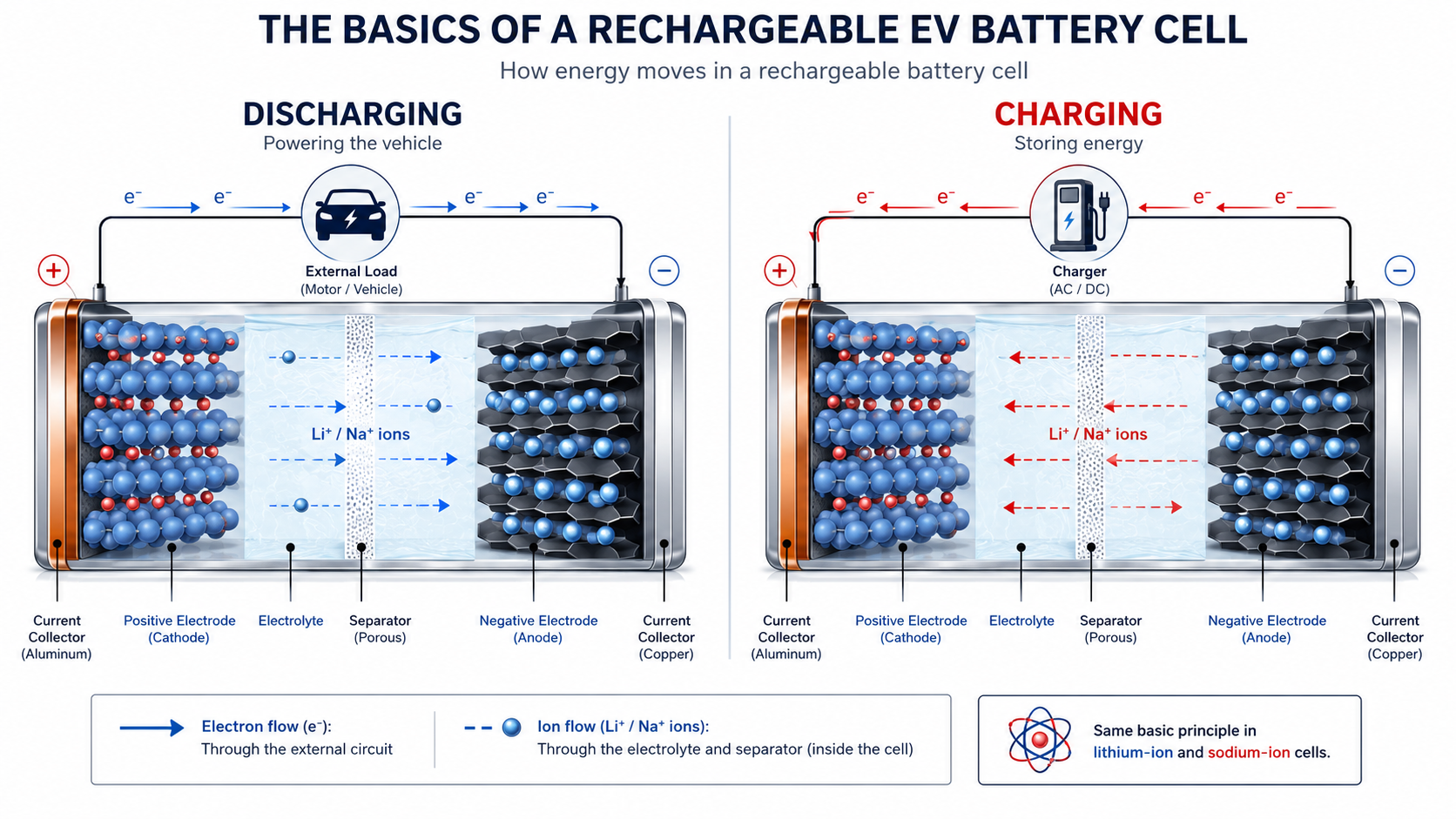
The illustration shows the shared operating principle of lithium-ion and sodium-ion cells. Lithium-ion cells move Li⁺ ions between the electrodes, while sodium-ion cells move Na⁺ ions. Their electrode materials, voltage, electrolyte, and detailed construction differ.
Voltage, current, power, and energy
These terms describe different battery properties:
- Voltage (V) is the electrical potential difference that pushes current through a circuit.
- Current (A) describes the rate of electrical charge flow.
- Power (kW) describes how quickly the battery delivers or receives energy.
- Capacity (Ah) describes how much electrical charge a cell or battery can move.
- Energy (kWh) describes how much electrical work the battery can provide.
Electrical power is calculated from voltage and current:
Power (kW) = Voltage (V) × Current (A) ÷ 1,000
The approximate nominal energy of a battery can be calculated from voltage and ampere-hour capacity:
Energy (kWh) ≈ Nominal voltage (V) × Capacity (Ah) ÷ 1,000
This is an approximation because cell voltage changes continuously with state of charge, current, temperature, and chemistry.
A high-energy battery can store a large amount of energy, while a high-power battery can deliver or accept that energy quickly. Battery design often requires a compromise between energy density, power, charging speed, durability, safety, mass, and cost.
Cell voltage and operating limits
A cell’s voltage comes from the difference in electrochemical potential between its positive and negative electrode materials.
The voltage is not constant. It changes as the cell charges and discharges, and the shape of that change depends on the chemistry.
Typical nominal values include:
- Approximately 3.2 V for an LFP lithium-ion cell
- Approximately 3.6–3.7 V for many NMC and NCA lithium-ion cells
Nominal voltage is a representative value used for calculations and comparison. The actual cell voltage moves through a wider operating range.
Each cell design has upper and lower voltage limits. Charging above the permitted maximum or discharging below the minimum can damage the cell, accelerate degradation, or create a safety risk.
The Battery Management System monitors cell voltage and keeps the battery within its permitted operating window. It also considers current, temperature, state of charge, and differences between cells.
Lithium-ion and sodium-ion
Lithium-ion and sodium-ion cells both move positively charged ions between two electrodes, but they are not interchangeable technologies.
Lithium-ion cells move lithium ions, written as Li⁺. Sodium-ion cells move sodium ions, written as Na⁺. Sodium ions are larger and interact differently with electrode materials, so sodium-ion cells require materials and designs developed specifically for sodium.
Most lithium-ion cells use graphite-based negative electrodes. Sodium-ion cells commonly use hard carbon. The positive-electrode materials, voltage, energy density, temperature behaviour, cost, and supply chains also differ.
The operating principle is therefore similar, but the resulting cell characteristics can be substantially different.
Why some energy becomes heat
Charging and discharging are not perfectly efficient. Every cell has electrical and electrochemical resistance, so some energy is converted into heat.
The resistance and heat generation depend on factors including:
- Cell chemistry and construction
- Battery temperature
- State of charge
- Charging or discharging current
- Cell age and condition
Higher current normally produces more heat. Low temperature can also increase resistance and reduce the battery’s ability to charge or deliver power.
These effects explain why an EV needs thermal management and why charging power, regenerative braking, and acceleration can be restricted when the battery is very cold, hot, nearly full, or nearly empty.
For a deeper technical walkthrough of lithium-ion cell operation, this video from The Limiting Factor provides a useful visual explanation.