
Noções básicas sobre baterias
As células de bateria recarregáveis armazenam energia quimicamente e libertam-na sob a forma de eletricidade, deslocando iões com carga entre dois elétrodos enquanto os eletrões percorrem um circuito externo. A maioria dos veículos elétricos utiliza células de iões de lítio; as células de iões de sódio seguem um princípio semelhante, mas utilizam materiais e iões portadores de carga diferentes.
Da célula à bateria
Uma célula é a menor unidade eletroquímica completa de armazenamento de energia. Uma célula produz normalmente apenas alguns volts, pelo que um veículo elétrico liga muitas células para criar a tensão e a energia necessárias.
As células podem ser agrupadas em módulos, que depois podem ser instalados numa bateria. Algumas baterias mais recentes colocam as células diretamente na estrutura da bateria, sem caixas de módulo convencionais.
A bateria completa também contém ligações elétricas, equipamento de refrigeração ou aquecimento, sensores, contactores, fusíveis, uma caixa de proteção e um sistema de gestão da bateria.
O capítulo Bateria e configuração explica como as células são ligadas e integradas fisicamente.
O que existe dentro de uma célula de bateria?
Uma célula de iões de lítio convencional tem cinco tipos principais de componentes:
- Um elétrodo negativo
- Um elétrodo positivo
- Um eletrólito
- Um separador
- Coletores de corrente para os dois elétrodos
O elétrodo negativo é habitualmente designado por ânodo, enquanto o elétrodo positivo é designado por cátodo. Estes nomes descrevem as respetivas funções durante a descarga da bateria. A literatura sobre baterias mantém normalmente as mesmas designações quando aborda o carregamento.
Elétrodo negativo
O elétrodo negativo armazena iões de lítio quando a célula está carregada e liberta-os quando a célula descarrega.
A maioria das atuais células de iões de lítio para veículos elétricos utiliza grafite como principal material do elétrodo negativo. Algumas adicionam silício para aumentar a quantidade de lítio que o elétrodo consegue armazenar. O lítio fica retido no material do elétrodo, em vez de ser armazenado como lítio metálico livre.
Elétrodo positivo
O elétrodo positivo liberta iões de lítio durante o carregamento e recebe-os durante a descarga.
O seu material ativo é um dos principais fatores que definem a química da célula. As famílias de cátodos comuns nos veículos elétricos incluem fosfato de ferro e lítio (LFP), níquel-manganês-cobalto (NMC) e níquel-cobalto-alumínio (NCA).
O capítulo Química e componentes das células explica estes materiais e os respetivos compromissos com maior detalhe.
Eletrólito
O eletrólito permite que os iões se desloquem entre os dois elétrodos.
A maioria das atuais células para veículos elétricos utiliza um eletrólito líquido que contém um sal de lítio dissolvido em solventes orgânicos. Outras conceções podem utilizar eletrólitos em gel, semissólidos, poliméricos ou sólidos.
O eletrólito conduz os iões no interior da célula. Os eletrões devem, por sua vez, percorrer o circuito elétrico externo.
Separador
O separador é uma membrana fina e porosa colocada entre os elétrodos positivo e negativo.
Impede o contacto físico direto entre os elétrodos, que poderia provocar um curto-circuito interno. Os seus poros microscópicos continuam a permitir que os iões se desloquem através do eletrólito.
Coletores de corrente
Os materiais ativos dos elétrodos são aplicados sobre folhas condutoras finas denominadas coletores de corrente. Estas folhas transportam eletrões entre os materiais dos elétrodos e os terminais da célula.
As células de iões de lítio convencionais utilizam normalmente folha de cobre no lado do elétrodo negativo e folha de alumínio no lado do elétrodo positivo. (U.S. Department of Energy)
Como funciona a descarga
Durante a descarga da célula, os iões de lítio deslocam-se do elétrodo negativo para o elétrodo positivo através do eletrólito e do separador.
Os eletrões não conseguem seguir o mesmo percurso interno através do separador. Deslocam-se do terminal negativo para o terminal positivo através do circuito externo. Este fluxo de eletrões fornece energia elétrica ao veículo. (U.S. Department of Energy)
Durante a descarga:
- O elétrodo negativo liberta iões de lítio para o eletrólito
- Os iões atravessam o separador em direção ao elétrodo positivo
- Os eletrões saem do elétrodo negativo através do respetivo coletor de corrente
- Os eletrões percorrem o circuito externo
- O elétrodo positivo recebe os iões e eletrões que regressam
Uma bateria de veículo elétrico fornece eletricidade em corrente contínua. A eletrónica de potência do veículo controla essa energia e fornece-a ao motor elétrico e aos restantes sistemas de alta tensão.
Como funciona o carregamento
O carregamento inverte o movimento dos iões e dos eletrões.
Uma fonte de alimentação externa retira eletrões do elétrodo positivo e fornece-os ao elétrodo negativo através do circuito elétrico. Ao mesmo tempo, os iões de lítio deslocam-se através do eletrólito, do elétrodo positivo de volta para o elétrodo negativo.
Durante o carregamento:
- O elétrodo positivo liberta iões de lítio
- Os iões deslocam-se através do eletrólito e do separador
- Os eletrões são retirados do elétrodo positivo
- O sistema de carregamento fornece eletrões ao elétrodo negativo
- O elétrodo negativo armazena os iões de lítio que regressam
- A energia elétrica é convertida em energia química armazenada
O mesmo processo básico ocorre durante a travagem regenerativa. O motor elétrico funciona como gerador, convertendo parte da energia cinética do veículo em energia elétrica que pode regressar à bateria.
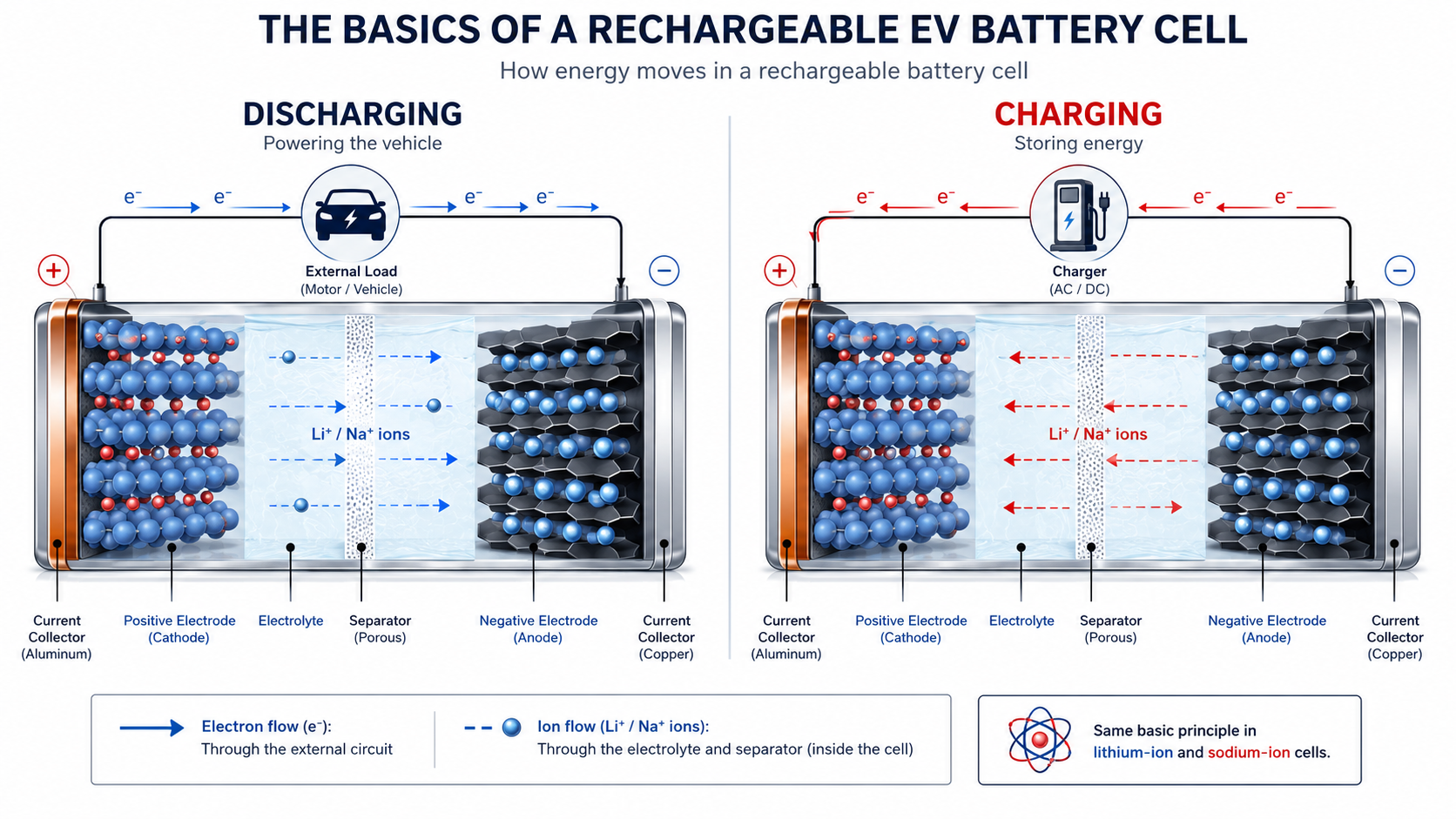
A ilustração mostra o princípio de funcionamento comum das células de iões de lítio e de iões de sódio. As células de iões de lítio deslocam iões Li⁺ entre os elétrodos, enquanto as células de iões de sódio deslocam iões Na⁺. Os materiais dos elétrodos, a tensão, o eletrólito e a construção detalhada são diferentes.
Tensão, corrente, potência e energia
Estes termos descrevem propriedades diferentes da bateria:
- Tensão (V) é a diferença de potencial elétrico que impulsiona a corrente através de um circuito.
- Corrente (A) descreve a taxa de fluxo da carga elétrica.
- Potência (kW) descreve a rapidez com que a bateria fornece ou recebe energia.
- Capacidade (Ah) descreve a quantidade de carga elétrica que uma célula ou bateria consegue deslocar.
- Energia (kWh) descreve a quantidade de trabalho elétrico que a bateria consegue fornecer.
A potência elétrica é calculada a partir da tensão e da corrente:
Potência (kW) = Tensão (V) × Corrente (A) ÷ 1,000
A energia nominal aproximada de uma bateria pode ser calculada a partir da tensão e da capacidade em amperes-hora:
Energia (kWh) ≈ Tensão nominal (V) × Capacidade (Ah) ÷ 1,000
Trata-se de uma aproximação porque a tensão da célula varia continuamente com o estado de carga, a corrente, a temperatura e a química.
Uma bateria de alta energia consegue armazenar uma grande quantidade de energia, enquanto uma bateria de alta potência consegue fornecer ou aceitar rapidamente essa energia. A conceção de uma bateria exige frequentemente um compromisso entre densidade energética, potência, velocidade de carregamento, durabilidade, segurança, massa e custo.
Tensão da célula e limites de funcionamento
A tensão de uma célula resulta da diferença de potencial eletroquímico entre os materiais dos elétrodos positivo e negativo.
A tensão não é constante. Varia à medida que a célula carrega e descarrega, e a forma dessa variação depende da química.
Os valores nominais típicos incluem:
- Aproximadamente 3.2 V para uma célula de iões de lítio LFP
- Aproximadamente 3.6–3.7 V para muitas células de iões de lítio NMC e NCA
A tensão nominal é um valor representativo utilizado em cálculos e comparações. A tensão real da célula varia num intervalo de funcionamento mais amplo.
Cada conceção de célula tem limites de tensão superior e inferior. Carregar acima do máximo permitido ou descarregar abaixo do mínimo pode danificar a célula, acelerar a degradação ou criar um risco de segurança.
O sistema de gestão da bateria monitoriza a tensão das células e mantém a bateria dentro da janela de funcionamento permitida. Também considera a corrente, a temperatura, o estado de carga e as diferenças entre as células.
Iões de lítio e iões de sódio
Tanto as células de iões de lítio como as de iões de sódio deslocam iões de carga positiva entre dois elétrodos, mas não são tecnologias intercambiáveis.
As células de iões de lítio deslocam iões de lítio, representados por Li⁺. As células de iões de sódio deslocam iões de sódio, representados por Na⁺. Os iões de sódio são maiores e interagem de forma diferente com os materiais dos elétrodos, pelo que as células de iões de sódio requerem materiais e conceções desenvolvidos especificamente para o sódio.
A maioria das células de iões de lítio utiliza elétrodos negativos à base de grafite. As células de iões de sódio utilizam habitualmente carbono duro. Os materiais dos elétrodos positivos, a tensão, a densidade energética, o comportamento térmico, o custo e as cadeias de abastecimento também diferem.
O princípio de funcionamento é, portanto, semelhante, mas as características resultantes das células podem ser substancialmente diferentes.
Por que motivo parte da energia se transforma em calor
O carregamento e a descarga não são perfeitamente eficientes. Todas as células têm resistência elétrica e eletroquímica, pelo que parte da energia é convertida em calor.
A resistência e a geração de calor dependem de fatores que incluem:
- Química e construção da célula
- Temperatura da bateria
- Estado de carga
- Corrente de carregamento ou descarga
- Idade e estado da célula
Uma corrente mais elevada produz normalmente mais calor. Uma temperatura baixa também pode aumentar a resistência e reduzir a capacidade da bateria para carregar ou fornecer potência.
Estes efeitos explicam por que motivo um veículo elétrico necessita de gestão térmica e por que razão a potência de carregamento, a travagem regenerativa e a aceleração podem ser limitadas quando a bateria está muito fria, quente, quase cheia ou quase vazia.
Para uma explicação técnica mais aprofundada do funcionamento das células de iões de lítio, este vídeo do The Limiting Factor proporciona uma explicação visual útil.