
Springs
Springs carry vehicle weight and define ride height. Explore coil, air, leaf, progressive setups, and what matters most in EVs.
Last modified: Mar 06, 2026What springs do (and what they don’t)
Springs have two core jobs:
- Support the vehicle’s weight at a chosen ride height
- Store and release energy as the wheels move over bumps
Springs do not control oscillation — that’s the damper’s job. Most ride quality complaints are really about the spring + damper pair being mismatched.
Coil springs
Coil springs are the most common in passenger vehicles.
Strengths
- Simple, durable, predictable
- Wide tuning flexibility (rate, length, shape, material)
- Lower cost and less complexity than air systems
Common tuning strategies
- Linear springs: consistent rate through travel, often preferred for predictable handling.
- Progressive springs: increase rate as they compress, helping comfort early in travel while preventing bottoming later.
Air springs (air suspension)
Air suspension uses pressurized air in a rubber bellows to support the vehicle. In most modern systems, air suspension is paired with adaptive dampers and a control unit.
Why manufacturers use it
- Adjustable ride height: lower for aero/high-speed stability, raise for snow/driveways/rough roads
- Load leveling: keeps a consistent ride height with passengers/cargo
- Comfort potential: can provide excellent isolation when tuned well
Trade-offs
- Added complexity (compressor, reservoir, valves, lines, sensors)
- Cost and long-term service considerations
- Packaging and weight penalties
Some systems primarily use air for leveling; others make height a central part of drive modes.
Single-chamber vs multi-chamber air springs
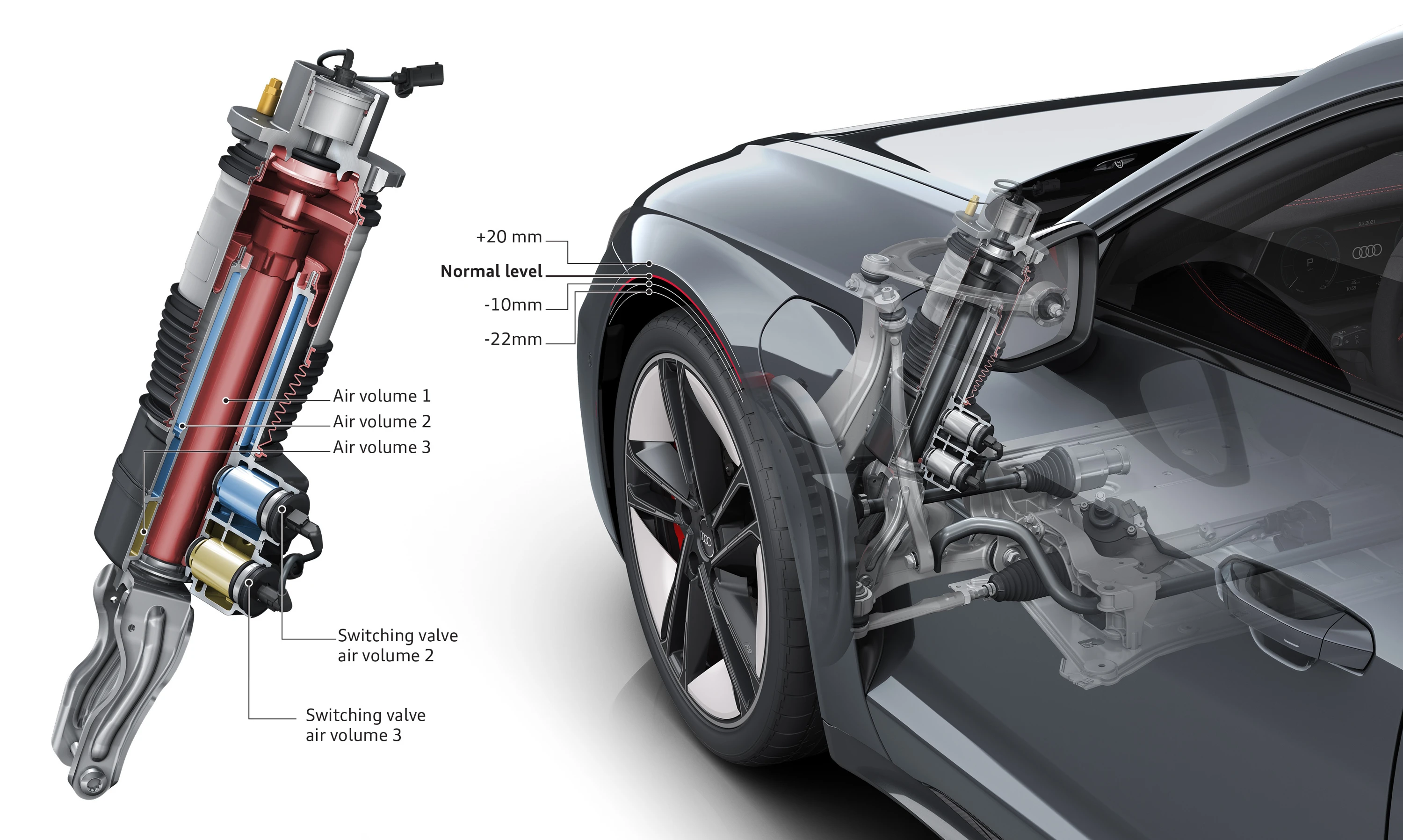
Not all air springs are the same. A simple air spring uses one air chamber, while more advanced designs use two or three chambers that can be connected or isolated with valves.
- Single-chamber: simplest design. Ride-height changes are straightforward, but the range between “comfort” and “sport” often relies more on damper tuning.
- Multi-chamber (2–3 chamber): changes the effective air volume.
- More volume (chambers connected) generally allows a softer initial spring behavior (better small-bump comfort).
- Less volume (chambers isolated) increases the effective spring rate, improving body control and reducing bottoming under load.
EVKX takeaway: Multi-chamber air springs can create a bigger difference between comfort and dynamic modes without needing extremely stiff coils.
System features that change the experience
Depending on the vehicle, air suspension can also include:
- Air reservoir: helps the system react quickly (faster height changes and smoother control).
- Interconnected / cross-linked air circuits (if used): can reduce head toss and improve comfort on uneven roads.
- Temperature compensation: important in cold climates, where air pressure behavior changes.
Leaf springs
Leaf springs are common in trucks and heavy-duty use because they handle payload well.
Strengths
- High load capacity, durable, relatively simple
Trade-offs
- Harder to achieve premium ride comfort
- More friction and “stiction” effects unless carefully designed
Torsion bars and composite springs
Less common in mainstream EV passenger cars, but worth knowing:
- Torsion bars: spring effect through twisting a bar; packaging advantages in some designs.
- Composite springs: can reduce weight and corrosion, sometimes used to cut mass.
Anti-roll bars (stabilizer bars) are “springs,” too
Anti-roll bars are effectively springs that only “work” when left and right sides move differently (cornering). They can improve handling without forcing the main springs to be overly stiff.
The downside is that very stiff anti-roll bars can reduce independence on uneven roads (one-wheel bumps).
Spring rate, ride height, and bump stops
Three practical points that define how an EV feels:
- Ride height: affects aero, comfort, and how often the suspension hits bump stops.
- Available travel: critical for comfort. Short travel + stiff rates often feels harsh.
- Bump stops: modern designs use progressive bump stops as part of the “spring system.”
- A well-tuned bump stop can feel controlled.
- A poorly tuned one feels like a sudden impact.
EV-specific spring considerations
EVs add constraints that influence spring choices:
- Mass: heavier vehicles require more support — which can mean higher spring rates or more reliance on air systems.
- Aero efficiency: lowering at speed can improve range on highways.
- Payload and towing: load leveling can be valuable for stability and headlight aim.
- Front/rear balance: EVs often have different weight distribution vs ICE equivalents, influencing front vs rear spring tuning.
What to look for in spec sheets and reviews
- “Air suspension” usually implies height control and load leveling — but the key is calibration.
- “Sport suspension” often means lower ride height and stiffer rates — not automatically better.
- If an EV rides harshly, it’s often due to short travel, big wheels, and high-speed compression damping, not spring rate alone.
Continue reading
Next up:
- Active suspension: what “active” really means, and how modern systems reduce body motion without ruining comfort