
Door Automation, Safety, and Comfort
Door features sit on top of the physical opening, handle, release path, and latch; they can reduce effort, prevent an unsafe opening, or improve access, but every automatic function also needs a clear boundary, a stop condition, and a degraded mode.
The underlying door layouts are covered in Vehicle Doors and Openings, and handle, latch, and emergency-release design in Door Handles and Emergency Access.
Assistance and automation are different
Door systems span a useful ladder:
- Warning: the vehicle detects an open door or approaching road user and alerts the occupant.
- Assistance: soft close or a servo reduces effort while the person still initiates and supervises movement.
- Powered operation: a motor moves most or all of the panel after a command.
- Automatic operation: proximity or software initiates movement without a direct press at the door.
The higher the system climbs, the more important sensing, predictable behaviour, interruption, manual control, authentication, and emergency recovery become.
Closing and movement assistance
Soft close
Soft close activates after the latch reaches a partially engaged position and pulls the panel fully shut. It solves a specific problem—closing a heavy or well-sealed door without slamming—without powering the complete opening arc.
The system should preserve ordinary manual closing if assistance is unavailable. Users should also distinguish soft close from a fully powered door; the hazards and sensing requirements are different.
Powered side doors
A powered side door controls most or all of the opening and closing movement. Commands may come from an interior or exterior switch, key, phone, voice interface, or infotainment system.

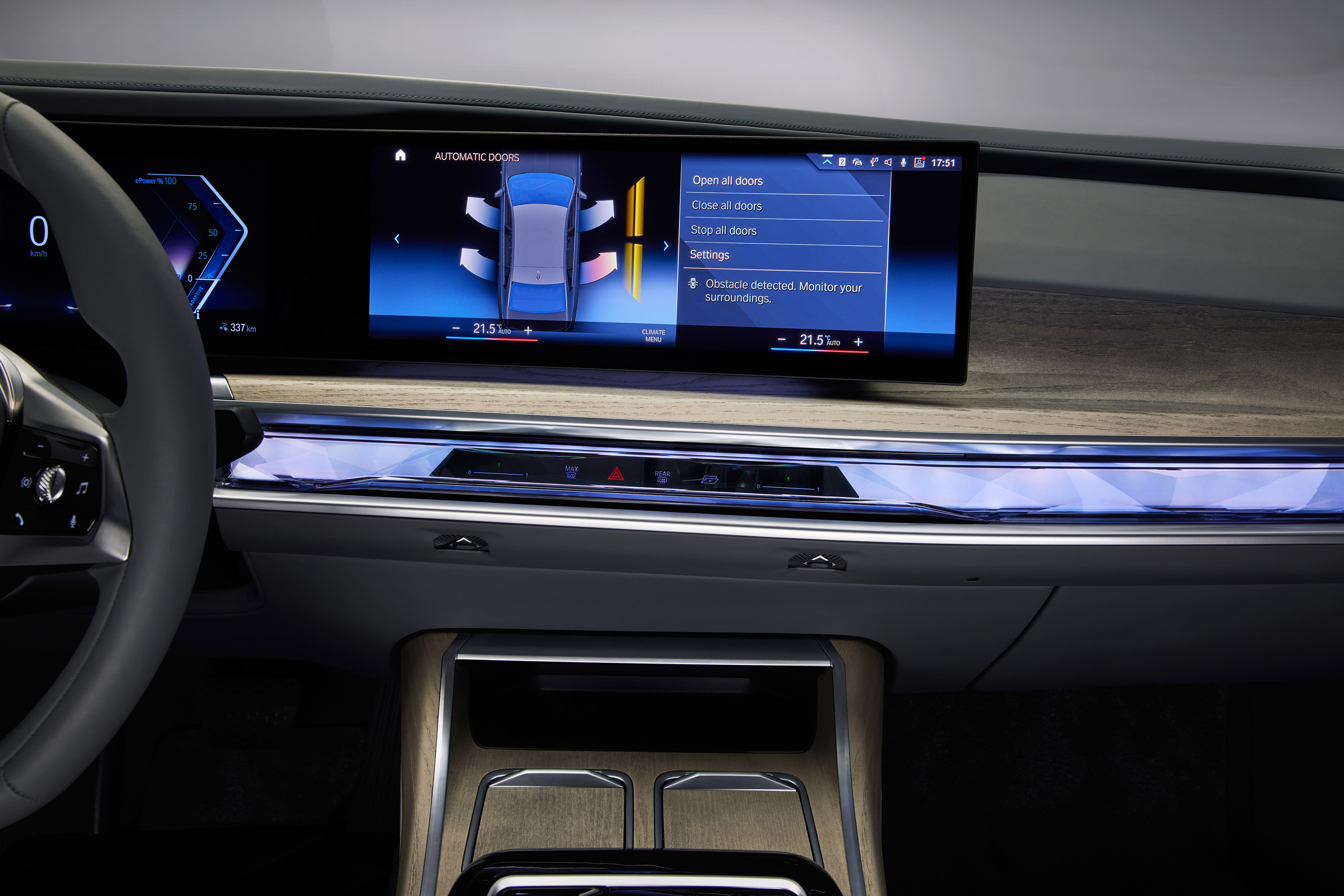
BMW’s updated 7 Series shows how far this can go: optional automatic doors use radar sensors to detect obstacles near the car and road users approaching from behind, while a servo mode still allows low-effort manual movement. The implementation matters more than the feature label. Buyers should test partial opening, manual resistance, stopping response, gradients, narrow spaces, and behaviour when a sensor is obscured.
Powered sliding doors
Powered sliding doors are especially useful because a long, heavy panel moves through a constrained track. They can improve access for families, taxis, shuttles, and wheelchair conversions without sweeping into the adjacent parking space.
Anti-trap performance matters along the leading edge and anywhere the mechanism creates a shear or pinch point. The user must also be able to stop the movement immediately and operate or secure the door after a power failure.
Powered liftgates and trunk lids
A powered liftgate moves a large panel containing structure, glass, trim, wiring, lights, and often a wiper. Adjustable opening height is valuable in a low garage; a remembered height can become a problem when the vehicle changes location.
A sedan trunk lid may be lighter and have a smaller path, but “power opening” does not always include powered closing. Buyers should verify the exact function rather than infer it from the sales name.
Powered hoods and frunks
A daily-use frunk benefits from powered operation, but the front panel has special responsibilities. It must latch securely before driving, avoid trapping hands or cargo, and remain accessible after low-voltage loss.
The control system should separate storage access from service access and prevent unintended movement while driving or when an unsafe state is detected. An interior entrapment release may also be required or provided, depending on compartment geometry and market rules.
Sensing the opening path
Obstacle detection
A moving panel can be monitored with radar, ultrasonic sensors, cameras, position sensors, motor current, edge switches, or a combination. Each observes something different:
- external sensors estimate free space before contact;
- position sensors report where the panel is in its path;
- current or torque sensing detects abnormal resistance;
- pressure-sensitive edges detect contact at a defined surface.
No sensor arrangement sees every object. Tesla’s Model X manual explicitly tells users to supervise Falcon Wing doors even though they have multiple sensors and adaptive movement. Thin poles, soft objects, hands near hinge zones, moving people, snow, and changed calibration can expose blind spots.
Anti-pinch and reversal
Anti-pinch control detects resistance during closing and then stops or reverses movement. Its usefulness depends on detection threshold, panel speed, reversal distance, and which edges are protected.
“Obstacle detection” and “anti-pinch” are not synonyms. The first may prevent contact by sensing free space; the second responds to resistance or contact. A mature system can use both.
Access and command features
Hands-free cargo access
A kick sensor, proximity key, or accurately located phone can request a liftgate or frunk opening without touching the vehicle. Authentication and intent are separate problems: knowing that the key is nearby does not always prove that the person wants a large panel to move.
A predictable system uses a deliberate gesture or dwell condition, signals acceptance before movement, and allows immediate cancellation. Trailer hitches, snow, dirt, pets, and a phone left inside can all change behaviour.
App, voice, and remote commands
Remote commands are useful for preparing a cargo opening before the user reaches the vehicle. They also increase the distance between the person issuing the command and the moving panel.
Safer designs restrict movement to Park, authenticate the user, show which opening will move, provide feedback, and stop when communication is lost or an obstacle is detected. Exterior voice control needs particular care because a nearby voice is not automatically an authorized voice.
Automatic presentation and walk-away closing
Automatic presentation partly opens a door as an authenticated user approaches. Walk-away closing moves a powered opening after that person leaves.
Both features should be configurable. Context can be ambiguous in a garage, car wash, workshop, ferry, loading area, or crowded pavement. A visible or audible pre-movement warning and an easy cancel action are more valuable than surprise-free operation in a carefully staged demonstration.
Release, locking, and emergency functions
Electric release and mechanical fallback
An electric interior button can coordinate the latch with frameless-window drop, child locking, soft close, and safe-exit intervention. It also stops working if its low-voltage supply or control path fails.
The mechanical fallback should be treated as a passenger control: visible, reachable, labelled, and described for the exact seating position. Tesla’s Model 3 manual, for example, distinguishes the normal powered release from model- and production-specific procedures for opening doors without power.
Child locks
A child lock prevents a rear door from being opened from inside. Mechanical locks are usually set at the door edge; electronic versions let the driver control one or both rear doors and may combine the function with rear-window lockout.
Electronic convenience does not remove the need for clear status. The driver should be able to see which side is locked, and an adult rear passenger should not mistake an active child lock for a failed door release.
Door-ajar and latch warnings
A useful warning distinguishes a fully latched opening from one resting on a secondary latch position. Hoods and front trunks deserve particular attention because an unsecured front panel can obstruct the windshield if it rises at speed.
The warning should identify the exact opening and remain visible when the driver attempts to select a drive mode.
Safe-exit assistance
Safe-exit systems monitor traffic approaching from behind when an occupant is about to open a side door. Implementations range from a light or audible warning to haptic feedback or a brief electronic delay.
Euro NCAP separately scores cyclist-dooring prevention. Its Audi Q6 e-tron assessment records sudden-opening prevention on all side doors, showing why reviewers should distinguish a warning on the driver’s door from intervention covering every passenger door.
A delay must still respect emergency escape. The safety case is strongest when the electronic intervention is short, clearly communicated, and overridable through an intentional mechanical action.
Comfort and visibility features
Frameless-window drop
A frameless side window commonly lowers a few millimetres before the door opens and rises into the seal after closing. This reduces seal interference and wind noise, but links door operation to glass position and low-voltage power.
Ice can prevent the glass from dropping or releasing from the seal. Owners should follow the manufacturer’s cold-weather procedure rather than forcing the door.
Sunshades and privacy
Door-mounted sunshades reduce glare and direct sunlight. Manual shades are lighter and simpler; powered shades add remote control and position memory but consume door space and add motors and guides.
A raised shade can reduce the driver’s rear-quarter view. It is also distinct from privacy glass: tinted glass is always present, while a shade can be retracted.
Access, puddle, and warning lighting
Handle lighting helps a user locate an unfamiliar flush control. Puddle lighting reveals water, snow, kerbs, and uneven ground. Edge or door-open warning lights make the open panel more visible to approaching traffic.
Lighting earns its place when it communicates location or risk. Welcome animations are secondary, and exposed lamps still need sealing against water, salt, impact, and dirt.
A practical evaluation
Test the complete system with the vehicle parked, not just the menu:
- Open each panel partially and stop it by hand and by control.
- Place a harmless soft obstacle at different heights and observe detection without creating a pinch risk.
- Try a wall, low ceiling, slope, trailer hitch, and tight adjacent parking space.
- Locate the manual release and low-voltage recovery point before they are needed.
- Check which features are standard, optional, market-specific, or tied to a subscription.
- Confirm whether a phone, key, or voice command can move a panel when the user cannot see it.
- Ask how ice, dirt, calibration loss, and a weak low-voltage battery alter operation.
- Verify that safe-exit protection covers the doors and road users relevant to your use.
Good automation reduces effort without hiding responsibility. The best door feature is one whose normal action, limits, warnings, and fallback all tell the same story.
Sources
- BMW Group: Updated 7 Series automatic doors and obstacle detection
- Tesla Model X Owner’s Manual: Powered doors and obstacle detection
- Euro NCAP: Audi Q6 e-tron cyclist-dooring prevention assessment
- Volkswagen: ID. Buzz Open & Close functions
- Tesla Model 3 Owner’s Manual: Doors
- Tesla Model 3 Owner’s Manual: Opening doors with no power