
How to protect your EV battery
Use your vehicle’s recommended daily charge limit, finish a needed full charge close to departure, and check its storage instructions before a long absence. These habits reduce unnecessary time at high charge levels while keeping enough energy available for your journeys.
Choose a daily charge limit
Start with the recommendation in the vehicle or its owner’s manual. For Model Y vehicles with a recommended daily limit of 80%, Tesla advises keeping that setting at about 80% and using 100% for longer drives. Tesla — Model Y high-voltage battery information Ford’s British-English Mustang Mach-E manual specifies 90% for the extended-range nickel cobalt manganese (NCM) batteries it covers. Ford — British-English Mustang Mach-E owner’s manual
Use the recommendation for your battery version and market. Chemistry alone does not establish the correct setting. The manufacturer also accounts for the cells, permitted operating window and battery-management strategy.
Displayed 100% marks the top of the car’s normal charge scale. Protective margins limit how far the cells can be charged and discharged, but the vehicle’s daily charge recommendation still applies. Some cars also provide accessible energy below displayed 0%. Plan the journey with a reserve above 0%, rather than relying on that extra energy. Battery buffers and usable capacity explains those boundaries.
Follow the specific instructions for LFP
Lithium iron phosphate (LFP) cells show only small voltage changes through much of their charge range. That makes charge estimation from voltage more difficult, so the battery-management system combines measurements with an estimation algorithm. Analog Devices — Considerations for Fuel Gauging Lithium-Iron-Phosphate Batteries
Ford’s manual specifies a 100% target for the standard-range LFP Mach-E batteries it covers, with a full charge at least once a month to maintain range accuracy. Ford — British-English Mustang Mach-E owner’s manual Follow the interval stated for your vehicle.
Charge-estimate calibration and cell balancing perform different tasks. Calibration corrects the estimate. Balancing changes the charge held by individual cell groups to reduce differences between them. Analog Devices — Passive Battery Cell Balancing The vehicle’s control strategy determines when balancing runs. The cell balancing chapter explains what balancing can achieve and when it can operate.
Time a full charge around the journey
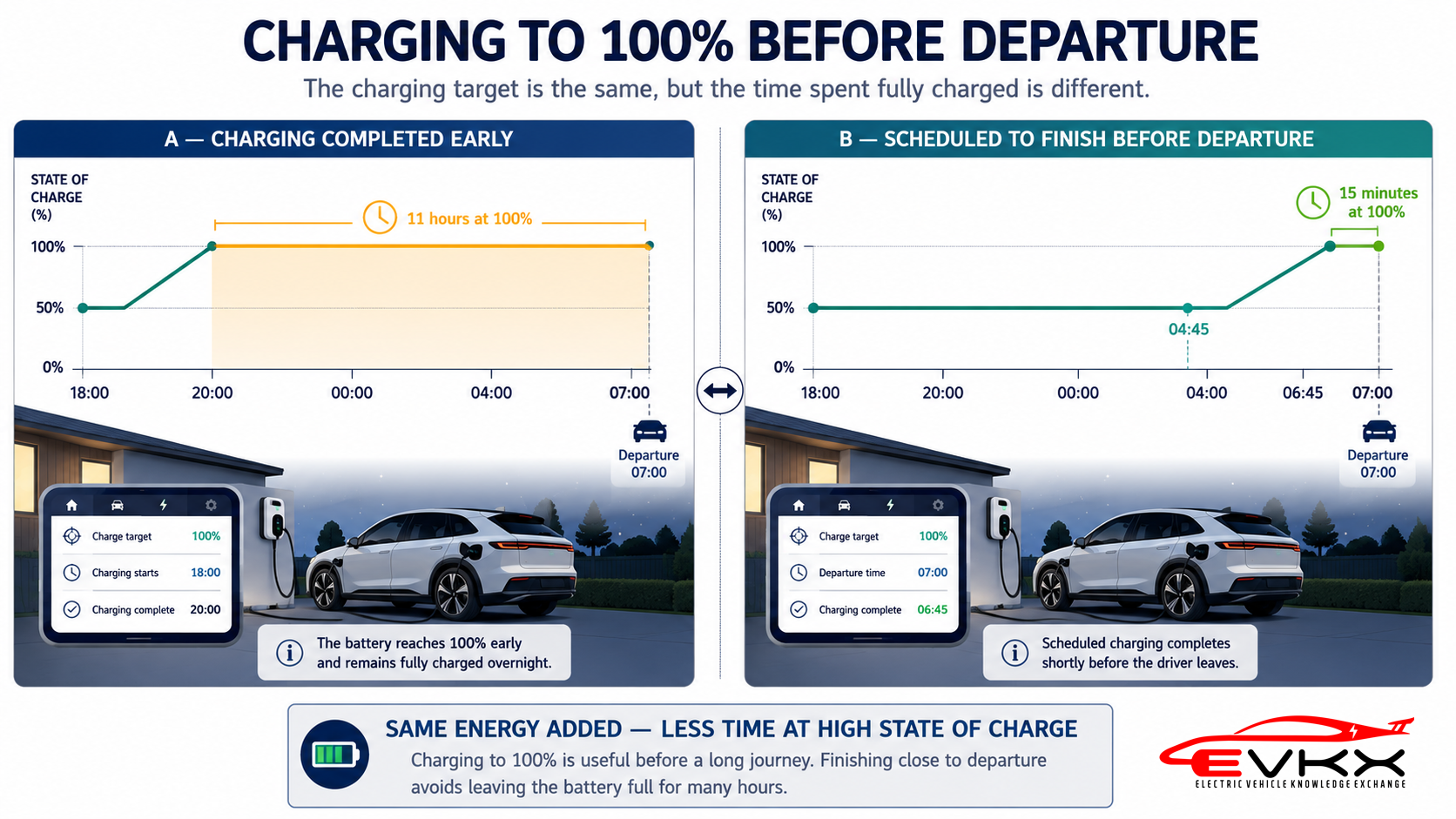
Charging to the vehicle’s full-charge target gives you the energy needed for a longer trip. When the schedule allows, arrange for charging to finish near departure, reducing the time spent parked at a high charge level. Ford’s manual describes delaying the start of charging and setting a maximum charge limit. Ford — British-English Mustang Mach-E owner’s manual
Time and temperature affect ageing. High temperatures accelerate many of the reactions that consume lithium or alter electrode materials, and high charge levels can promote some of those reactions. The relationship varies with cell design and operating conditions. Edge et al. — Lithium ion battery degradation: what you need to know A required full charge before driving and several days parked hot and full create different exposure.
Set the target around the distance, weather and charging opportunities ahead. A departure schedule can help coordinate the charge finish time. If you also use a wallbox or energy-service schedule, check that its permitted hours allow the car to reach the selected target. Smart EV Charging covers how scheduling and available power interact.
Use fast charging when the journey needs it
AC charging is a practical routine choice when the car will be parked long enough. Tesla recommends AC charging where possible and reserving Supercharging for longer drives. Tesla — Model Y high-voltage battery information The home charging guide helps match charging power to the energy you need and the time available.
High charging current increases heat generation and can make lithium transport within the cells a limiting factor. Cold cells are particularly susceptible to lithium plating if charging current is excessive for their condition. Edge et al. — Lithium ion battery degradation: what you need to know The car manages this by controlling charging power and, where equipped, heating or cooling the battery. Battery charging explains those limits.
Repeated reliance on high-power DC charging can affect long-term ageing. Geotab’s analysis dated 28 April 2026 found greater average degradation among vehicles with frequent high-power DC use. Its results describe groups of vehicles with different designs and usage histories, so they cannot forecast an individual car’s degradation or the effect of a single charging stop. Geotab — EV battery health analysis, April 2026 The detailed results and limitations are covered in Battery degradation.
At a charging stop, use the car’s charging curve and the energy needed for the next leg to choose when to leave. Power often falls as the battery fills, so continuing towards full charge can add substantial waiting time. Continue when that energy is needed to reach the next suitable charger with a reserve. For the equipment and vehicle limits that shape a stop, see DC fast charging.
Prepare the battery before arrival
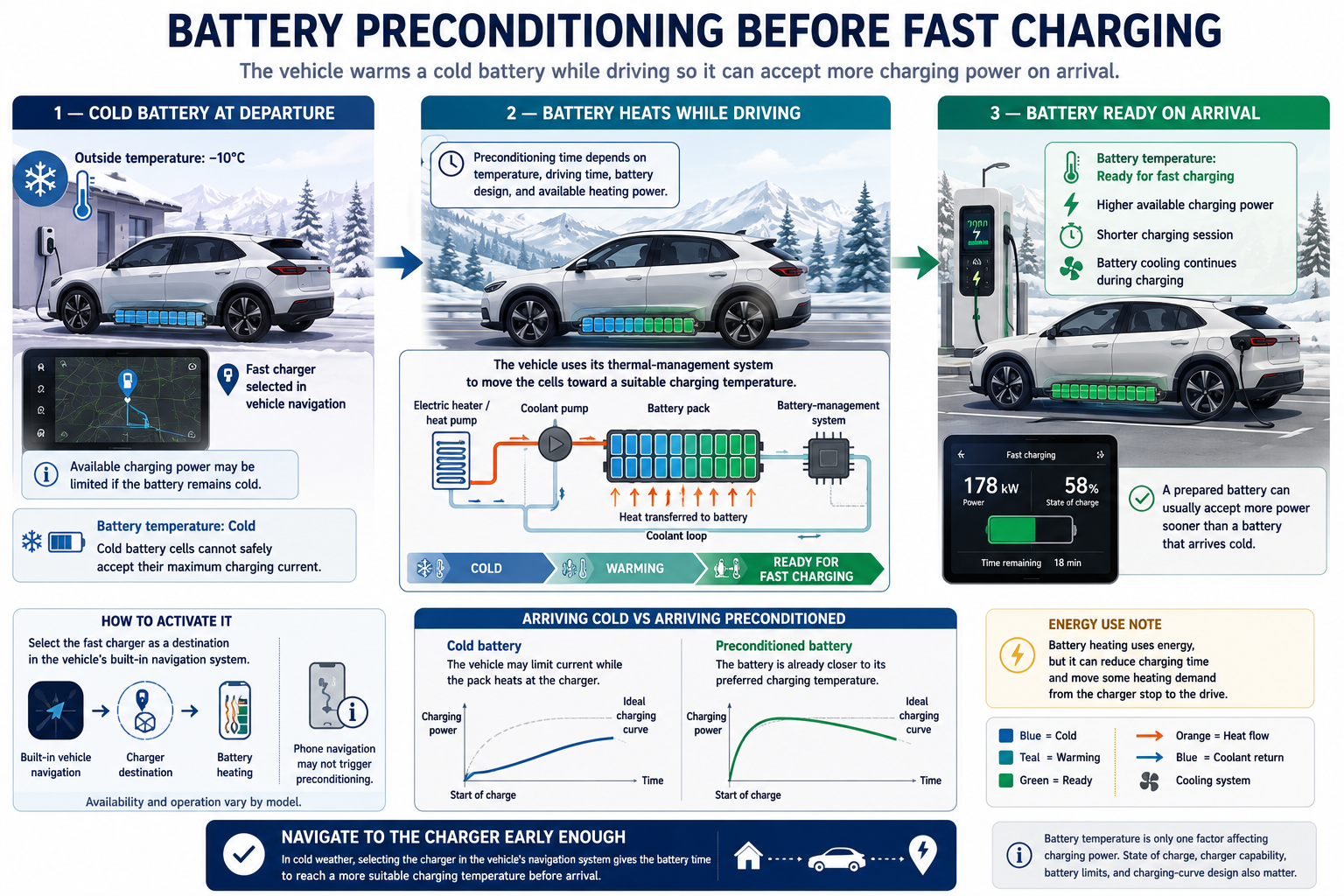
Select the charger using the vehicle’s supported route-planning function early enough for battery preparation. If the car offers manual preconditioning, use it according to the manual when the route planner is not preparing the battery. Check whether a destination selected in a phone app triggers the vehicle’s function.
Preparation can heat a cold pack or cool a hot one. Kia’s 2026 US EV9 manual explains that it takes time and consumes battery energy, and may be unavailable at low charge to preserve driving range. Kia — 2026 US EV9 battery-conditioning settings
Tesla’s Model 3 manual describes two ways to prepare the battery. Cabin preconditioning also warms it as needed before departure. Navigating to a Tesla charging location with Trip Planner prepares it for charging. If the drive is too short to complete that preparation, Tesla recommends preconditioning before leaving. Tesla — Model 3 cold-weather preparation A warm cabin alone therefore cannot tell you whether the battery is ready to accept its highest charging power.
Battery thermal management covers automatic and manual controls, low-charge restrictions and the energy used for preparation.
Plan for heat and long-term parking
For an absence lasting weeks or months, consult the storage instructions for the exact vehicle. Tesla recommends around 50% charge for prolonged Model Y storage and keeping it plugged in where possible, with the limit set to maintain that level. Tesla — Model Y high-voltage battery information Ford’s cited Mach-E manual specifies approximately 50% for storage longer than 30 days for both the NCM and LFP batteries it covers. Ford — British-English Mustang Mach-E owner’s manual
In hot weather, choose a cooler parking location when practical, and avoid leaving a hot battery unnecessarily full for a prolonged period. The reason is the additional exposure to conditions that accelerate ageing. Edge et al. — Lithium ion battery degradation: what you need to know
Allow for parked energy use. Security monitoring, climate functions and other vehicle systems can draw energy while the car is stationary. Tesla advises reducing unnecessary parked consumption and warns that leaving a depleted vehicle unplugged can eventually cause operating problems or permanent damage. Tesla — Model Y high-voltage battery information
Check the charge level before leaving the car and arrange any monitoring or recharging recommended by its manual. Plan using your vehicle’s storage guidance and allow for its active features.
Frequent charging and battery cycles
You can recharge after a short journey instead of waiting for the battery to become nearly empty. Tesla explicitly advises regular charging. Tesla — Model Y high-voltage battery information The number of times you connect a cable does not by itself measure how much the battery has cycled.
An equivalent full cycle expresses accumulated throughput against a defined capacity reference. For an illustrative energy-based calculation using discharged energy and a fixed 60 kWh reference:
Equivalent full cycles = discharged energy ÷ reference energy
Ten discharges of 6 kWh total 60 kWh, or one equivalent full cycle on this basis. Count only the discharged energy in that calculation. Other conventions use ampere-hours or include both charging and discharging with a corresponding adjustment to the denominator.
Equal cycle totals can still represent different operating conditions and wear. The charge window, temperature and current also matter. Battery degradation explains these comparisons and the distinction between calendar and cycle ageing.
If the battery seems to have lost range
A shorter journey on a charge can reflect higher consumption, reduced available energy, or both. The dashboard range estimate combines an estimate of available energy with consumption assumptions, so it is not a direct measurement of battery capacity. Compare similar routes and temperatures, including heating use, before attributing the change to permanent capacity loss. Battery degradation
For a repeatable estimate, How to check EV battery health shows how to record a drive and compare available energy with a matching reference. Follow the vehicle’s instructions for battery warnings and diagnostic checks. Tesla, for example, recommends its dedicated Model Y battery-health test on equipped vehicles only when there is a concern about energy retention. If active battery or thermal-system alerts prevent the test from running, Tesla directs the owner to service. Tesla — Model Y battery-health evaluation and test
Further viewing
These Engineering Explained videos offer further discussion of battery ageing. Use your vehicle’s manual to choose charging limits and storage settings.
How To Ruin Your Electric Car's Battery - NMC Edition!
How To Ruin Your Electric Car's Battery - LFP Edition!
Does Fast Charging Ruin Your Electric Car's Battery?
Sources
9
- Tesla — Model Y high-voltage battery information — US Model Y manual, daily charging, parked consumption and prolonged storage.
- Ford — British-English Mustang Mach-E owner’s manual — British-English Mustang Mach-E manual for vehicles built from 18 December 2023. Printed pages 156–157 cover NCM and LFP charging guidance and storage. Their footers show edition 202410, although the PDF filename uses 202310.
- Analog Devices — Considerations for Fuel Gauging Lithium-Iron-Phosphate Batteries — LFP voltage curves, hysteresis and charge-estimation methods.
- Analog Devices — Passive Battery Cell Balancing — removing charge from selected cell groups through passive balancing.
- Edge et al. — Lithium ion battery degradation: what you need to know — Edge and colleagues’ 2021 review of degradation mechanisms and operating conditions.
- Geotab — EV battery health analysis, April 2026 — fleet analysis dated 28 April 2026 using its 2025 dataset.
- Kia — 2026 US EV9 battery-conditioning settings — 2026 US EV9 manual, battery preparation, energy use and activation limits.
- Tesla — Model 3 cold-weather preparation — US Model 3 manual, departure preparation and route-based preparation for charging.
- Tesla — Model Y battery-health evaluation and test — US Model Y manual, battery-health evaluation and diagnostic-test guidance.