
Nio ES9 world premiere: the flagship that sets a new ceiling for Chinese electric SUVs
Nio has fully unveiled the ES9, the new flagship of its NT3.0 lineup and the largest mass-produced battery-electric SUV ever built in China. The reveal was split across several dates — a regulatory filing in January, official images on 7 April, and a pre-sale launch on 9 April 2026 — but the full picture is now on the table. The ES9 sits above the third-generation ES8 and takes the same NT3.0 architecture one step further, adding full active suspension, steer-by-wire and Nio's first in-house drive computing chip.
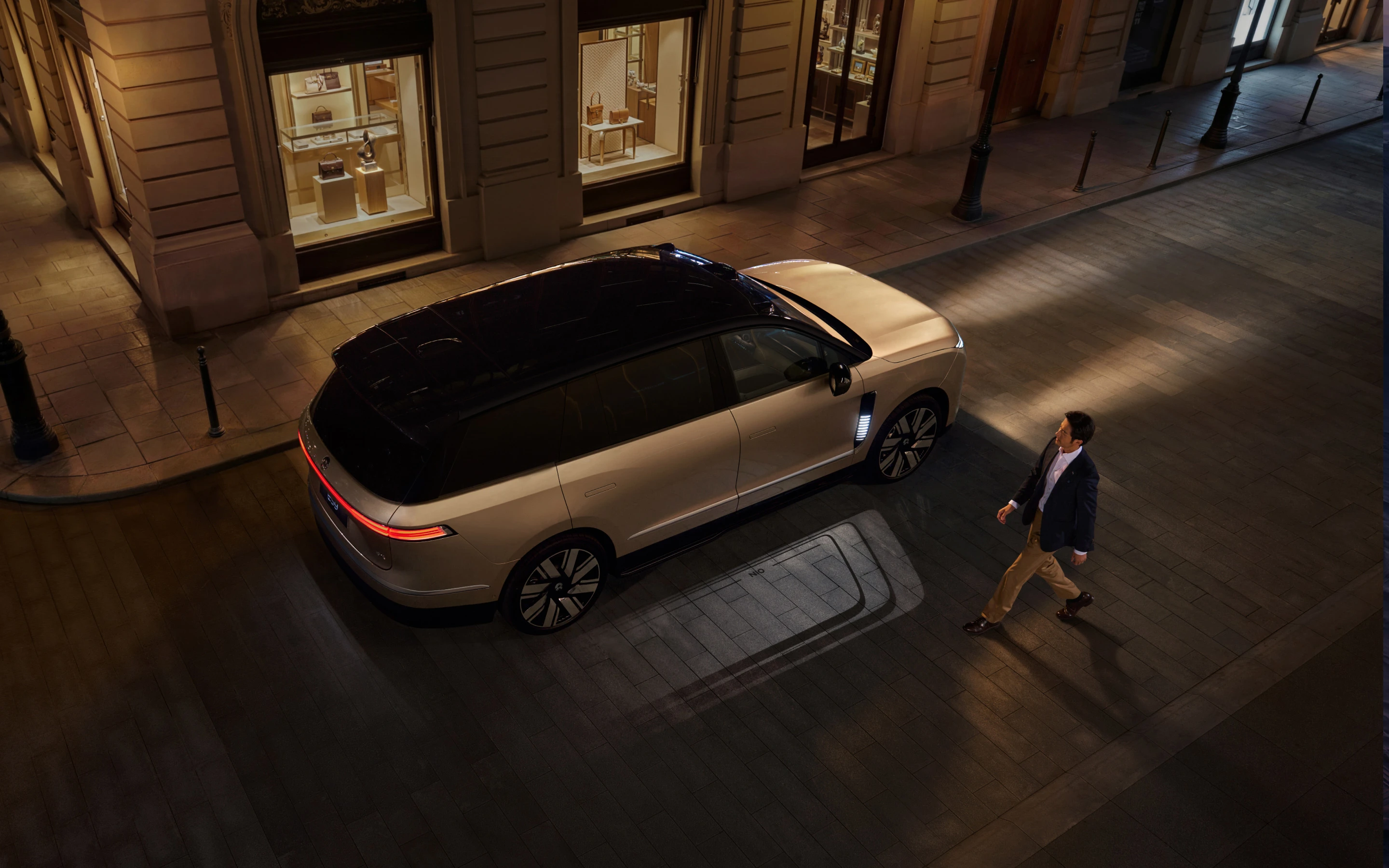
First deliveries are set for 1 June 2026 in China. Pricing starts at CNY 528,000 for the standard purchase and drops to CNY 420,000 under Nio's battery-as-a-service programme. Full technical details are on the EVKX database page at Nio ES9.
What has been confirmed
Nio has released full dimensions, drivetrain figures, three CLTC range variants, the entire suite of new hardware features and the pricing structure for both battery-purchase and BaaS buyers. That makes the ES9 one of the best-documented Chinese flagship launches of the year, even before it reaches customers.

The car is 5,365 mm long, 2,029 mm wide and 1,870 mm tall, riding on a 3,250 mm wheelbase. That makes it marginally longer than the third-generation ES8 and puts it firmly into full-size territory — larger than a Mercedes EQS SUV or a Cadillac Escalade IQ on wheelbase, and noticeably longer than the current BMW iX. Despite the size, Nio has kept the drag coefficient down to 0.264.
The internal project code is Draco, and production runs at Nio's F2 plant in Hefei, Anhui.
Platform and size
The ES9 is built on NT3.0 with a 900V full-domain high-voltage architecture — the same platform as the new ES8, but with a set of flagship-only hardware upgrades. Active air suspension is standard and runs Nio's SkyRide system, which uses individually controlled hydraulic actuators at each wheel rather than passive or semi-active dampers. Ride height is adjustable across a 60 mm range.
Steer-by-wire is standard, with a variable steering ratio and rear-wheel steering that brings the turning radius down to 5.4 metres. For a car of this footprint, that is a meaningful number — a direct practical consequence of the new hardware rather than a marketing line.
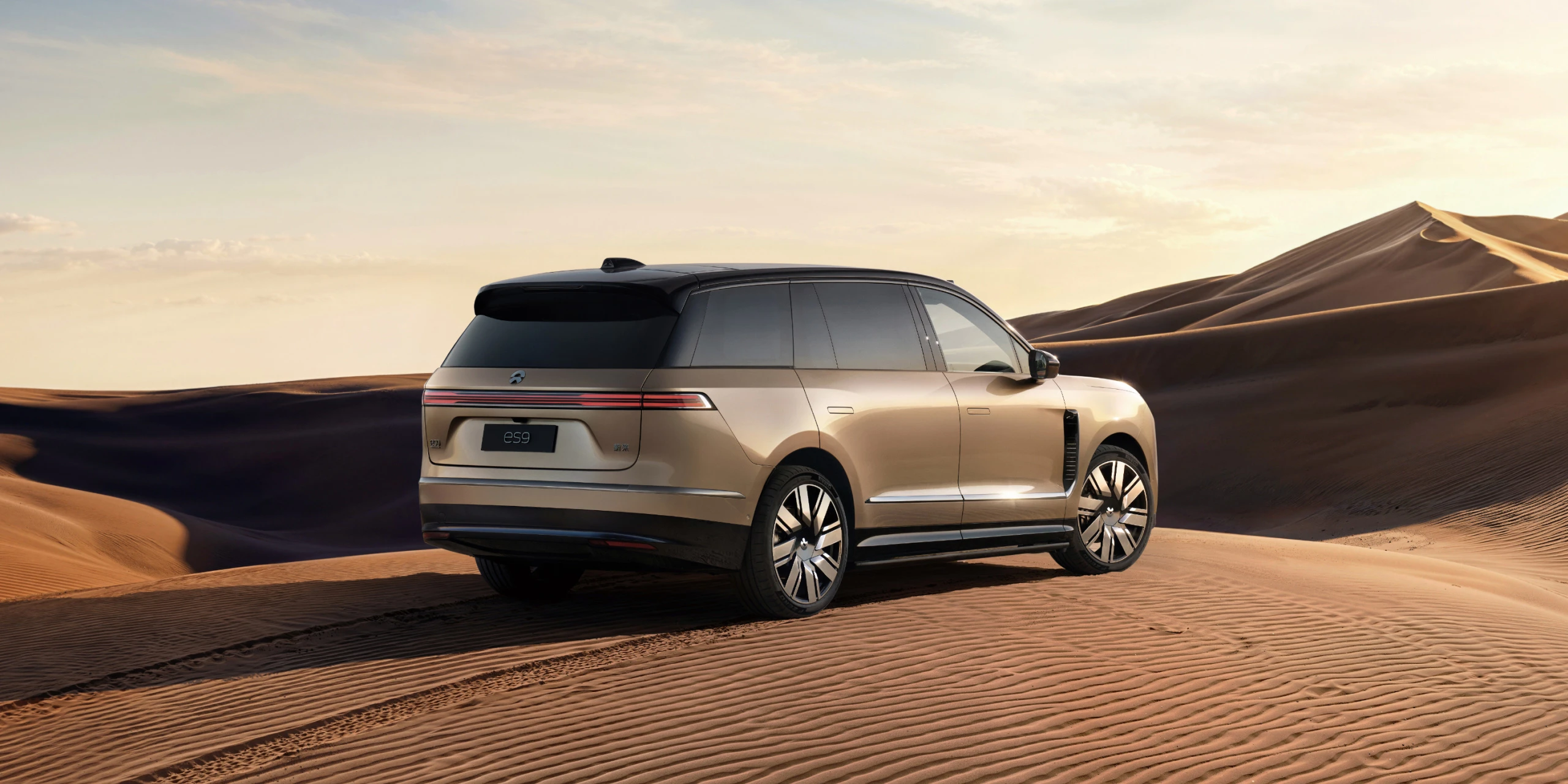
Wheel sizes go up to 23 inches, and curb weight sits between 2,845 and 2,915 kg depending on trim. Cargo volume is 477 litres behind the third row and 1,586 litres with the third row folded, with a 216-litre frunk under the nose.
Battery, charging and drivetrain
The ES9 uses a 102 kWh CATL NMC prismatic cell-to-pack battery running at a nominal 720 V. Three CLTC range ratings are offered at launch — 580, 600 and 620 km — depending on wheel and trim choice, not pack size. All variants share the same dual-motor powertrain: an asynchronous 180 kW front motor paired with a 340 kW rear permanent-magnet synchronous motor, for a combined 520 kW and 700 Nm. The car reaches 100 km/h in 4.3 seconds and tops out at 220 km/h.
Nio has not yet published a detailed DC charge curve for the ES9, but the 900V NT3.0 architecture and Nio's 5C-class charging programme suggest a peak well above 500 kW. EVKX has entered an estimated 600 kW peak curve pending official data from Fastned or Bjørn Nyland-style testing. The pack is also compatible with Nio's fourth- and fifth-generation Power Swap stations, for a three-minute station swap as an alternative to plugging in.
BaaS remains central to Nio's pitch. Customers can buy the car without the battery for CNY 108,000 less than the standard price and pay a monthly subscription instead. That pushes the entry-level ES9 below CNY 420,000, which is aggressive for a car this large.
Interior and technology
Inside, the ES9 is where Nio has pushed hardest. The main dashboard is built around a 48-inch display spanning the full width of the cockpit, supplemented by a 15.6-inch AMOLED centre touchscreen, a 130-inch AR head-up display projection, and two 16-inch rear entertainment screens mounted on the front seat backs. Audio is handled by a 47-speaker, 3,020 W system.

Seat configurations are split between six-seat (2+2+2 captain chairs) and seven-seat (2+2+3 bench) layouts. The second-row captain chairs in the six-seat version include a 42-point massage programme with a 20-point foot massage — a detail that places the ES9 well inside Chinese ultra-luxury SUV territory rather than mainstream premium.
The computing side is equally significant. The ES9 is the first Nio model to run the company's in-house NX9031 SoC for driver assistance, paired with SkyOS as the full-vehicle operating system. Nio claims the NX9031 delivers performance roughly equivalent to four Nvidia Orin-X chips, though independent benchmarks are not yet available. The ES9 runs the NAD (Nio Assisted Driving) stack with NWM (Nio World Model) and carries 31 sensors in total, including roof-mounted LiDAR, 4D imaging radar, surround cameras and ultrasonic sensors.
Twelve airbags come standard. Nio Mate 3.0 handles voice and AI interaction, and a built-in refrigerator is fitted to the centre console.
Launch timing and pricing
The ES9 was first shown in a regulatory filing on 8 January 2026, followed by official press images on 7 April and pre-sale launch on 9 April 2026. Sales start in May, with customer deliveries from 1 June 2026 in China only.
Nio has published four headline prices:
- CNY 528,000 for the entry trim with the battery included
- CNY 658,000 for the top trim with the battery included
- CNY 420,000 for the entry trim under BaaS
- CNY 550,000 for the top trim under BaaS
No European pricing or launch date has been announced. Nio continues to sell the previous ES8 generation in Norway, Germany, the Netherlands, Denmark and Sweden, but the ES9 has not been confirmed for those markets.
What is still unknown
Several details are missing from the official material. Nio has not confirmed the individual motor torque split, the exact DC peak charging speed, the weight of the 102 kWh pack, the number of LiDAR units (Nio's ET9 uses one, the ES8 has three), the specific brake dimensions, or the track widths. There is also no official WLTP range, no European homologation data, and no Euro NCAP test scheduled. The full spec page on EVKX at Nio ES9 flags these gaps and will be updated as Nio releases more information.
Whether the ES9 reaches Europe at all is the larger open question. Nio's European strategy has been cautious and the company has not yet committed to bringing its newest flagships outside China. The ES9's size — wider than 2,000 mm and longer than 5,300 mm — also makes it a difficult fit for European garages and parking regulations, even before import and homologation costs enter the picture.
This article will be updated as more details are released.