
Dampers
Dampers (shock absorbers) control spring motion and tire contact. Learn passive, adaptive, CDC/CCD, FSD, and advanced damper technologies.
Last modified: Mar 06, 2026What a damper actually does
A spring on its own will keep oscillating after a bump. The damper’s role is to control that motion, keeping the tire planted and preventing the body from floating, bouncing, or “crashing” into the bump stops.
Dampers influence:
- Ride comfort: harshness over sharp edges, and secondary body motion after bumps
- Handling: stability during braking, cornering, and rapid direction changes
- Grip: consistent vertical load = more usable traction
Compression vs rebound (and why rebound matters)
Dampers generate force in both directions:
- Compression (bump): when the suspension moves upward
- Rebound (extension): when the suspension returns downward
Many “bad ride” complaints (bouncy, floaty, hobby-horse motion) come from insufficient rebound control. Many “crashy ride” complaints come from too much high-speed compression.
Low-speed vs high-speed damping
This confuses people because it’s not vehicle speed — it’s damper piston speed.
- Low-speed damping: controls body motions (roll, pitch, squat/dive). You feel it in steering response and stability.
- High-speed damping: controls sharp impacts (potholes, expansion joints). You feel it as harshness or composure.
A great damper setup often has:
- enough low-speed control for confidence
- enough high-speed compliance to avoid harshness
Passive dampers (fixed characteristics)
Most basic dampers are “passive” — their behavior is set by internal valves, oil flow paths, and gas pressure.
Common constructions:
- Twin-tube: often comfortable and cost-effective, can be sensitive to heat in aggressive driving.
- Monotube: often sharper response and better heat management, commonly used in performance applications.
You’ll also see:
- Gas-charged dampers: reduce foaming and improve consistency.
- Hydraulic rebound stops / bump stops: add progressive resistance near the end of travel for better control.
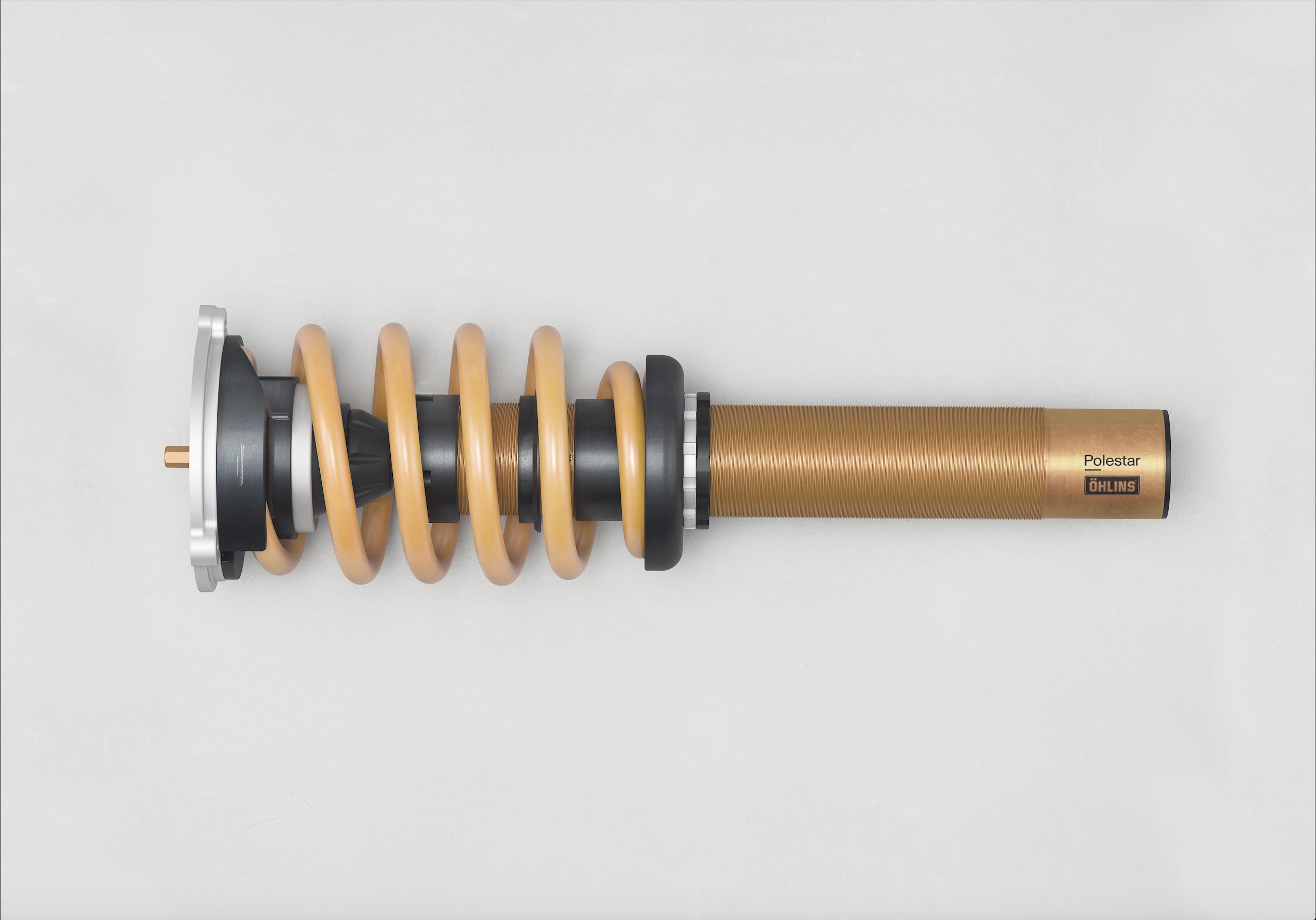
Manually adjustable performance dampers (example: Öhlins DFV on Polestar 2)
Not every “upgrade” damper is electronic. Some EVs use manually adjustable dampers, where you set the damping level with a physical adjuster (clicks) at each wheel.
A well-known EV example is the Polestar 2 Performance Pack, which uses Öhlins DFV (Dual Flow Valve) adjustable dampers. The key idea is simple:
- You can dial the damping stiffer or softer to match your roads and preferences.
- Once set, it behaves like a passive damper (it does not change automatically while driving).
What manual adjustment changes (in real driving)
More damping (stiffer setting):
- tighter body control and quicker settling
- sharper response in transitions
- can feel busier/harsh on broken pavement if overdone
Less damping (softer setting):
- better compliance over rough surfaces
- less impact harshness
- too soft can feel floaty and less controlled after big bumps
How it’s typically used
Manufacturers that offer manual dampers usually provide recommended baselines (often something like comfort / normal / track). The best approach is to:
- start from the recommended baseline,
- adjust in small steps,
- keep left/right settings identical,
- and re-test on the roads you actually drive.
EVKX takeaway: Manual adjustable dampers are an enthusiast-friendly solution that can deliver excellent results — but only if the owner is willing to tune them.
Frequency Selective Damping (FSD)
FSD is a clever middle ground: it stays purely mechanical, but changes behavior depending on the frequency of inputs.
KONI describes its FSD concept as adding an extra valve path so the damper can react differently to small, rapid road vibrations versus larger, slower body motions.
What it’s good at
- Smoother ride over small chatter
- Maintains control during bigger events (braking/cornering/large bumps)
Limitations
- Still a passive concept at heart: it can’t “anticipate” road events
- Tuning range is narrower than electronically controlled systems
Electronically controlled dampers (CDC / CCD / “adaptive”)
You’ll see many names:
- CDC (Continuous Damping Control)
- CCD (Continuous/Computer-Controlled Damping — naming varies by supplier/brand)
- Adaptive damping
- Electronically controlled shocks
The idea is consistent: a control unit changes damping by adjusting internal valves, often using:
- wheel accelerometers
- body accelerometers
- steering angle
- yaw rate
- brake/throttle inputs
- drive mode selection
Porsche’s PASM is a well-known example of continuously adjusting damper behavior to balance comfort and performance.
What you gain
- Comfortable ride without giving up body control
- Drive modes that feel meaningfully different
- Better composure across mixed surfaces
What can still feel “off”
- Some systems chase comfort but allow too much vertical motion (float)
- Some systems chase control but become busy or harsh on broken pavement
- Calibration matters as much as hardware
Magnetorheological (MR) dampers
MR dampers use a fluid whose viscosity changes under a magnetic field. They can react very quickly and are often praised for response and control. (Brand naming varies widely across the industry.)
Strength
- Very fast adjustments
- Wide range between comfort and control
Trade-offs
- Higher cost
- Long-term service/parts pricing can be higher
High-end performance dampers (spool valves, multi-stage)
In motorsport-influenced designs, you may see:
- Spool-valve dampers
- Multi-stage / position-sensitive damping
- Remote reservoirs
These can deliver remarkable control, especially at the limit, but they’re expensive and are typically found in performance variants.
EV-specific damper tuning considerations
EVs create unique calibration targets:
- Regen deceleration: can mimic light braking repeatedly; poor tuning can feel like continuous dive/return.
- Heavy wheel/tire packages: common on EVs and increase the demand on high-speed damping.
- Quiet powertrain: makes damper “thumps,” top-out noises, and bushing inputs more obvious.
- Thermal consistency: heavy vehicles on mountain roads can heat dampers — monotube designs and better oil management help.
What to look for when shopping or comparing
When a brand says “adaptive suspension,” try to identify:
- Is it adaptive damping only, or air + damping, or active roll control too?
- Does it have road preview (camera/radar-based) or only reactive sensors?
- Are the drive modes meaningful, or mostly steering/throttle changes?
Also look for cases where a car offers manual adjustment instead of electronic control — it can be excellent, but it’s a different ownership experience.
Continue reading
Next up:
- Springs: coil vs air, progressive rates, load leveling, and range/comfort trade-offs
- Active suspension techniques: semi-active vs truly active, with modern examples