
Jeep Avenger

The Jeep Avenger is an all-electric crossover offering a WLTP range of up to 404 km (251 miles). EVKX.net has all the details you need.
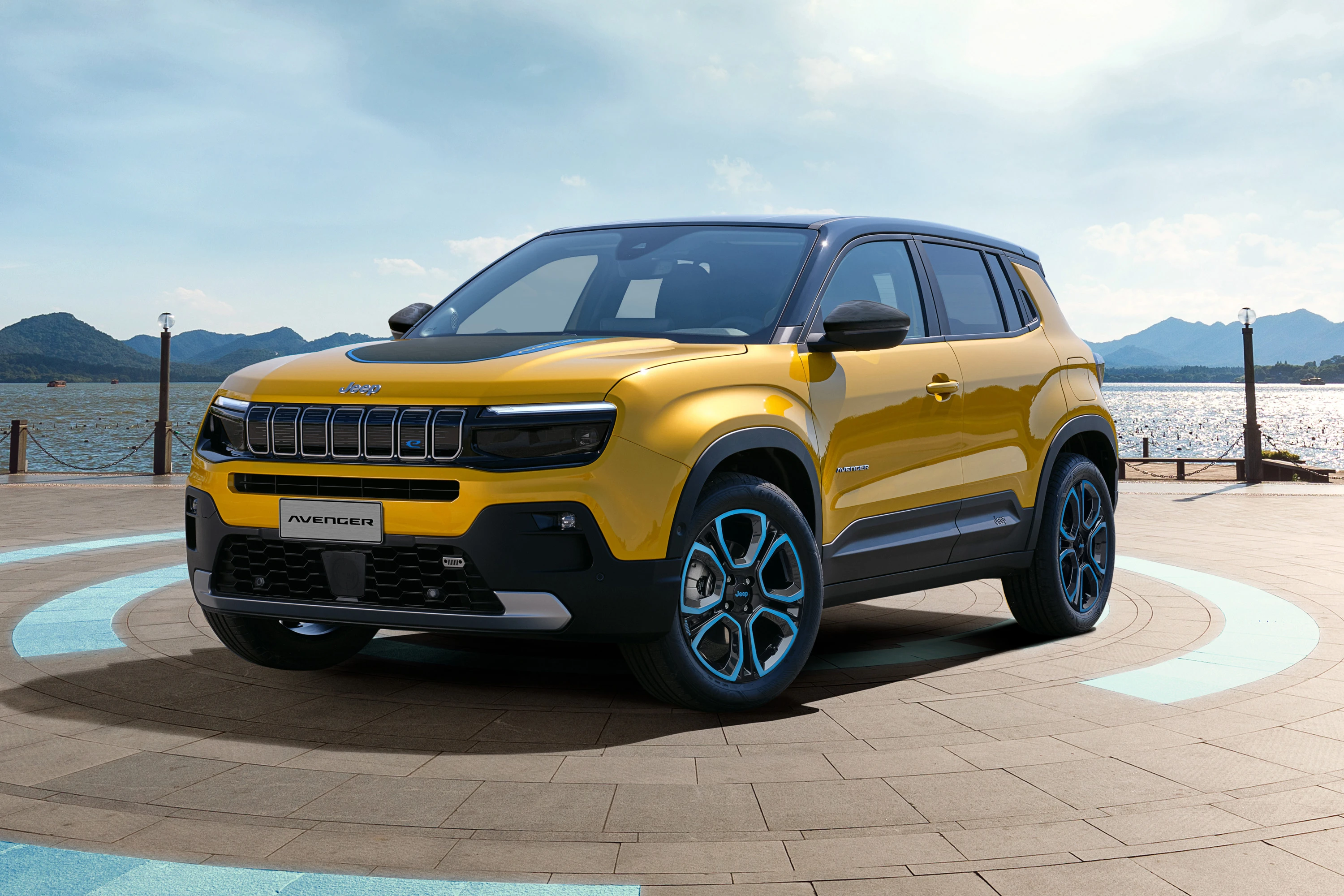
Jeep Avenger
We've organized this article into specific sections for easier navigation. Click the links below to jump to different areas or read on for the full article. Additionally, we offer an overview of the full specifications, an image gallery, detailed information about charging performance, and some online reviews. Our sections include:
Performance
The Jeep Avenger has a maximum power of 115 kW (156 hp / 154 bhp) and a total torque of 260 Nm (192 lb-ft). It accelerates from 0 to 100 km/h (0 to 62 mph) in 9 seconds and reaches a top speed of 150 km/h (93 mph).
Battery, Range, and Charging
The battery has a gross capacity of 54.0 kWh and a net usable capacity of 50.8 kWh, with a 3.2 kWh buffer (5.9%) for battery protection. With a nominal voltage of 377 volts, the system is classified as a 400-volt battery system, aligning with industry standards.
This Lithium-Ion battery utilizes NMC (Nickel Manganese Cobalt) technology.
Under the WLTP (Worldwide Harmonized Light Vehicles Test Procedure) standard, the vehicle's range varies between 404 to 385 km (251-239 miles), depending on the specific configuration and options, such as wheel size. Larger wheels can increase energy consumption and subsequently reduce the overall range.
The vehicle's energy consumption is rated at 12.6 kWh/100 km for the base model and 13.2 kWh/100 km for the top-tier model under the WLTP test cycle.
For more details about the range, see real-world data and range listings on this model’s range and consumption page.
The vehicle supports fast DC charging with a maximum power of 100 kW. Charging from 0% to 100% takes approximately 54 minutes, while a typical 10% to 80% charge takes about 29 minutes with an average charging speed of 73 kW.
Considering an additional 5 minutes for each charging stop due to driving interruptions, the optimal charging range is from 2% to 60%. This results in an effective charging speed, including time lost, of 68 kW, with each charging session taking about 26 minutes and 10 seconds.
In a 1000 km challenge at a constant speed of 120 km/h (75 mph) with an assumed consumption rate of 22 kWh/100 km, the trip would take about 10 hours and 51 minutes, needing six charging stops from 2% to 58%, totaling 152 minutes of charging time.
Onboard Charger
The standard onboard charger supports up to 11 kW for Level 1 and Level 2 AC charging, allowing a full 0–100% charge in about 4 hours and 37 minutes with a standard home setup.
Charge Port
The charge port is located on the left rear side, making it easy to use charge stations where you need to back up into the charger.
Connector types vary by market: this model uses CCS Combo 1 in North America and CCS Combo 2 in Europe. For complete specifications for all markets, refer to the full specifications.
Drivetrain
The Jeep Avenger has a front-wheel drive system supported by one motor on the front axle.
The motor used is Permanent Magnet Synchronous Motor.
Suspension
The suspension system features a MacPherson strut front construction and a torsion beam rear construction. Both the front and rear dampers are monotube dampers, providing consistent performance and durability. The front and rear springs are coil springs, offering a balance of comfort and performance.
The Standard suspension has a fixed height and damping characteristics.
Ground clearance with this setup is 200 mm.
Drive Modes
The Jeep Avenger lets the user select different drive modes that affect the car's handling.
The driver can choose between 6 modes:
- Eco: Comfort steering and throttle.
- Normal: Balanced steering and throttle.
- Sport: Dynamic steering and throttle.
- Sand: Balanced steering and throttle.
- Snow: Comfort steering and throttle.
- en drivetrain.drivetrain.drivemodes_steeringResponse:Balanced_throttle:Dynamic
Brakes
The Jeep Avenger is equipped with cast-iron disc brakes on both the front and rear.
The front discs measure 302 mm, while the rear discs are 268 mm.
Regenerative Braking
Regenerative braking is available in two modes. You can use one-pedal driving or you can coast and use the blended brakes to regen.
However, it is not considered full one-pedal driving since, at low speeds, the vehicle will keep rolling until it comes to a stop by itself.Drivers can also adjust the regenerative braking strength when lifting off the accelerator. There are two levels of regenerative braking to choose from, allowing you to customize the driving experience to your preference.
The maximum regenerative braking power is 46 kW.
Exterior
The Jeep Avenger, with dimensions of 4084 mm in length, 1776 mm in width, and 1528 mm in height, falls into the B-SUV segment cars, also known as subcompact SUVs or crossovers, offer a combination of the compact size and maneuverability of B-segment cars with the higher driving position, increased cargo space, and rugged styling of an SUV.
The Jeep Avenger is available in a total of 5 solid paint colors.
The Jeep Avenger offers multiple wheel options in different sizes, allowing you to customize your vehicle to suit your style and driving preferences. The available tire and wheel combinations include:
- 215/60 tires on 17" rims
- 215/55 tires on 18" rims
Narrower wheels improve consumption and provide a longer range, while wider wheels offer better traction and handling.
The car has four regular doors and a liftgate.
The liftgate is electric-powered and has a kick-sensor as standard.
There is only one roof option for this model.
The standard is just a regular roof.
Additionally, you can order the car with tinted windows from the B-pillar backward, which enhances privacy and reduces glare and heat from the sun, making the interior more comfortable for passengers.

Jeep Avenger
Interior
There is one seat type you can select in different materials.
Seats
The Jeep Avenger accommodates five passengers with two front seats and a three-seat bench in the rear.
First Row Seats
The Jeep Avenger offers a single type of front seat.
The following functionalities are available on the standard seat:
- Fore-and-aft adjustment (manually adjustable, electrically adjustable as an option)
- Recline adjustment (manually adjustable, electrically adjustable as an option)
- Heating (optional)
- Adjustable lumbar support (electrically adjustable as an option)
- Massage (optional)
Available in:
- Black fabric upholstering
- Black leatherette upholstering
- Gray Nappa leather upholstering
- Black Nappa leather upholstering
Second Row Seat
The second row features a standard three-seat bench with a 60:40 split, allowing each section to fold separately to increase cargo space.
Additional functionalities include:
Interior Storage
The Jeep Avenger has the following interior storage:
- Cupholders: Two cupholders are located in the front center console, with an additional two in the rear armrest.
Interior Lighting
The Jeep Avenger offers several interior lighting options.
- en interior.light..white.roof
Climate System
There is one climate system available:
- 1-zone climate system: Supports only controlling one shared zone for the whole car.
A standard heat pump reduces heating energy use in cold weather.
Comfort Features
The Jeep Avenger includes several features to enhance comfort and convenience:
User Interface and Control
The control interface of the Jeep Avenger combines physical buttons, steering column stalks, and touchscreen displays.
This model features a dual-screen layout, separating key driver information from infotainment and vehicle controls for a more structured user experience.
Key screen details:
- en uicontrols.screen.info.BehindSteeringWheelInDash.
- A touchscreen is centrally placed on the dashboard.
A standard head-up display projects key driving information—such as speed and navigation cues—onto the windshield for enhanced safety and convenience.

Jeep Avenger
Steering Wheel
The Jeep Avenger is equipped with a single type of steering wheel:
The steering wheel is adjustable for both tilt and telescope. The adjustment is manual.
Design: Circular flat-bottom
Controls: Physical buttons
Heating: Available as an option
From the steering wheel you can control:
- en uicontrols.controls.media
- **Phone Controls:** Buttons on the steering wheel allow you to answer, end, and manage phone calls.
- **Voice Control:** A button on the steering wheel activates the voice control system.
- **Cruise Control:** A stalk or button on the steering wheel allows you to set and adjust the cruise control speed.
Mirrors
Both the exterior and interior mirrors use conventional mirror technology to provide a clear view of the area behind the vehicle.
Infotainment
en infotainment.os.Uconnect
Navigation System
The built-in navigation system uses detailed maps and offers advanced route planning. The system provides real-time traffic information ensuring an efficient and stress-free journey.
Phone Mirroring
The Jeep Avenger supports Android Auto and Apple CarPlay, allowing you to mirror your phone's screen on the car's display. This functionality enables you to run apps like Google Maps or Waze directly from your phone.
Sound System
The Jeep Avenger has one sound system option:
- Standard Audio: Features six speakers.
Additionally, the model includes 1 USB-C connections as standard.The model has 1 USB-A connections as standard.
Mobile App
The Jeep Avenger has a mobile app for Android and iOS to manage and monitor the vehicle remotely. Features:
- Locate Your Vehicle: Easily check the current location of your car.
- Preconditioning: Preheat or cool your car before you start your journey for optimal comfort.
- Lock & Unlock: Securely lock or unlock your car doors with a tap.
- Scheduled Charging: Plan and schedule charging sessions ahead of your trips.
- Adjust Charging Target: Set your desired State of Charge to start or stop charging as needed.
- Find Your Car: Trigger the horn or lights to help find your car in crowded areas.
- Route Planning: Plan your route and send it directly to your car's navigation system.
Lights
The Jeep Avenger uses LED Matrix headlights. LED Matrix splits the headlight beam into multiple smaller rays that the controller can turn on and off individually to avoid dazzling other drivers.
The taillights use LED technology.

Jeep Avenger
Advanced Driver Assistance Systems
The Jeep Avenger offers standard and optional advanced driver assistance systems (ADAS).
Safety Systems
Anti-lock Braking System (ABS): Standard on the Jeep Avenger, this system prevents the wheels from locking during braking.
Electronic Stability Control (ESC): Standard on the Jeep Avenger, this system improves the vehicle's stability and handling during sudden maneuvers or on slippery road conditions.
Lane-Keeping Assist (LKA): Standard on the Jeep Avenger, this system helps prevent the vehicle from drifting out of its lane.
It also includes a Lane Departure Warning system to alert the driver if the vehicle veers out of the lane.
Front Cross Traffic Assist (FCTA): Standard on the Jeep Avenger, this system helps detect oncoming traffic when crossing an intersection or turning from a stopped position.
Rear Cross Traffic Alert (RCTA): Standard on the Jeep Avenger, this system uses sensors to detect approaching vehicles from the side when backing out of a parking space or driveway.
Forward Collision Warning (FCW): Standard on the Jeep Avenger, this driver assist system helps drivers avoid or mitigate frontal collisions.
Automatic Emergency Braking (AEB): Standard on the Jeep Avenger, this system autonomously applies the brakes to prevent or reduce the severity of a collision if the driver does not react in time.
Blind-spot Monitoring (BSM): Standard on the Jeep Avenger, this system helps detect traffic in blind spots.
Driving Automation
The Jeep Avenger offers driving automation at level 1, depending on the equipment level.
With the Jeep Active Driving Assist level 1 system, you get the following driving automation features.
Safety
The Jeep Avenger is equipped with multiple airbags to ensure occupant protection in the event of a collision. The airbag system includes:
- Front airbags for the driver and front passenger
- Side curtain airbags for both the first and second rows
- Side airbags for the driver and front passenger
Security and Access Technologies
The Jeep Avenger is equipped with advanced security features to protect you and your vehicle. These include:
- Keyless Entry and Start: Unlock and start the car with the key in your pocket or bag.
- Alarm System: An integrated alarm system monitors for unauthorized entry or tampering, providing alerts to help deter intrusions and keep your vehicle secure.
Cargo Capacity and Towing Ability
The trunk offers a cargo capacity of 355 liters (12.5 CU FT). With the rear seat folded down, this expands to 1050 liters (37.1 CU FT).
The vehicle’s maximum weight is 2025 kg (4464 lbs), with a base weight of 1520 kg (3351 lbs). This allows for a maximum load of 505 kg (1113 lbs), including the driver and passengers. Note that some options may increase the base weight and reduce the maximum loading capacity.
This model is not available with a towbar. So, to pull a trailer, you must look at other models.
Availability & Pricing
The Jeep Avenger had its world premiere on 10/17/2022, with deliveries starting in January 2023.
More information
Alternative Models
In the rapidly expanding EV market, EVKX.net has identified several alternatives to the Jeep Avenger that are worth considering based on features, specifications, and pricing.
Compare These Vehicles
Most sold EVs in USA
Q2 2025 · Quarter