
Charging Loss
Charging loss is the difference between the electrical energy supplied during a charging session and the increase in energy stored in the traction battery. The result depends on where the supplied energy is measured.
Where the measurement is taken
For AC charging, a meter on the dedicated charging circuit includes energy used by equipment downstream, including the onboard charger that converts AC to DC. A whole-house meter also includes unrelated household consumption, which must be excluded from a charging comparison.
A DC measurement at the vehicle connector excludes the station's upstream AC-to-DC conversion losses. Vehicle-side losses and energy used by heating, cooling and other systems still separate connector-delivered energy from stored battery energy. ADAC: measurements of EV charging losses For station operation and planning a charging stop, see DC Fast Charging.
OIML G 22, an international guide to measuring charging energy for billing, defines an effective metering point at the connection: the vehicle connector for a fixed cable, or the charging equipment's socket for a detachable cable. This is the boundary the measurement represents; the meter itself may be elsewhere. OIML G 22: Electric vehicle supply equipment metrology
Where energy goes
The onboard charger's conversion of AC to DC is a major source of AC charging loss. Resistance in cables and cells produces additional heat. The vehicle's controls also remain active during charging, while battery heating or cooling may use extra power. All of these contributions count as charging loss when supplied energy is compared with the increase in stored battery energy. ADAC: measurements of EV charging losses
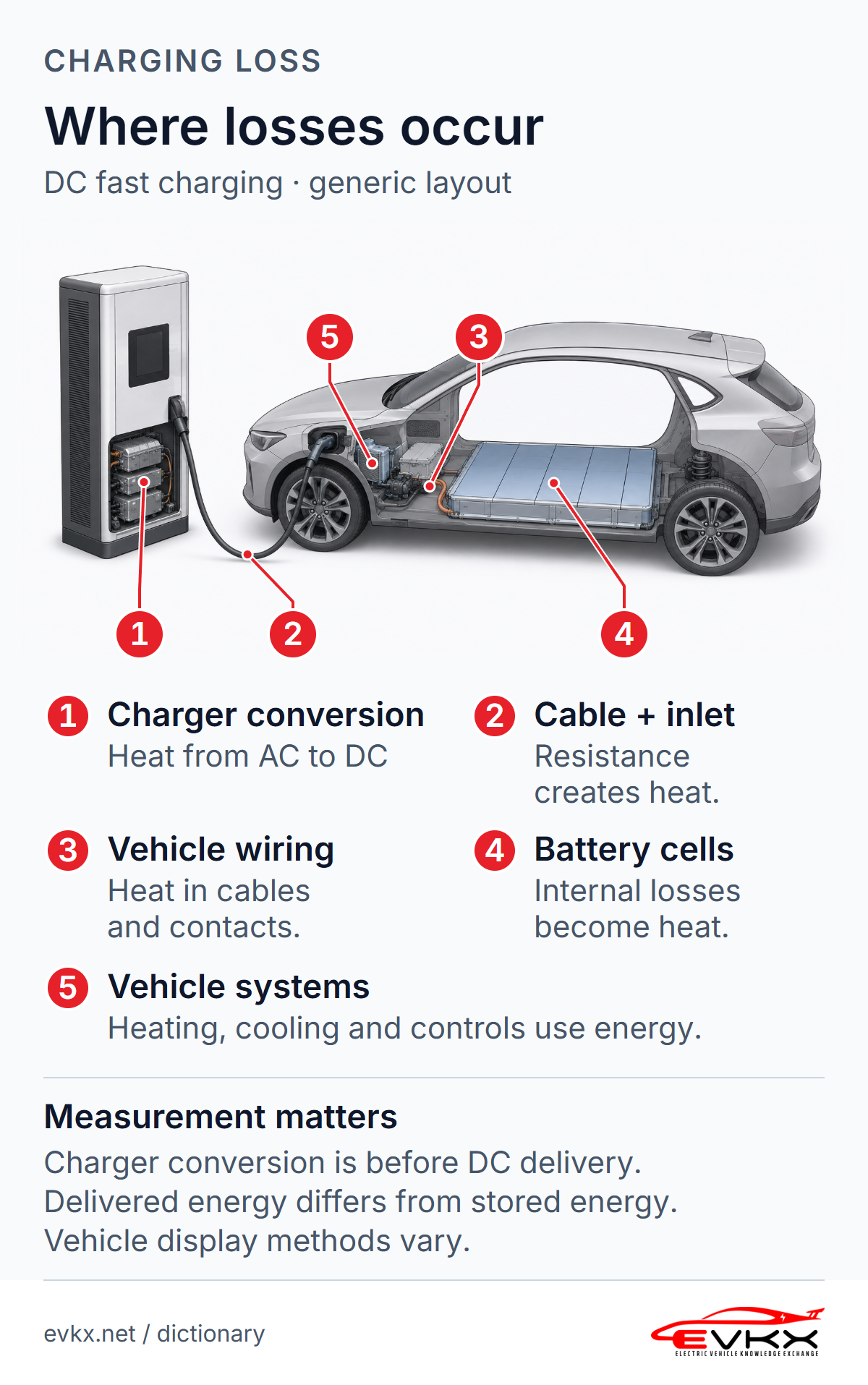
Loss varies with the equipment and conditions. A longer session keeps supporting systems running for longer, so reducing charging power can increase their share of the energy supplied. Battery temperature also affects conditioning demand. ADAC: measurements of EV charging losses See Home EV Charging for measured AC examples and practical charging settings.
Calculating and comparing loss
Use energy measurements over the same interval and state the upstream measurement point:
Charging loss = energy supplied − increase in stored battery energy
For an illustrative session with 50 kWh supplied and a 45 kWh increase in stored energy, the loss is 5 kWh. Dividing that loss by the 50 kWh input gives a 10% loss; charging efficiency is 45 ÷ 50 = 90%.
Stored-energy increase is difficult to establish from the dashboard alone. Displayed state of charge is an estimate, and the battery capacity used in the calculation must match its accessible energy and condition. Multiplying a displayed percentage change by a nominal capacity gives only an estimate of the energy added.
EVKX's charging-time calculations, on vehicle pages and in Range & Travel Calculator charging stops, apply a fixed 5% reduction to charger-side power when estimating the rate of stored-energy increase. This is a modelling assumption, not a measured loss for a particular vehicle or session.
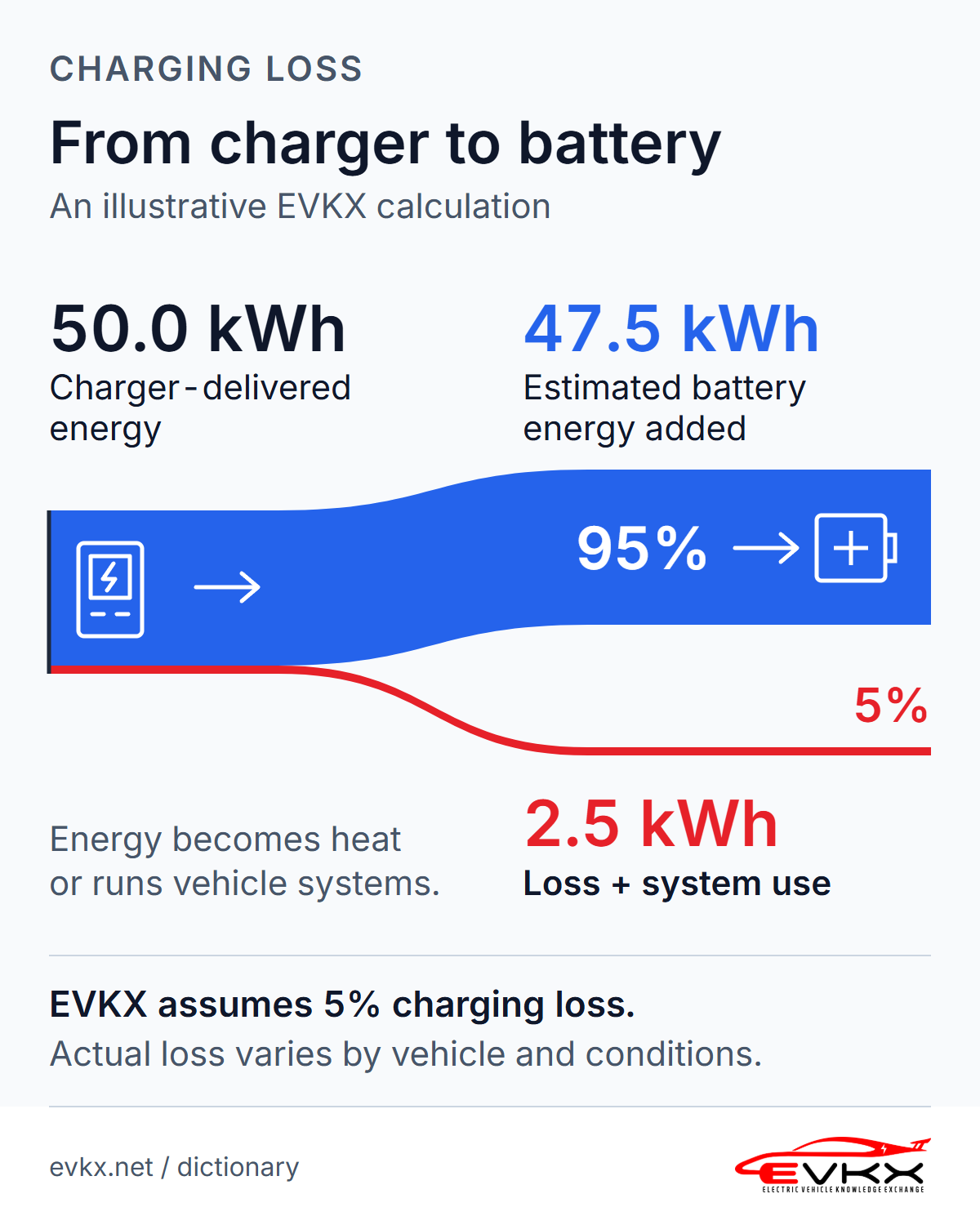
When estimating costs from consumption, check its basis: battery-side consumption excludes charging losses, while U.S. EPA label electricity consumption already includes wall-to-vehicle charging losses. Adding another allowance to an inclusive figure would count them twice. U.S. EPA Automotive Trends Report 2022: Appendix E
Sources
6
- OIML G 22: Electric vehicle supply equipment metrology — connection-point definitions and metering guidance.
- NIST Handbook 44: Electric vehicle fueling systems — U.S. commercial EV charging measurement requirements.
- ADAC: measurements of EV charging losses — AC and DC tests, August 2026; measured losses and their causes.
- U.S. EPA Automotive Trends Report 2022: Appendix E — label electricity-consumption boundary, Appendix E.
- U.S. EPA: Fuel economy and EV range testing — vehicle range and consumption testing.
- U.S. Department of Energy: EVSE efficiency — charging-equipment efficiency.