
CUPRA Raval makes its world premiere as the brand's first urban EV
CUPRA has pulled the covers off the Raval, the brand's first electric urban car and the first production model on the Volkswagen Group's new entry-level MEB+ architecture. The world premiere took place on 9 April 2026, with deliveries planned for the summer. It is also the first EV from the Spanish brand built outside the existing MEB B-segment-and-up family that gave us the CUPRA Born and Tavascan.
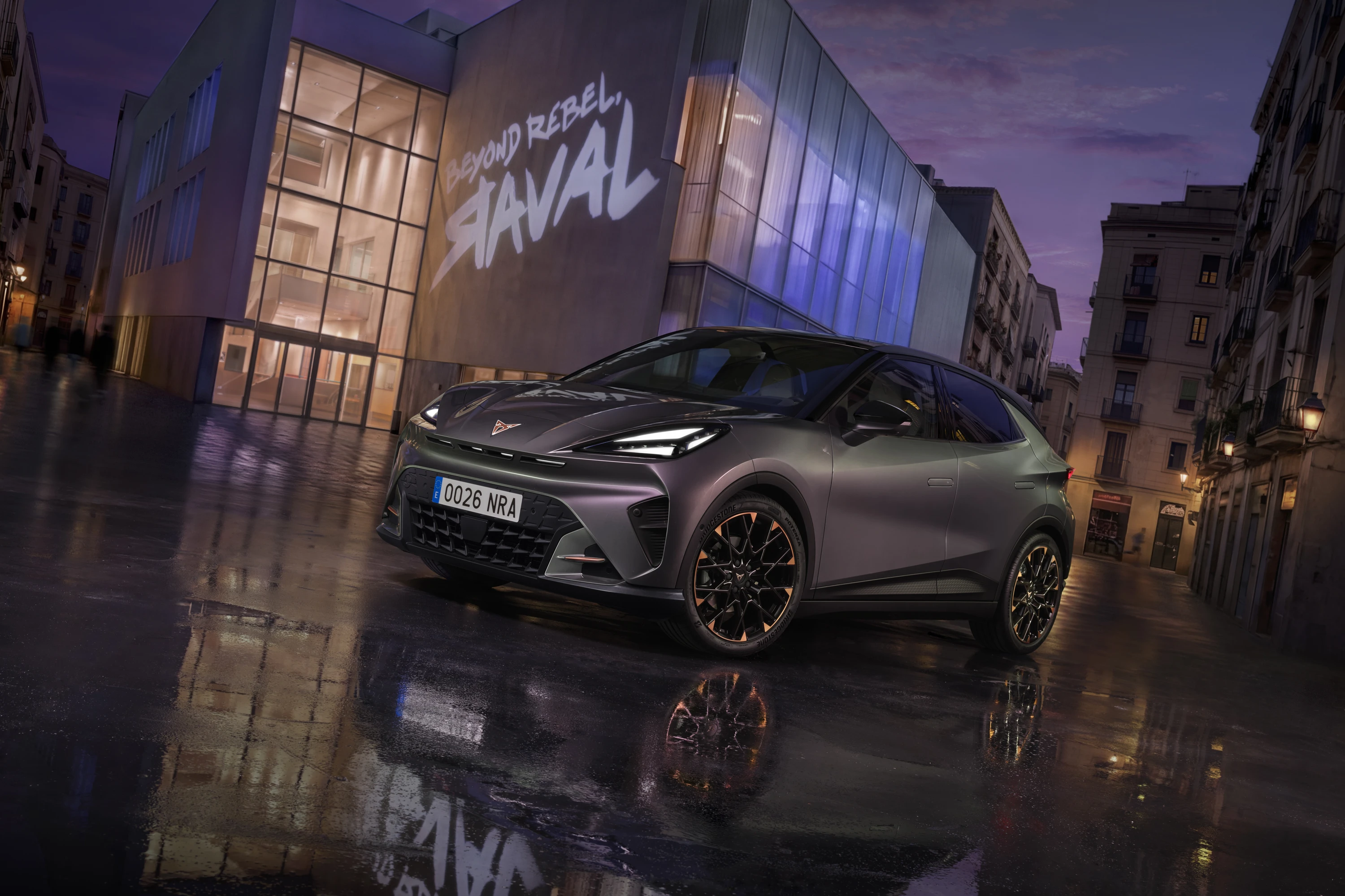
The Raval shares its underpinnings with three other VW Group models that are arriving over the next year: the Volkswagen ID. Polo, the Volkswagen ID. Cross, and the Skoda Epiq. CUPRA is first out of the gate with the production version, and it is positioning the car as the sportier and more aggressive interpretation of the platform.
What CUPRA confirmed at the premiere
The launch lineup is built around three trims: Dynamic, Dynamic Plus, and VZ Extreme. All three use the same 52 kWh NMC battery and a single front-mounted motor. A smaller 37 kWh LFP "Smart Efficiency" version has been confirmed for September 2026, but it was not part of the launch event.
In powertrain terms, that gives four distinct cars: the CUPRA Raval and CUPRA Raval Plus on the 37 kWh LFP pack, and the CUPRA Raval Endurance and CUPRA Raval VZ on the 52 kWh NMC pack.
Production is at the SEAT plant in Martorell, Spain. CUPRA has not yet released the full European price list, but UK figures put the entry trim under £23,000 and the VZ Extreme at around £35,705. Pre-orders open shortly after the reveal, with first customer deliveries in July 2026.
Platform and size
The Raval rides on the MEB+ entry-level platform, which is the Volkswagen Group's answer to the question of how to build an affordable electric supermini without sharing components with existing combustion cars. It is a front-motor, front-wheel-drive layout, which is a notable change from the rear-motor MEB cars CUPRA has been building until now.
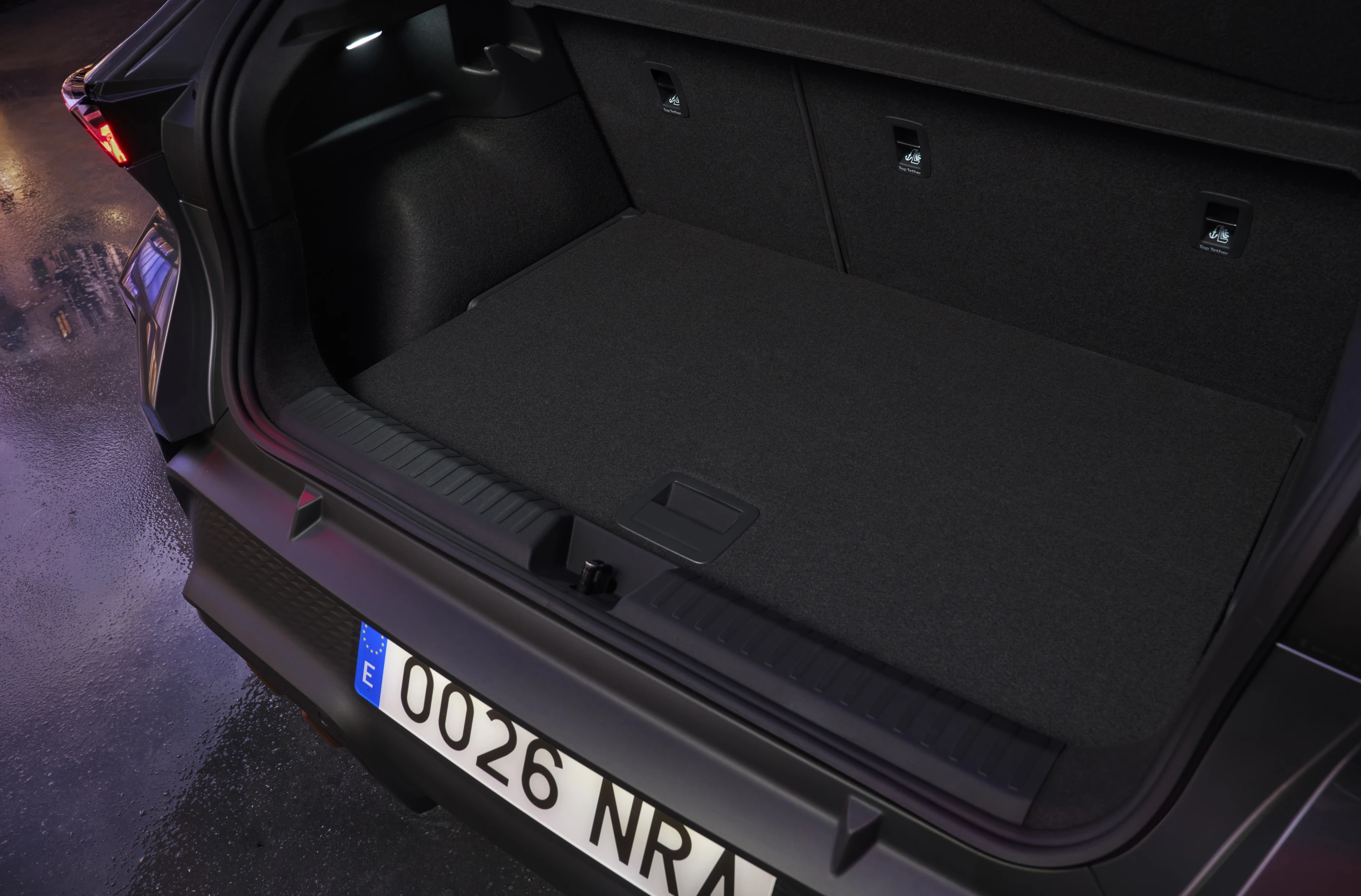
Externally, the car is 4,046 mm long, 1,784 mm wide, and 1,518 mm tall, on a 2,600 mm wheelbase. That puts it in the same B-segment footprint as the Renault 5, the Peugeot e-208, and the upcoming Volkswagen ID. Polo. Boot capacity is quoted at 430 litres, which is meaningfully larger than what the CUPRA Born offers in a much bigger car.
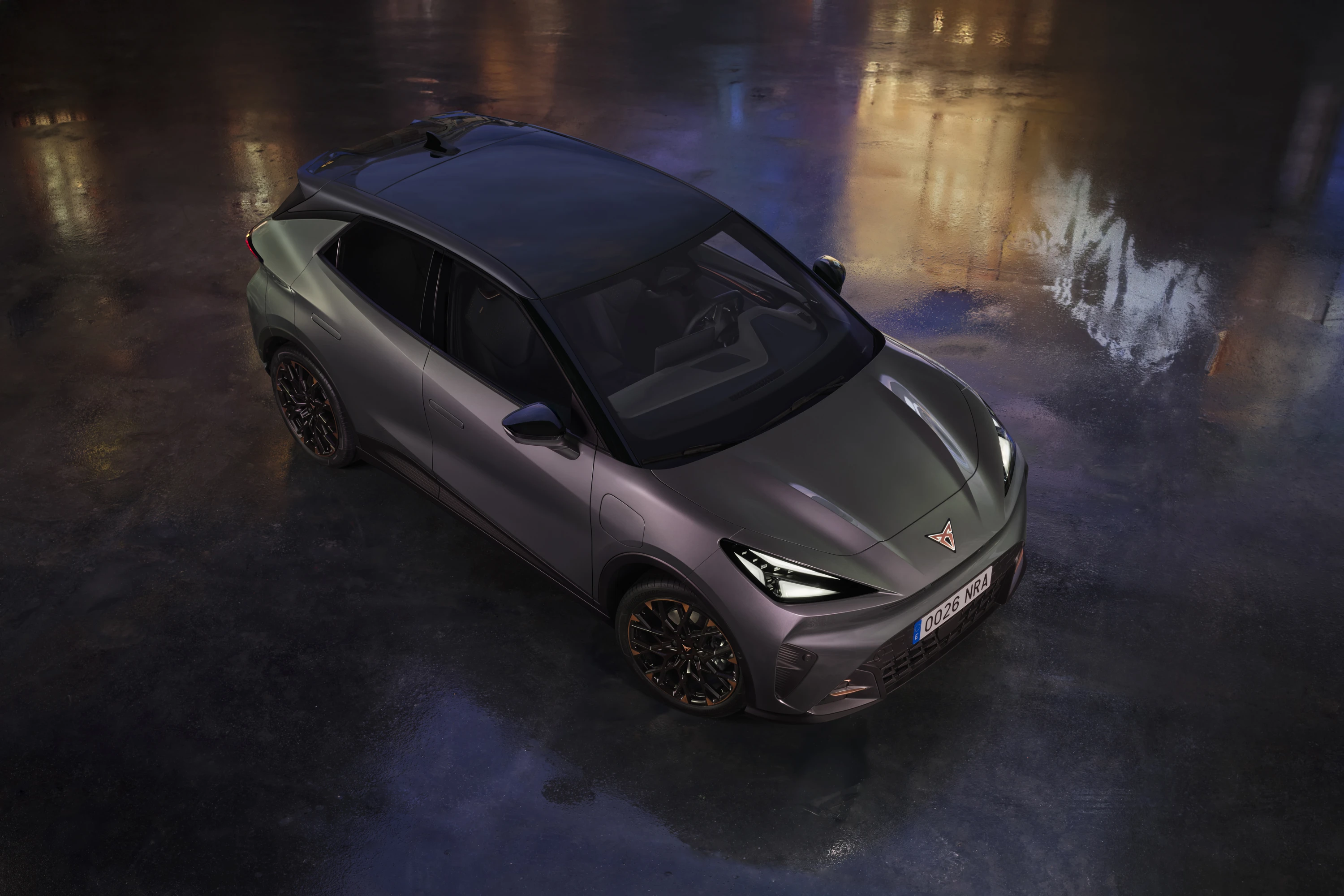
The styling carries over the prominent "sharknose" front end from the show car, with backlit air intakes, tri-LED matrix headlamps, full-width 3D rear lights, and flush door handles that extend and illuminate as the driver approaches. The body sits on 18-inch wheels in the base Dynamic trim and 19-inch wheels on Dynamic Plus and VZ Extreme.
Battery, charging and range
The launch trims all use a 52 kWh NMC battery. CUPRA quotes a WLTP range of 446 km for the CUPRA Raval Endurance, and 440 km for the CUPRA Raval VZ. DC charging peaks at 105 kW, and CUPRA says a 10–80% top-up takes around 24 minutes.
Those figures are in line with what the MEB+ platform was designed to deliver, but they are not headline-grabbing. The Raval is not chasing the 800-volt fast-charge crowd. The focus is on cost and packaging rather than peak charging power.
The smaller 37 kWh LFP battery arriving in September 2026 has been confirmed with up to 115 kW DC charging. CUPRA has not yet quoted a WLTP range or a power figure for that variant, but third-party reporting points to a motor in the 116 hp class and a range a little under 300 km.
VZ Extreme and the case for performance
The CUPRA Raval VZ is the most interesting car in the lineup, and the one most clearly aimed at CUPRA's existing customer base. It uses a 166 kW (226 hp) front motor with 290 Nm of torque, and CUPRA quotes a 0–100 km/h time of 6.8 seconds. Top speed is electronically limited to 175 km/h (108 mph).
The hardware is the genuinely interesting part. The VZ Extreme gets an e-VAQ electronic limited-slip differential on the front axle, DCC Sport adaptive dampers, a chassis lowered by 15 mm, and a track widened by 10 mm relative to the standard car. It rides on 19-inch REBEL wheels with 235-section tyres and Cup-bucket seats trimmed in 3D Knit fabric.
This is a pattern that Cupra has used before with the CUPRA Born VZ — push the front axle hardware as far as it can go, lean into the chassis tuning, and avoid the weight and cost of an all-wheel-drive layout. Whether that approach works on a 1.5-tonne front-wheel-drive supermini against rivals like the Alpine A290 will depend on how well the front diff manages the available torque on a tight road.
Interior and technology
The cabin pairs a 10.25-inch driver display with a 12.9-inch central touchscreen. CUPRA has confirmed Travel Assist 3.0 with predictive adaptive cruise control, an Emergency Assist system, and the brand's Smartlight Next Gen ambient lighting system. The Sennheiser AMBEO sound system rated at 475 watts is offered higher up the range.
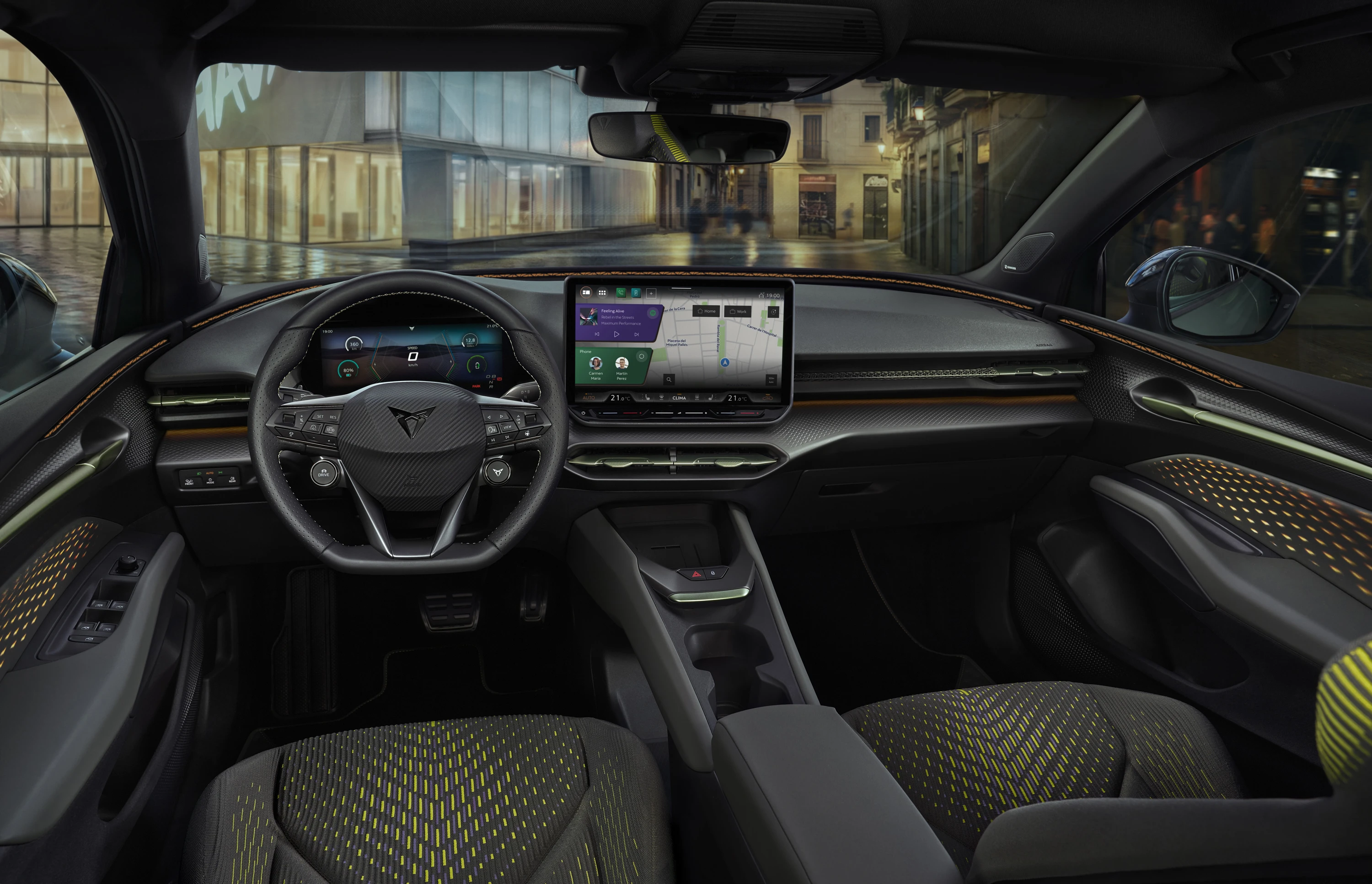
One detail worth flagging is that the dashboard includes projectors that throw drive-mode-linked animations onto the trim. It is the kind of feature that will divide opinion, but it shows that CUPRA is willing to use the small-car cabin as a place to try ideas the brand cannot easily put into the CUPRA Born or Tavascan.
Seating uses Dinamica bucket designs in the launch trims, with vegan leather upholstery and integrated lateral and central seat airbags. Material choice is part of the brand pitch: CUPRA is presenting the Raval as a car for buyers who want something younger, more design-forward, and more sustainable than the traditional supermini playbook.
Launch timing and pricing
CUPRA has confirmed the world premiere date (9 April 2026), the production location (Martorell, Spain), and a summer 2026 delivery window. UK pricing is the most detailed so far: from £22,785 for the entry car, with the VZ Extreme topping out at around £35,705. European prices in euros have not been published yet.
The Smart Efficiency variant with the 37 kWh LFP battery is scheduled for September 2026, and a 19-inch ICON wheel option is listed for week 36 of 2026 onwards. That timing implies a staggered rollout rather than a single launch wave.
What is still unclear
CUPRA has not yet published a full technical data sheet for the Raval. The most important gaps:
- Exact kerb weight per variant
- Battery gross capacity and chemistry confirmation for the 52 kWh pack (NMC has been reported but not formally specified)
- Onboard AC charger rating (11 kW is expected; 22 kW availability is unclear)
- WLTP range and motor power for the 37 kWh Smart Efficiency variant
- Heat pump availability across the trim ladder
- Detailed Euro NCAP results — the car has not yet been tested
- Full European pricing in euros, and confirmation of which markets get which trims at launch
Most of these will be filled in over the next few weeks as CUPRA opens the configurator and the first press cars reach reviewers. The shape of the lineup is now clear: a small EV that prices below £23,000 at the bottom and crosses £35,000 at the top, with a real performance variant that uses front-axle hardware rather than a second motor to make its case.
On EVKX
All four Raval powertrain variants — CUPRA Raval, CUPRA Raval Plus, CUPRA Raval Endurance and CUPRA Raval VZ — are now in the EVKX database. The entries hold what CUPRA has confirmed so far: dimensions, drivetrain layout, motor power, WLTP range on the 52 kWh trims, the 105 kW DC peak, and UK launch pricing. Each variant page can be opened side by side with the CUPRA Born, the upcoming Volkswagen ID. Polo, or any other car in the database for direct comparison. The remaining fields — kerb weight, motor torque, the real charge curve, Euro NCAP, full European pricing — will be added as CUPRA and independent testers publish them.
This article will be updated as more details are released.