
EV Information Design
EV information design turns battery, energy, charging, thermal, and route data into decisions a driver can understand. The goal is not to expose every signal; it is to show the right level of certainty, explain meaningful changes, and offer a useful next action.
Build an energy hierarchy
Three values answer different questions:
- Displayed state of charge (SoC) estimates how much of the battery’s managed usable window remains.
- Estimated range predicts how far the vehicle may travel under a set of assumptions.
- Arrival SoC predicts the battery percentage at a selected destination or charging stop.
SoC is not a direct measurement like liquid in a transparent tank. The battery-management system estimates it from electrical, thermal, and historical data, then the vehicle maps that estimate to the displayed usable window. It is still the most stable everyday anchor because it does not pretend to know the route.
Range is a forecast, not a promise. It changes with speed, temperature, elevation, wind, precipitation, traffic, tyres, load, towing, climate demand, and the model’s assumptions. A good interface distinguishes a test-cycle reference from a dynamic vehicle estimate and explains a significant revision instead of silently moving the number.
When navigation is active, arrival SoC is usually the most useful trip value. “Arrive with 18%” answers the route question more directly than “240 km remaining.”
Show uncertainty without creating anxiety
Every energy prediction has uncertainty. The interface can manage it through realistic margins and transparent causes rather than false precision.
A useful route view shows:
- current SoC;
- predicted SoC at the next charging stop and final destination;
- planned charge target and estimated stop duration;
- a low-margin warning before the route becomes critical;
- an updated explanation when weather, speed, traffic, or a route change materially alters the forecast.
The driver should be able to set a preferred arrival reserve where the vehicle supports it. The system can then offer an action—add a charging stop, reduce speed, charge longer, or choose another route—rather than presenting a low number without help.
Consumption needs context
Markets use units such as kWh/100 km, Wh/km, miles/kWh, and kWh/100 miles. With energy per distance, lower is better; with distance per energy, higher is better. A vehicle should use one convention consistently and explain the averaging window.
Useful views separate:
- current or short-term consumption;
- trip average;
- consumption since charging;
- route-predicted consumption;
- long-term history;
- climate and battery-conditioning energy where available.
Short-term power can swing rapidly and is easy to overinterpret. Trip and route averages are better for understanding range. Advanced data can sit one layer deeper so that the main display remains calm.
Weather and HVAC deserve plain explanation. U.S. Department of Energy material documents that cold ambient conditions and cabin heating can reduce battery-electric range, while preconditioning and heat-pump systems can mitigate part of the effect depending on conditions and vehicle design. The HMI should translate the vehicle’s actual state rather than apply a generic percentage. U.S. Department of Energy — Cold-temperature effects on battery-electric vehicles
Power, regeneration, and thermal limits
An EV can change propulsion power and regenerative braking as SoC, battery temperature, traction, or component protection changes. The driver feels these changes even though the cause is invisible.
A power and regeneration meter can show acceleration, coasting, recuperation, and available limits. The interface should then explain an important restriction in plain language:
Regeneration is limited because the battery is nearly full. Brake-pedal operation remains available.
Propulsion power is temporarily limited while the battery is cold.
The exact message must match the vehicle. A nearly full battery, a cold battery, reduced grip, thermal protection, and a fault are not interchangeable causes. The display should distinguish a normal temporary limit from a condition requiring service.
The Alternative Fuels Data Center describes how the onboard charger monitors battery characteristics including voltage, current, temperature, and SoC, while the thermal system manages component operating temperatures. Drivers do not need every raw value, but they do need the operational consequence. Alternative Fuels Data Center — How all-electric cars work
Make preconditioning visible
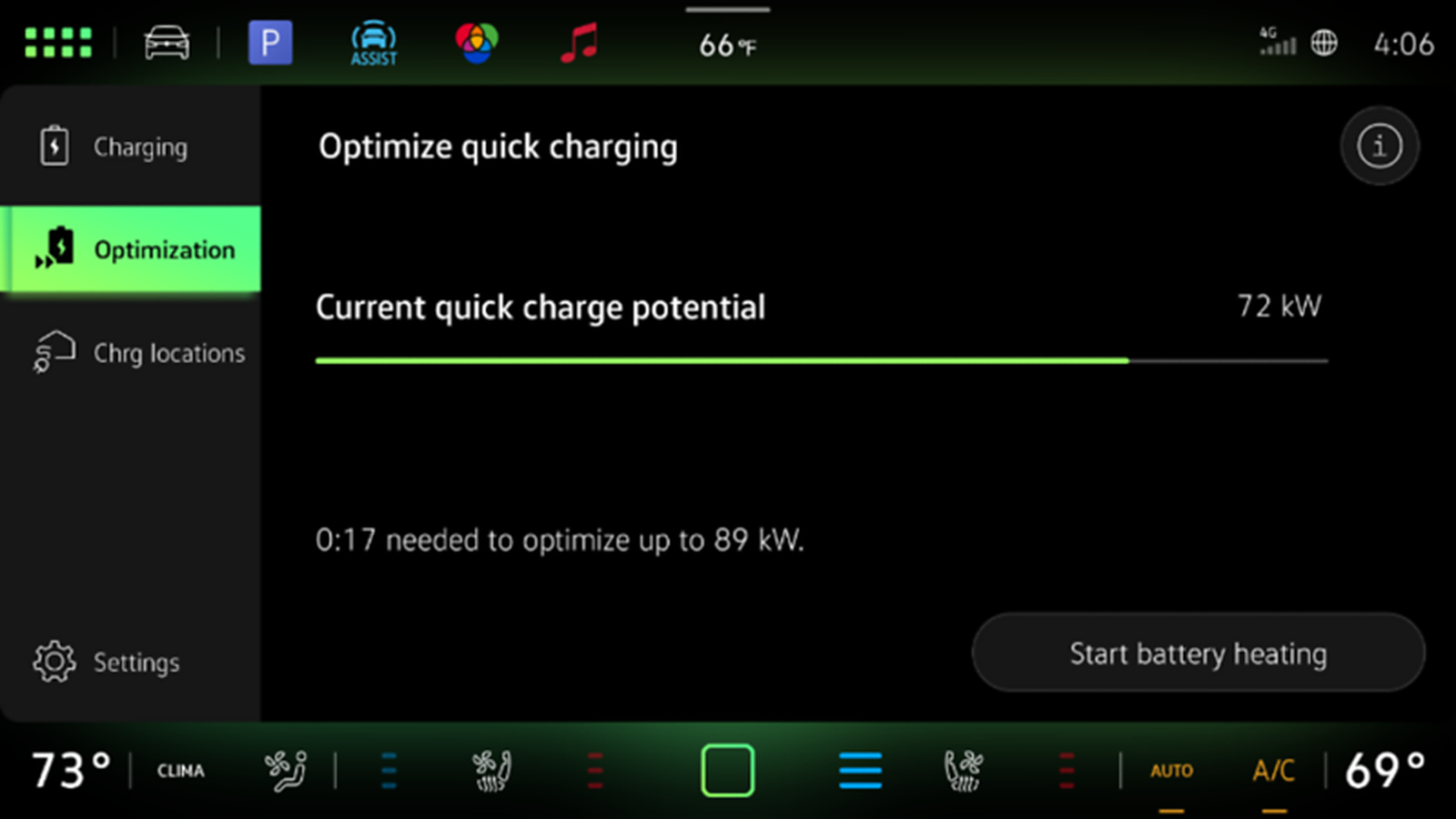
Battery preconditioning can warm or cool the pack before fast charging. It may consume energy before arrival in order to reduce charging time. If the interface hides the process, the driver may see falling range and then remain unsure whether the battery is ready.
Useful states include:
- preconditioning requested;
- warming or cooling active;
- battery expected to be ready at arrival;
- preconditioning complete;
- preconditioning unavailable, with the reason;
- manual preparation active, if the vehicle provides it.
Routing to a compatible fast charger should start the correct preparation automatically where supported, but automatic behaviour still needs visible status. The car should not force the driver to infer it from a small energy-flow animation.
Explain charging as a session
Charging power is the rate at one moment, not a fixed property of the charger or vehicle. The battery-management system limits acceptance according to SoC, temperature, cell conditions, and the vehicle’s charging strategy; the charging equipment and site can impose their own limits.
During a session, the primary information is:
- current SoC and selected target;
- current charging power;
- time to the target, not only time to 100%;
- expected completion time;
- added energy;
- session state and any interruption;
- cost when reliable data is available;
- the reason for a material power limit when the vehicle can determine it.
“Connected,” “authorising,” “charging,” “scheduled,” “paused,” “complete,” and “faulted” are different states. A useful failure message identifies whether the next action is to reseat the connector, authenticate, change charger, wait for a schedule, or seek service.
Put information in the right place
Different displays have different attention budgets.
The Head-up displays should carry only immediate driving information: speed, concise navigation, a critical warning, and selected assistance status.
The driver display should keep SoC, speed, range context, power or regeneration, assistance state, and high-priority warnings visible.
The centre Screens in EVs can hold the charging plan, map, energy history, charge settings, and detailed explanations.
The mobile app is suited to parked and remote tasks: current battery and charging status, target, schedule, preconditioning, notifications, and route preparation. It must show when data was last refreshed and whether a command succeeded.
This layering is called progressive disclosure: essential meaning first, detail on demand. ISO 15005 supplies ergonomic principles for driver-system dialogue, while ISO 15008 addresses legibility of dynamic visual information presented to a passenger-car driver. ISO 15005:2017 — Dialogue management principles ISO 15008:2017 — In-vehicle visual presentation
Write messages that lead to action
A useful EV message answers four questions in order:
- What changed?
- Why, if the vehicle knows?
- What should the driver do?
- Is it safe to continue?
“Charging unavailable” is incomplete. “Charging did not start because the connector is not locked; remove and reconnect it” gives a cause and recovery step. “Power limited” creates uncertainty. “Power is temporarily limited while the battery warms” explains the state.
The interface should not invent a cause. When several explanations are possible, it should say what is known, offer the safest next step, and preserve diagnostic detail for service.
What buyers should check
- Is displayed SoC always visible while driving and charging?
- Does navigation show arrival SoC at the destination and each charging stop?
- Can you set a preferred arrival reserve or clearly see the system’s margin?
- Does the car explain a large change in range prediction?
- Are consumption units and averaging periods clear?
- Is battery preconditioning visible before fast charging?
- Does the charging screen show time to the selected target?
- Can it explain reduced charging power when the cause is known?
- Are reduced regeneration and propulsion limits explained separately?
- Does the app show a refresh time and command status?
- Can advanced data be opened without crowding the default driving view?
Trust comes from calibrated predictions and honest explanations. A strong EV interface tells the driver what the vehicle knows, what it is estimating, what changed, and what action will improve the outcome.