
Ultrasonic Sensors
Ultrasonic sensors measure echoes from high-frequency sound and are optimized for the area close to the vehicle. Their low cost and near-field coverage make them useful for parking, but their output is neither an image nor a universal obstacle detector.
How ultrasonic ranging works
A transducer emits a short acoustic pulse and listens for reflections. The elapsed time, combined with an estimate of the speed of sound, provides range. Several transducers are normally distributed across the front and rear bumpers to cover different directions.
Temperature affects the speed of sound, while target angle, material and shape affect the returned echo. The sensor and software must also wait for the transmitted pulse and nearby ringing to decay, creating a minimum-range consideration.
Vehicle installation
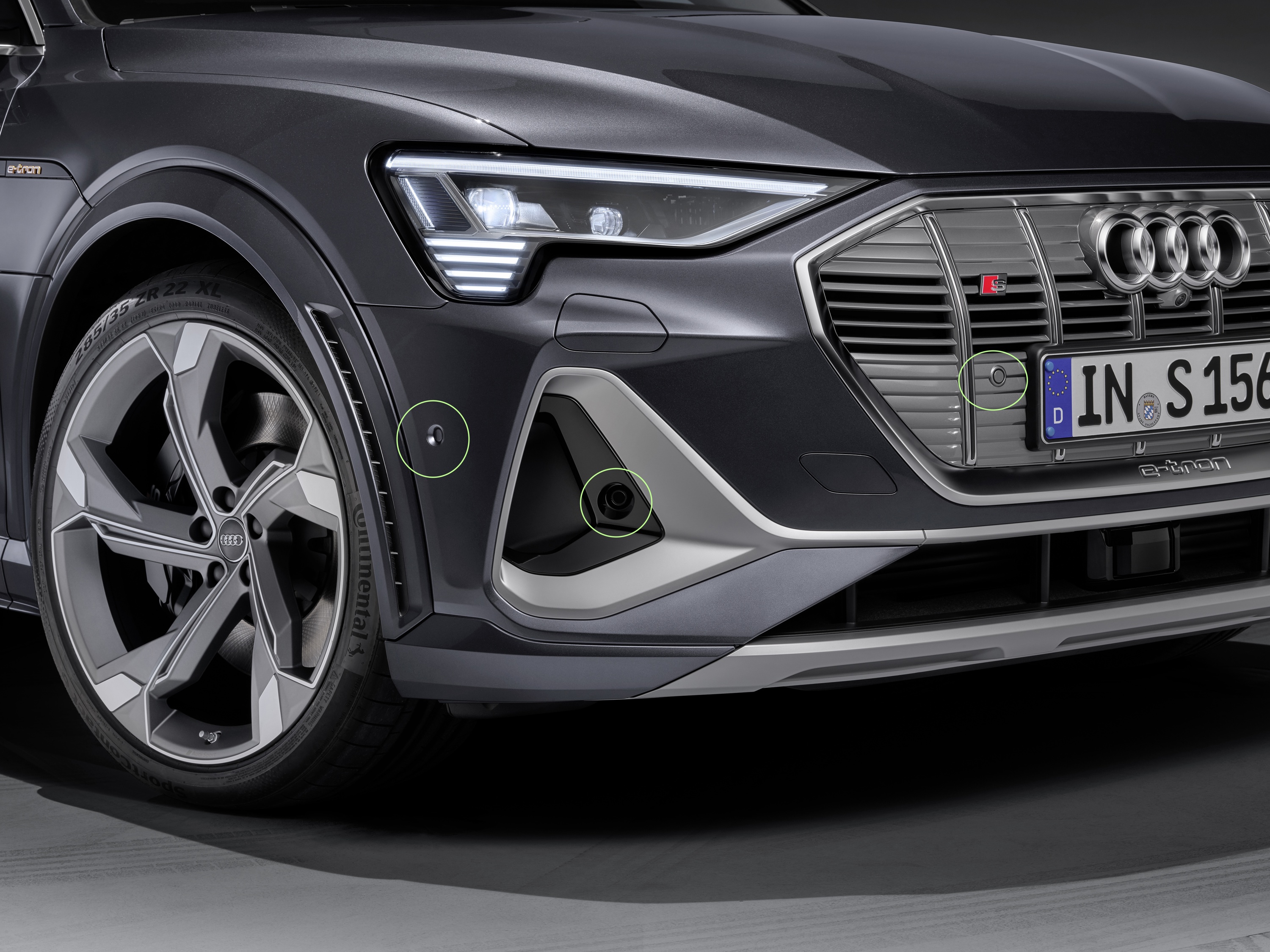
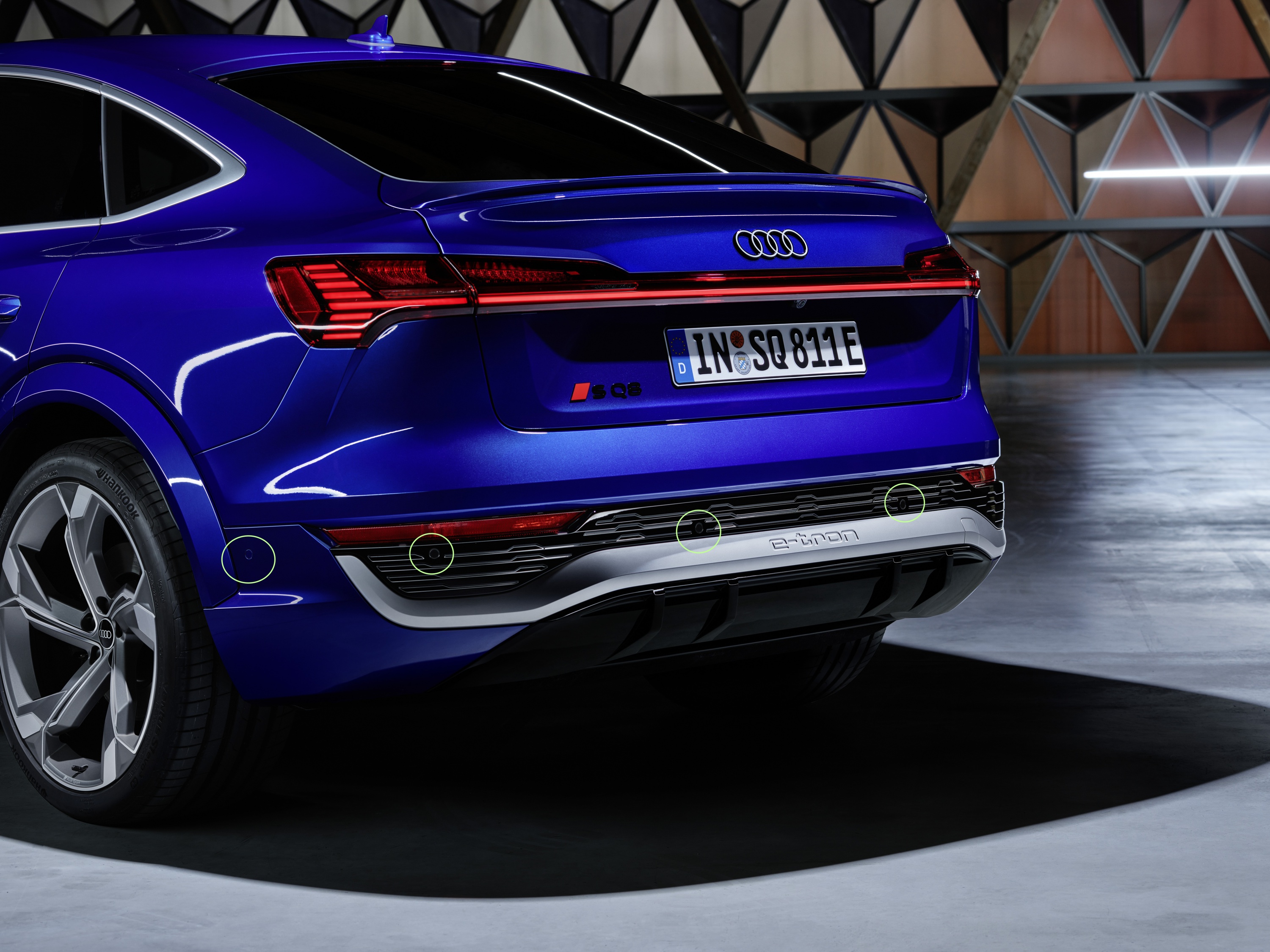
Sensors are usually visible as small circular areas in painted bumpers, although mounting details vary. Poor repair, excessive paint, accessories, ice or contamination can alter their acoustic path. Calibration and diagnostic requirements are vehicle-specific; see Calibration, cleaning and sensor health.
Typical functions
Ultrasonic sensing is most useful at low speed and short range:
- parking-distance warnings;
- automated or remote parking maneuvers;
- detection of walls, posts and nearby vehicles;
- close obstacle protection during low-speed movement;
- door-opening or curb-related assistance on selected vehicles.
The driver interface may convert several uncertain ranges into colored zones, audio pulses or a surround-view overlay. That visualization should not be mistaken for a complete geometric reconstruction.
Limitations
Ultrasonic performance can be reduced by:
- narrow, soft, porous or sound-absorbing targets;
- angled surfaces that reflect sound away from the receiver;
- objects below or above the acoustic beam;
- fast relative motion or rapidly changing geometry;
- cross-talk, strong environmental ultrasound or nearby sensors;
- snow, ice, dirt, water or an obstructed bumper;
- temperature and airflow assumptions.
Bosch specifies a minimum and maximum range for a defined reference target in one ultrasonic product sheet, while Continental gives a similar product-specific operating range. See Bosch ultrasonic sensor product information and Continental ultrasonic parking sensor. These numbers should not be generalized to every curb, child, post or vehicle.
Can cameras replace ultrasonic sensors?
Surround cameras can estimate nearby geometry and provide far richer visual context. A camera-based parking system can therefore implement many of the same user functions. It also inherits camera-specific sensitivities such as lens contamination, glare, darkness, geometric calibration and occlusion near the body.
Tesla has removed ultrasonic sensors from some configurations and uses camera-based park assistance where available. Tesla's own documentation says availability varies with configuration, market, software and detected conditions. See Tesla owner's manual: Park Assist. This demonstrates one product strategy; it does not prove that ultrasonic measurement is generally unnecessary or that every camera implementation has equivalent near-field coverage.
The same reasoning applies in reverse. A ring of ultrasonic sensors does not replace cameras because it cannot read markings, classify most objects or show the driver an image. Camera-only vs multimodal sensing explains how architecture claims should be bounded.
Integration and fallback
Parking systems often combine ultrasound with cameras and vehicle-motion estimates. The software must account for sensor blind zones, delayed or missing echoes and changing steering geometry. Sensor fusion covers the distinction between complementary inputs and true redundancy.
When sensing is degraded, the system should warn the driver, reduce the claimed function or stop the automated maneuver. Owners should treat parking displays as assistance, not proof that every low obstacle has been detected.
An implementation example
The legacy video below illustrates behavior reported for one camera-based parking implementation. It is not a standardized or controlled comparison of camera and ultrasonic architectures.
Use the criteria in How to validate sensor and perception claims for repeatable evaluation.