
Skoda Peaq — what we know so far
The Skoda Peaq is the Czech brand's largest and most ambitious electric vehicle to date. Positioned as the new flagship above the Enyaq, it is a full-size seven-seat SUV built on the Volkswagen Group's MEB platform. Skoda confirmed the name in January 2026, with a world premiere scheduled for summer 2026 and customer deliveries expected later the same year.
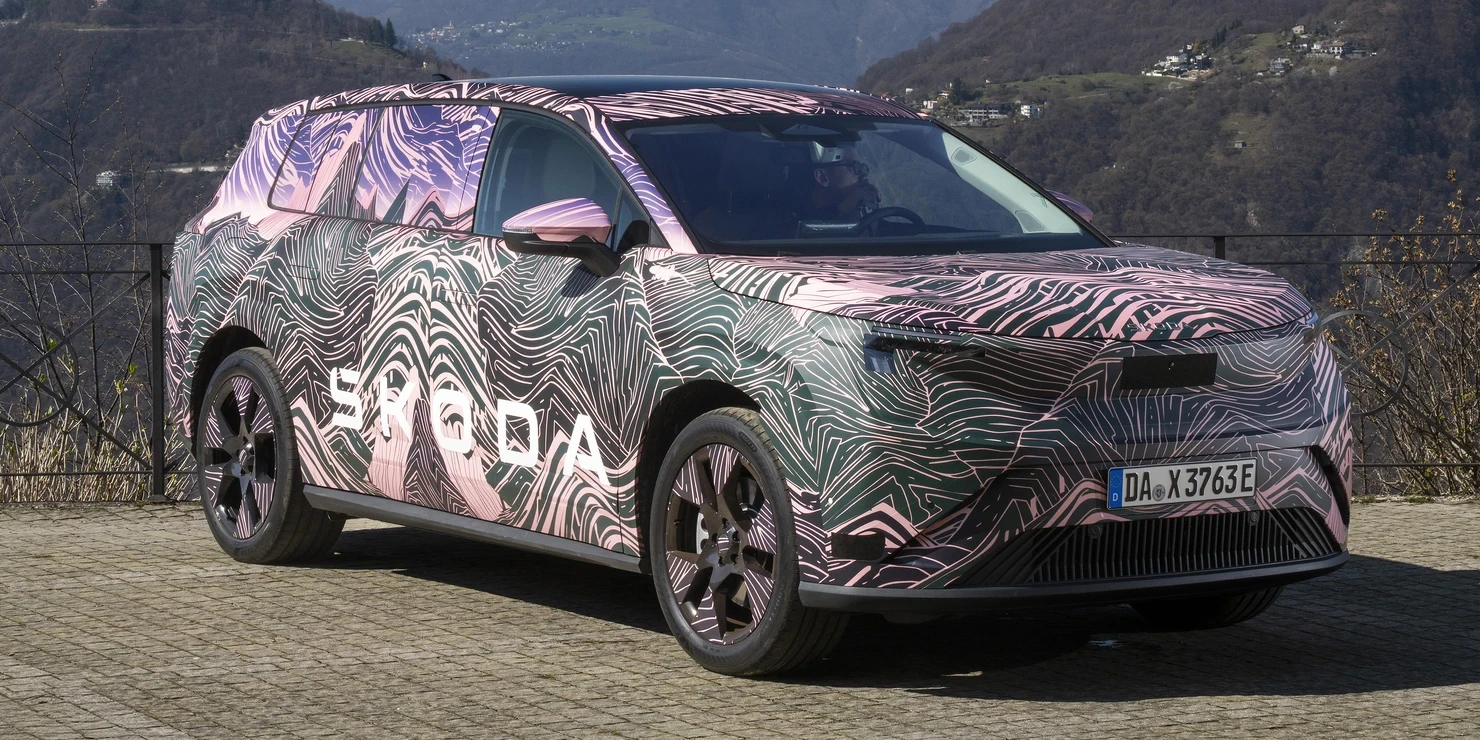
The name itself is a statement of intent. "Peaq" signals the top of Skoda's electric lineup, and the car it describes is the production evolution of the Vision 7S concept first shown in spring 2022. That concept introduced Skoda's current "Modern Solid" design language, and the Peaq carries it forward into a vehicle aimed squarely at families who need three rows and a fully electric drivetrain.
What has been confirmed
Skoda has officially confirmed the following:
- The model name: Peaq.
- Seven-seat configuration with three rows.
- All-electric drivetrain on the MEB platform.
- Flagship positioning above the Enyaq in Skoda's lineup.
- World premiere in summer 2026.
- Design rooted in the Vision 7S concept and the Modern Solid design language.
Martin Jahn, Skoda Auto Board Member for Sales and Marketing, said at the name reveal: "With the Vision 7S, we entered new territory for Skoda, with a clear idea of how to elevate the brand."
Beyond these points, Skoda has been measured with the technical details. Most of the numbers circulating come from informed expectations rather than official spec sheets.
Platform and size
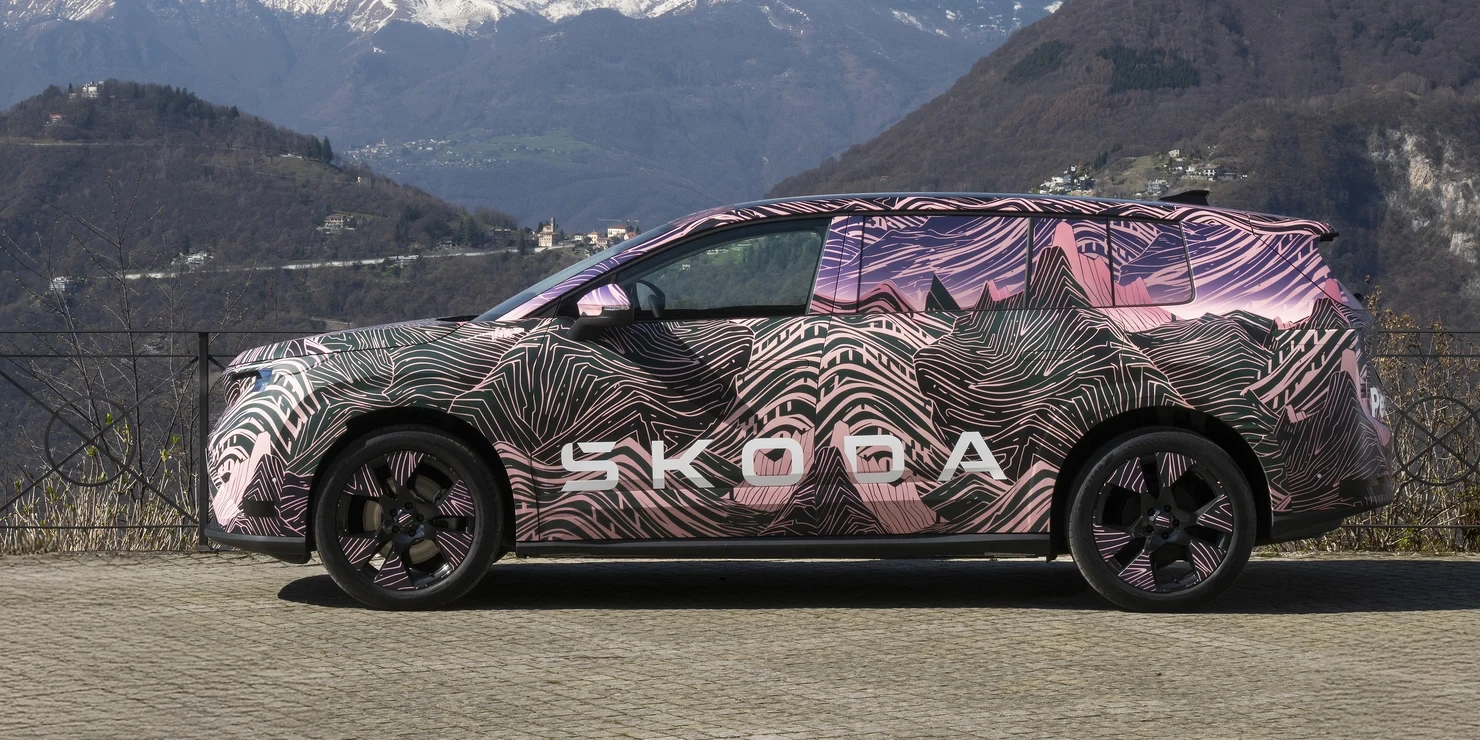
The Peaq sits on the MEB platform, the same architecture underpinning the Skoda Enyaq, Volkswagen ID.Buzz, and Audi Q4 e-tron. At over five metres in length, the Peaq is large by European standards and clearly sized to compete with vehicles like the Hyundai Ioniq 9 rather than the mid-size electric SUV crowd.
That length is the key packaging story. Five metres gives Skoda enough room for a genuine third row rather than the emergency-only kind. The Vision 7S concept hinted at a long wheelbase and short overhangs, both of which help maximise interior space on a skateboard platform where the battery sits under the floor.
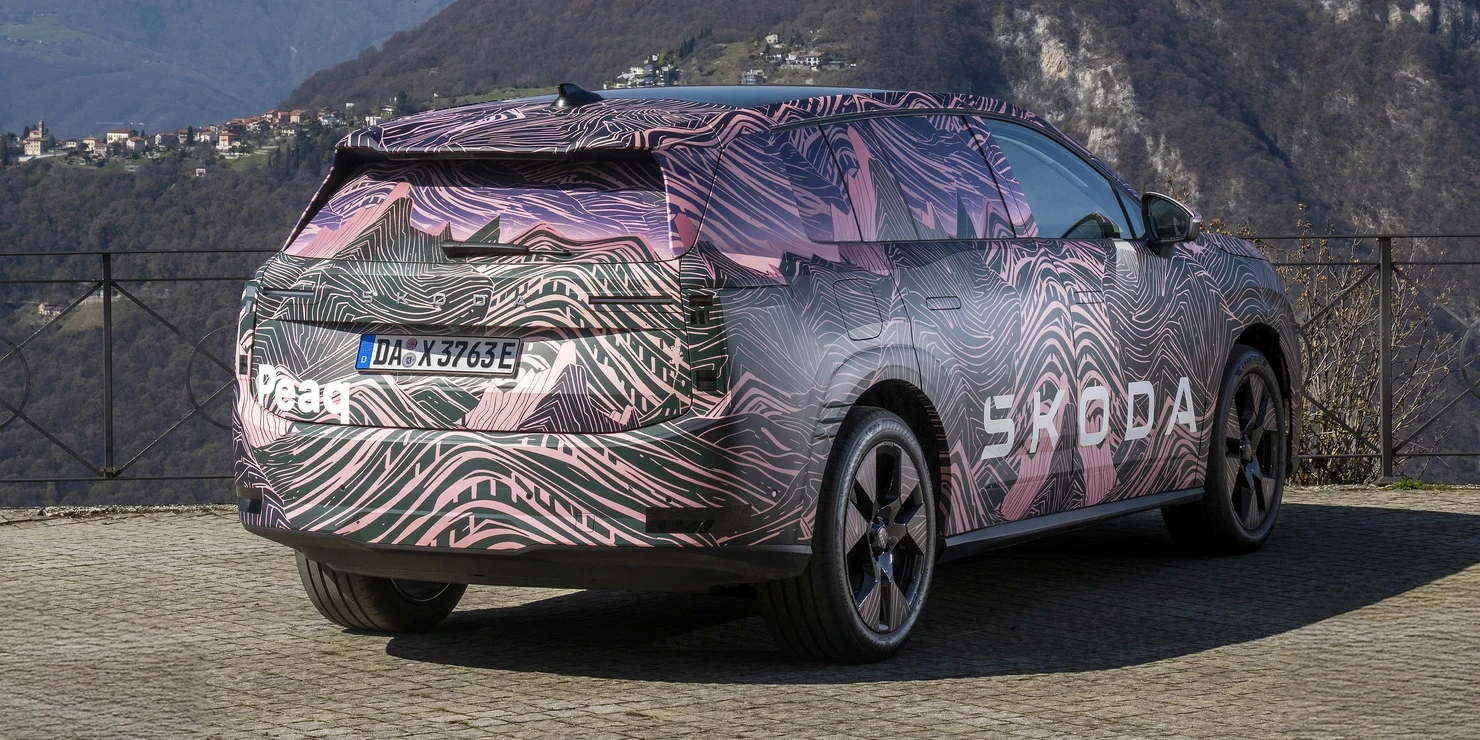
Spy shots of test prototypes, including cars running at the Nurburgring, show a silhouette broadly consistent with the concept: upright, squared-off, and purposeful. The production design appears to feature angular air curtains, C-shaped headlights, and T-shaped taillights in line with the current Skoda family look.
Battery, charging, and drivetrain
Skoda has not published a full technical specification, but several details have emerged from official teasers and credible reporting.
The battery is expected to be an 89 kWh unit, consistent with the largest pack available on the current MEB platform. Combined with the aerodynamic profile of a large SUV, that pack is expected to deliver a WLTP range of over 600 km. That is an ambitious figure for a vehicle of this size and weight class, and the final number will depend heavily on the production car's drag coefficient and kerb weight, neither of which has been confirmed.
DC fast charging is expected at up to 200 kW, which would place a 10-to-80 percent charge in roughly 28 to 30 minutes on a suitably capable charger. That is in line with what the current MEB platform supports at its upper end.
There are some indications from reporting outlets that 800-volt architecture could be part of the picture, though this remains unconfirmed. The standard MEB platform operates at 400 volts; if Skoda has moved to a higher voltage for the Peaq, it would be a notable step and could push peak charging rates higher.
Drivetrain options are expected to follow the pattern established by the Enyaq. That means a rear-wheel-drive single-motor variant for efficiency, and a dual-motor all-wheel-drive version for those who need traction or more power. The top AWD configuration is expected to produce around 250 kW (340 PS). Skoda may offer updated, more efficient motors compared to the current Enyaq, though specifics have not been confirmed.
Interior and technology
Details on the cabin are sparse. Skoda has said the Peaq will focus on "space, practicality, and comfort" with its signature Simply Clever features. That phrase covers a wide range of small practical touches Skoda is known for — things like umbrella holders in the doors, removable LED torches, and clever storage solutions.
As the brand's flagship, the Peaq's interior is expected to be a step above the Enyaq in material quality and equipment level. Reporting suggests a large central touchscreen alongside a digital driver display, with Skoda retaining some physical controls rather than going fully touch-based. That would be consistent with the approach Skoda has taken in its recent models, where the brand has resisted the trend toward eliminating all buttons.
Cargo capacity with the third row folded is still unknown, and so is the luggage space available with all seven seats in use. For a family-oriented seven-seater, those numbers matter as much as the powertrain specs.
Advanced driver assistance systems are expected, though Skoda has not detailed the ADAS package. Given the MEB platform and VW Group's shared technology pool, expect a suite comparable to what is available on the Enyaq and ID.Buzz, likely including adaptive cruise control, lane-keeping assistance, and parking automation.
Launch timing and expected pricing
The world premiere is confirmed for summer 2026. Customer deliveries are expected to follow in late 2026 across European markets.
Pricing has not been announced. Analysts and automotive publications estimate a starting price in the range of 50,000 to 55,000 euros in Europe, which would position the Peaq as Skoda's most expensive model but still below comparable offerings from Audi or BMW. For the UK market, expectations centre around 50,000 to 55,000 pounds.
That pricing, if accurate, would be a significant part of the Peaq's appeal. A seven-seat electric SUV with over 600 km of range at a price point below the premium German brands is a proposition that currently has limited competition.
What is still unknown
Several important details remain unconfirmed:
- Exact dimensions, wheelbase, and kerb weight.
- Final battery capacity and whether it operates at 400 V or 800 V.
- Confirmed range figures (the 600 km WLTP target is expected but not locked in).
- Cargo capacity, both with and without the third row.
- Towing capacity.
- Full ADAS feature list.
- Trim levels and standard equipment.
- Official pricing.
- Production location.
The summer 2026 premiere should fill in most of these gaps.
This article will be updated as more details are released.