
Steering Wheels and Controls
The steering wheel is both the driver’s primary directional control and one of the busiest HMI surfaces in the vehicle. Its geometry must support steering first; every switch, touch area, paddle, sensor, and display interaction added to it competes for limited space and attention.
Shape, grip, and steering geometry
Most wheels are circular or close to circular because the rim remains available through large hand-over-hand movements. Flat-bottomed, D-shaped, and contoured wheels can improve knee clearance or alter the grip area, but the effect depends on steering ratio and the range of wheel rotation required in low-speed manoeuvres.

Diameter, rim thickness, spoke position, surface material, heating, and reach all affect comfort and control. A smaller wheel does not by itself make steering more precise; steering response is set by the complete steering system, including ratio, assistance, suspension, tyres, and software.
UN Regulation No. 79 establishes approval provisions for steering equipment in markets applying it. Its scope is the steering system and its performance, not a styling preference for round wheels or a particular button layout. UNECE — UN Regulation No. 79 on steering equipment
Steering-wheel controls
Wheel controls can reduce reach for tasks used while driving:
- cruise speed, following distance, and steering assistance;
- audio volume, track selection, calls, and voice activation;
- driver-display pages and information emphasis;
- configurable shortcuts;
- regeneration level or drive-mode paddles.
The control groups should be separable by touch and logically divided between the left and right spokes. A press needs prompt feedback, and any mode-dependent input needs visible confirmation. A driver should not have to inspect a small icon to discover which surface is currently active.
Mechanical buttons and scroll wheels offer travel and boundaries. Capacitive areas can support swipes or changing functions, but gloves, moisture, palm contact, steering movement, and road vibration can affect operation. Haptic feedback confirms activation only after contact; it does not solve poor target placement.
Euro NCAP’s 2026 control assessment defines requirements for direct physical and direct touch inputs, including tactile identification or target-size and separation criteria for assessed steering-wheel controls. It also checks that relevant status information appears in the driver’s direct line of sight. Euro NCAP — 2026 Safe Driving protocols
Yokes and variable-ratio steering
A yoke removes the upper and lower rim. It can improve the view of the driver display and create space around the driver’s legs, but it also removes hand positions used during large steering rotations.
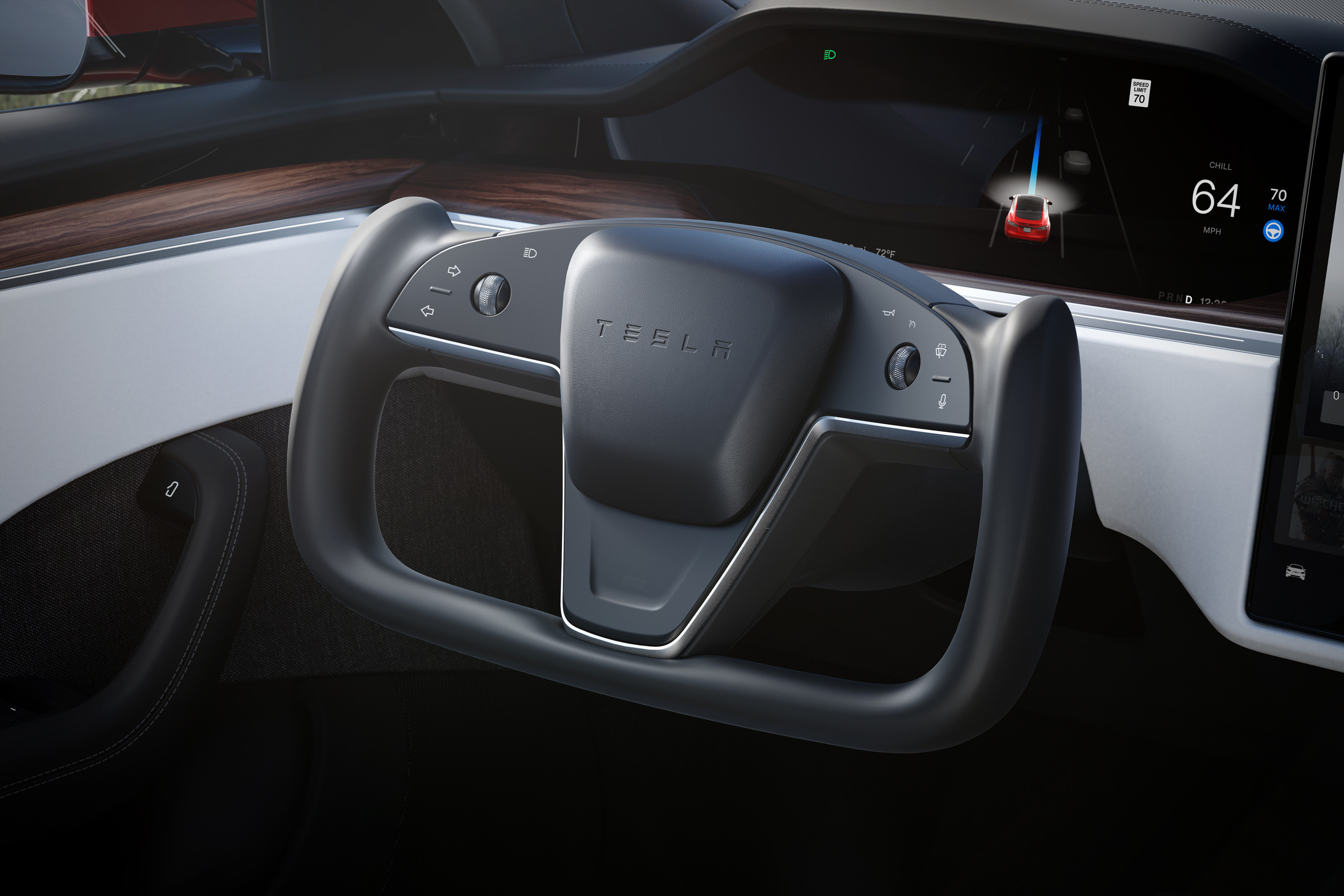
The practical result depends on the steering ratio. A conventional fixed ratio may still require the driver to reposition hands in parking, tight turns, or recovery from a slide. A sufficiently variable steer-by-wire system can produce the required road-wheel angle with less control rotation, changing that trade-off. Shape and steering system therefore need to be evaluated together.
Steer-by-wire also changes feedback and failure design because software and actuators can shape the relationship between control angle, road-wheel angle, and steering effort. Regulatory provisions for steer-by-wire continue to develop; a buyer should judge the certified production implementation rather than treating the technology name as a performance claim.
Adjustment and driving position
Tilt changes wheel height or angle; telescopic adjustment changes reach. Electric adjustment can be linked to a driver profile and entry function. Whatever the mechanism, the driver needs a position that permits full steering movement, clear instrument visibility, comfortable pedal operation, and appropriate distance from the airbag.
NHTSA recommends maintaining at least 10 inches, about 25 cm, between the centre of the driver airbag cover and the breastbone while still being able to reach the pedals comfortably. This is general U.S. safety guidance; drivers should also follow the vehicle handbook and any medical or mobility advice specific to them. NHTSA — Vehicle air bags and seating guidance
The wheel should not hide speed, warnings, or assistance status at the preferred seating position. A display that looks clear from a showroom camera angle may be partly masked for a shorter or taller driver.
Controls, assistance, and hand detection
Some assistance systems use steering torque, capacitive sensing, or driver monitoring to assess engagement. A “hands detected” indication does not prove that the driver is watching the road, and a driver-monitoring camera does not remove the need for usable controls.
Mode clarity is essential. The interface should show:
- whether cruise and steering assistance are off, available, or active;
- which set speed and following distance are selected;
- why assistance became unavailable or disengaged;
- what the driver must do next;
- whether a wheel input will adjust speed, media, a display, or another context.
The wheel should remain a dependable steering control when secondary features, touch surfaces, or assistance software are unavailable.
What buyers should check
- Can you reach the full rim without moving your shoulders away from the seat?
- Does the wheel obscure the driver display at your preferred position?
- Can left and right control groups be distinguished by touch?
- Do accidental touches occur during large steering movements?
- Are cruise and assistance states confirmed in the direct forward view?
- If the wheel is non-circular, is low-speed hand repositioning comfortable?
- Do paddles have a consistent function across drive modes?
- Can the wheel be adjusted far enough to provide pedal reach and airbag clearance?
- Is the horn easy to operate from normal and emergency hand positions?
A strong steering-wheel HMI preserves an uncomplicated physical truth: steering always has priority. Secondary controls should reduce reach without making the primary task less predictable.