
Rear lights, turn signals and vehicle communication
Rear lighting is a visual language for presence, braking, direction, reversing and danger. EVs add regenerative-braking logic, charging indicators and software-controlled signatures, but every decorative function must preserve the speed and clarity of the regulated signals.
The functions in and around a rear lamp
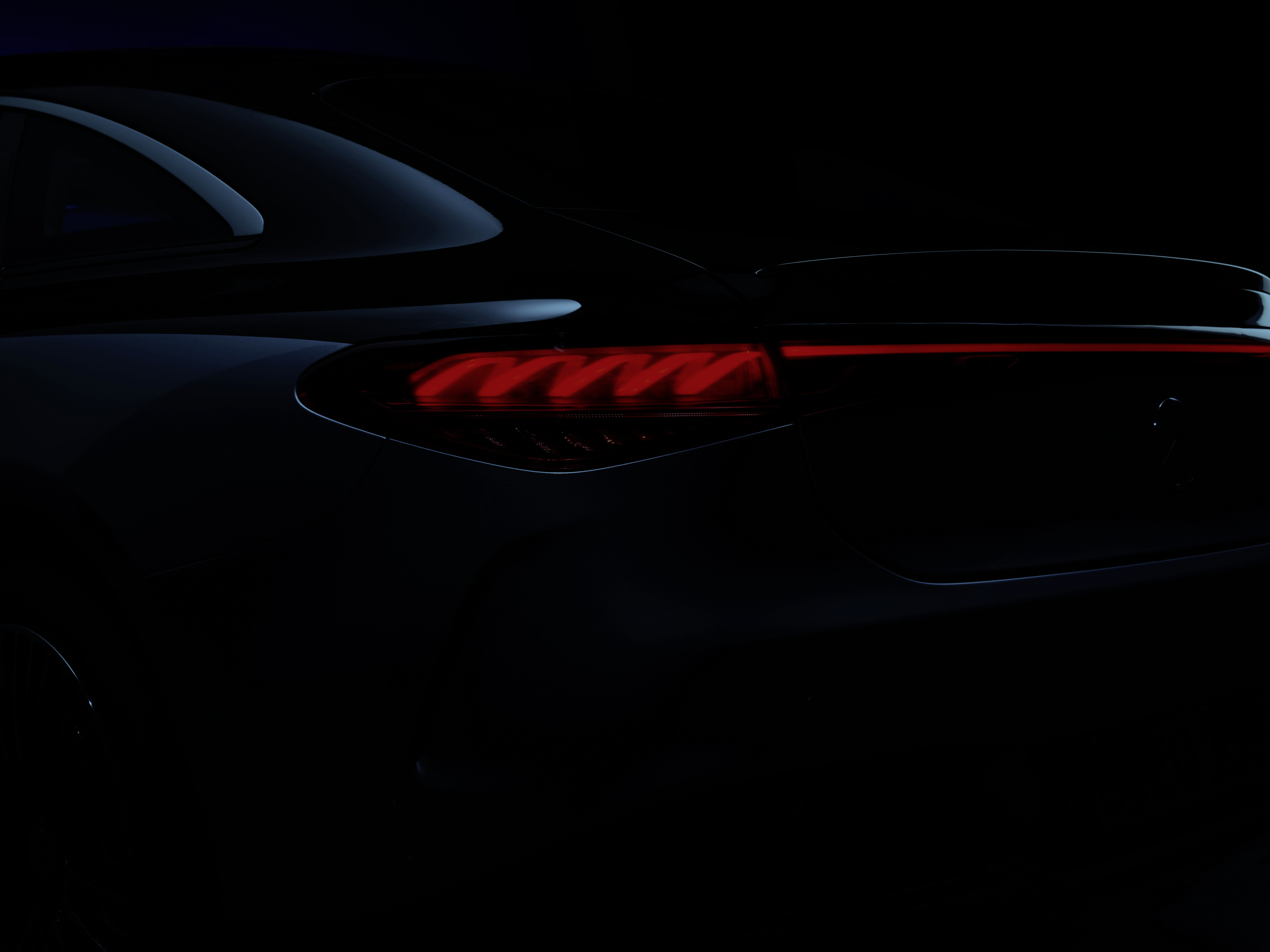
A rear lamp cluster can contain several separate functions:
- Rear position lamps, commonly called tail lights, show the vehicle's presence and width.
- Stop lamps become brighter when the braking signal is generated.
- The center high-mounted stop lamp provides a separated brake signal near the vehicle centerline.
- Direction indicators communicate a turn, lane change or hazard-warning state.
- Reversing lamps emit white light to indicate reverse and illuminate the area behind.
- A rear fog lamp emits an intense red signal for severely reduced visibility.
- Side markers and reflectors help other road users perceive vehicle length, width and orientation.
- The license-plate lamp illuminates the rear registration plate without showing white light directly rearward as a reversing signal.
These functions can share a lens and housing, but they should remain visually distinguishable. Color, intensity, illuminated area, separation, viewing angle and timing all contribute to the message.
Position and brake lights
Rear position lamps are steady red markers. Stop lamps add a conspicuous change when the driver or an automated system demands braking. A well-designed combination lamp creates enough contrast between the tail and stop states across the required viewing angles; a large decorative signature is not useful if the brake increment is hard to recognize.
The center high-mounted stop lamp, or CHMSL, is deliberately separated from the two lower stop lamps. It remains visible through or above some traffic and gives following drivers a signal that is less likely to be confused with a turn indicator. NHTSA required it on U.S. passenger cars from model year 1986 and later on light trucks after fleet and crash-data research showed fewer rear impacts.
LED stop lamps reach their commanded output faster than filament bulbs, but timing alone does not make a safe rear lamp. Signal area, intensity, contrast, separation and the following driver's view remain decisive.
Regenerative braking and one-pedal driving
An EV can decelerate significantly when the accelerator is released, before the driver touches the brake pedal. Stop-lamp activation is therefore based on a braking signal and deceleration logic, not solely on physical brake-pedal movement.
Current UN passenger-car braking provisions distinguish deceleration produced by regenerative or automatically commanded braking:
- at or below 1.3 m/s², the braking signal may be generated;
- above 1.3 m/s², the braking signal must be generated;
- once generated, the signal is held while a deceleration demand persists, with permitted suppression conditions;
- hysteresis, averaging or a time delay should prevent rapid on-off flicker.
This explains why two EVs can illuminate their stop lamps differently during mild lift-off while both comply. The mandatory threshold covers stronger deceleration; the lower range gives manufacturers discretion. Natural rolling resistance, aerodynamic drag, road gradient and an engine's natural braking effect are not treated as a commanded braking signal.
Drivers can inspect their own vehicle safely by having another person observe from outside or by reviewing a stationary recording made in a controlled location. They should not assume that every level of regenerative deceleration illuminates the stop lamps.
Turn indicators, hazards and emergency braking
Direction indicators need to be distinct from tail and stop lamps. UN-regulation markets use amber rear indicators, while U.S. FMVSS No. 108 permits amber or red. A NHTSA crash-data analysis found a statistically significant 5.3% reduction in relevant rear impacts for vehicles with amber rather than red rear turn signals in the matched vehicle groups studied.
Sequential indicators illuminate segments in a directional sequence. The animation can make the intended direction easy to parse, but it must reach the required signal area and meet regulated timing and intensity. A narrow decorative sweep is not automatically a stronger signal than a large conventional indicator.
Hazard warning uses both left and right direction indicators. Some vehicles can activate the hazards automatically after a crash or following an emergency-stop signal. Under UN provisions, an emergency-stop signal may rapidly flash stop lamps or direction indicators during defined severe-braking conditions. Availability and activation logic vary by regulation and vehicle.
Front indicators and side repeaters complete the directional message. Side markers, required on many North American vehicles and on longer vehicles in other markets, help reveal vehicle orientation at oblique angles.
Reversing, manoeuvring and rear fog lights
Reversing lamps communicate that reverse is selected and provide light for the driver and rear camera. Their white color must not be confused with a normal rear-facing driving lamp. Some vehicles also have regulated manoeuvring lamps that illuminate nearby ground at low speed under limited conditions.
A rear fog lamp is much brighter than a tail lamp. It is intended for severely reduced visibility and can dazzle or mask brake-light contrast when misused in clear weather. Vehicles may have one lamp or an asymmetric pair depending on design and market; drivers should learn the switch and dashboard tell-tale before fog arrives.
Reflectors provide passive visibility when the vehicle is parked or unpowered. They return light toward the source and remain important even on a vehicle filled with active LEDs.
LED, OLED and optical design

LED rear lamps use small point sources with reflectors, lenses, diffusers or light guides. The technology enables thin signatures, multiple functions and individually controlled segments. Electrical efficiency and source life are useful, but the complete assembly still depends on drivers, connectors, seals, lenses and thermal design.
OLEDs are area emitters: thin organic semiconductor layers produce light across a surface rather than from a visible point source. Their uniform appearance and segmentability allow shallow packaging and precise graphics. Automotive OLED panels still need protection from moisture, temperature extremes and aging; "organic" does not mean biodegradable or maintenance-free.
The Audi Q6 e-tron uses second-generation digital OLED rear lights with six panels and 360 controlled segments according to Audi. The system can create selectable signatures and specific communication graphics while retaining the mandatory lamp functions.
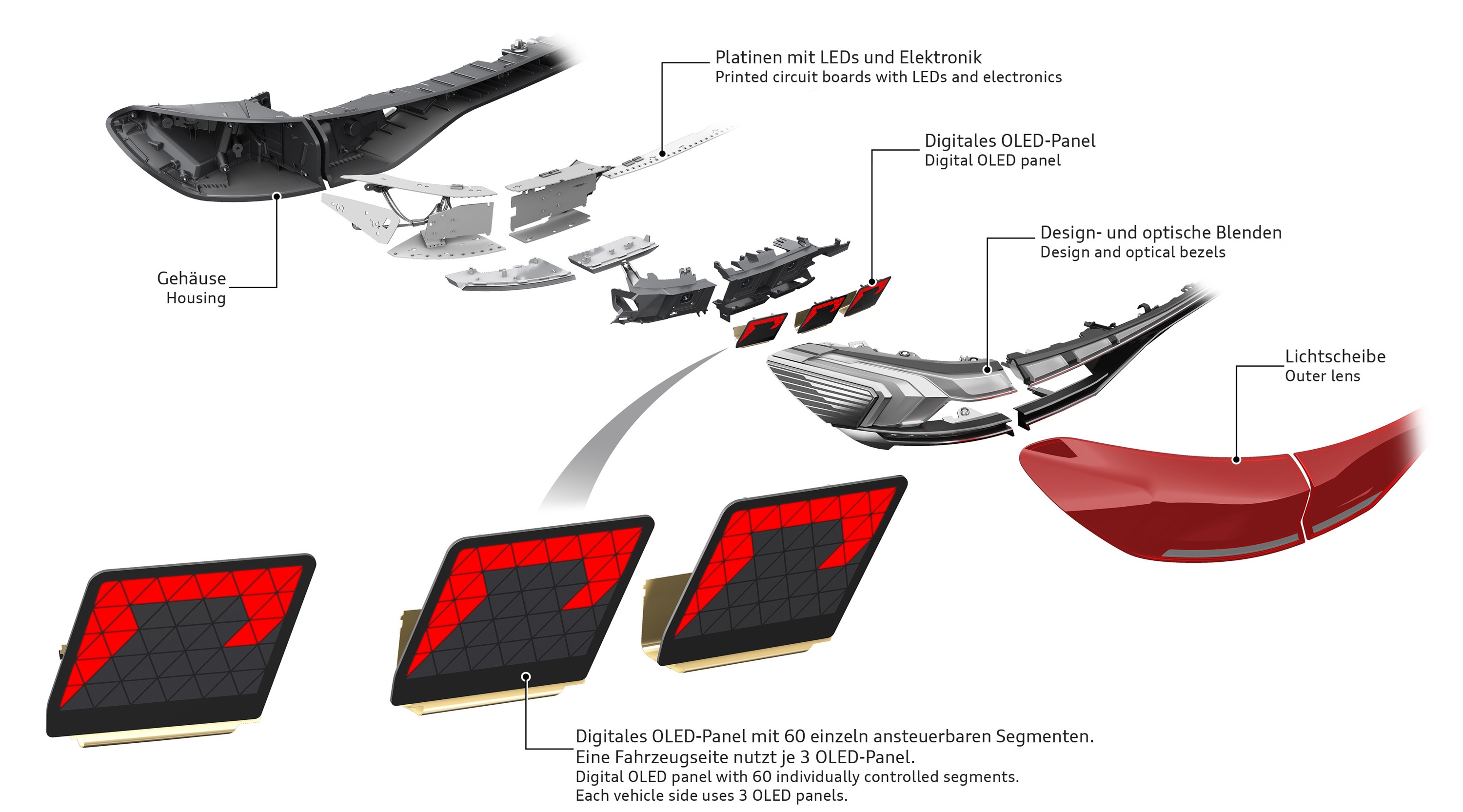
OLED and LED are not a quality ranking. LEDs can provide high-intensity functions and excellent three-dimensional optics; OLEDs can provide thin, homogeneous surfaces. Many lamp assemblies combine technologies because stop, indicator, position and design functions have different needs.
Signatures, animations and communication light
Rear lamps have become a brand identifier, but signatures operate inside a safety grammar. The legal signal must remain red, amber or white as required, appear in an allowed place, meet intensity and visibility requirements, and avoid a pattern that could be mistaken for another function.
Some vehicles allow owners to choose among approved signatures. The Audi Q6 e-tron offers up to eight digital signatures depending on equipment and market. Selection changes the graphic, not the meaning of the stop or turn signal.
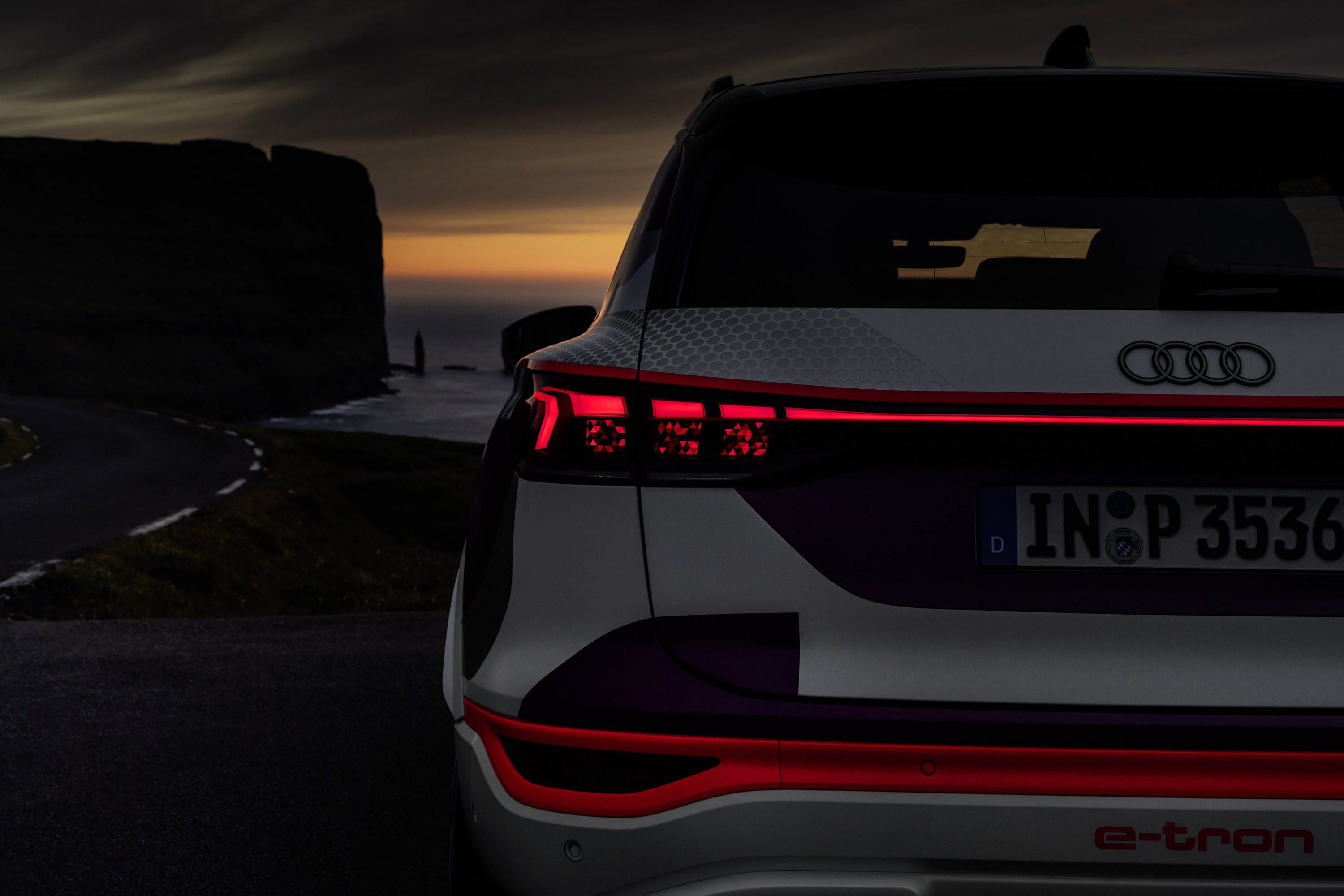
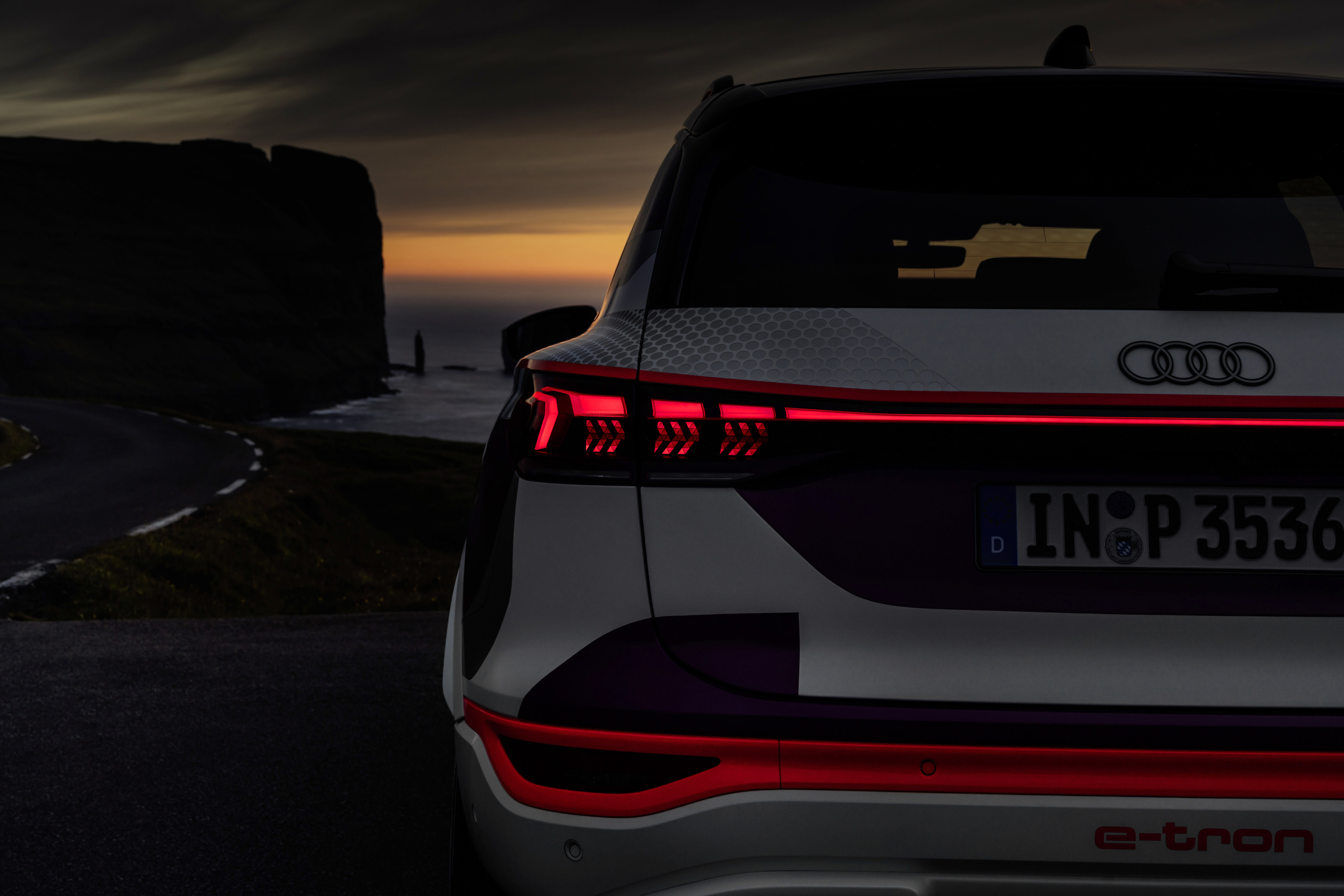
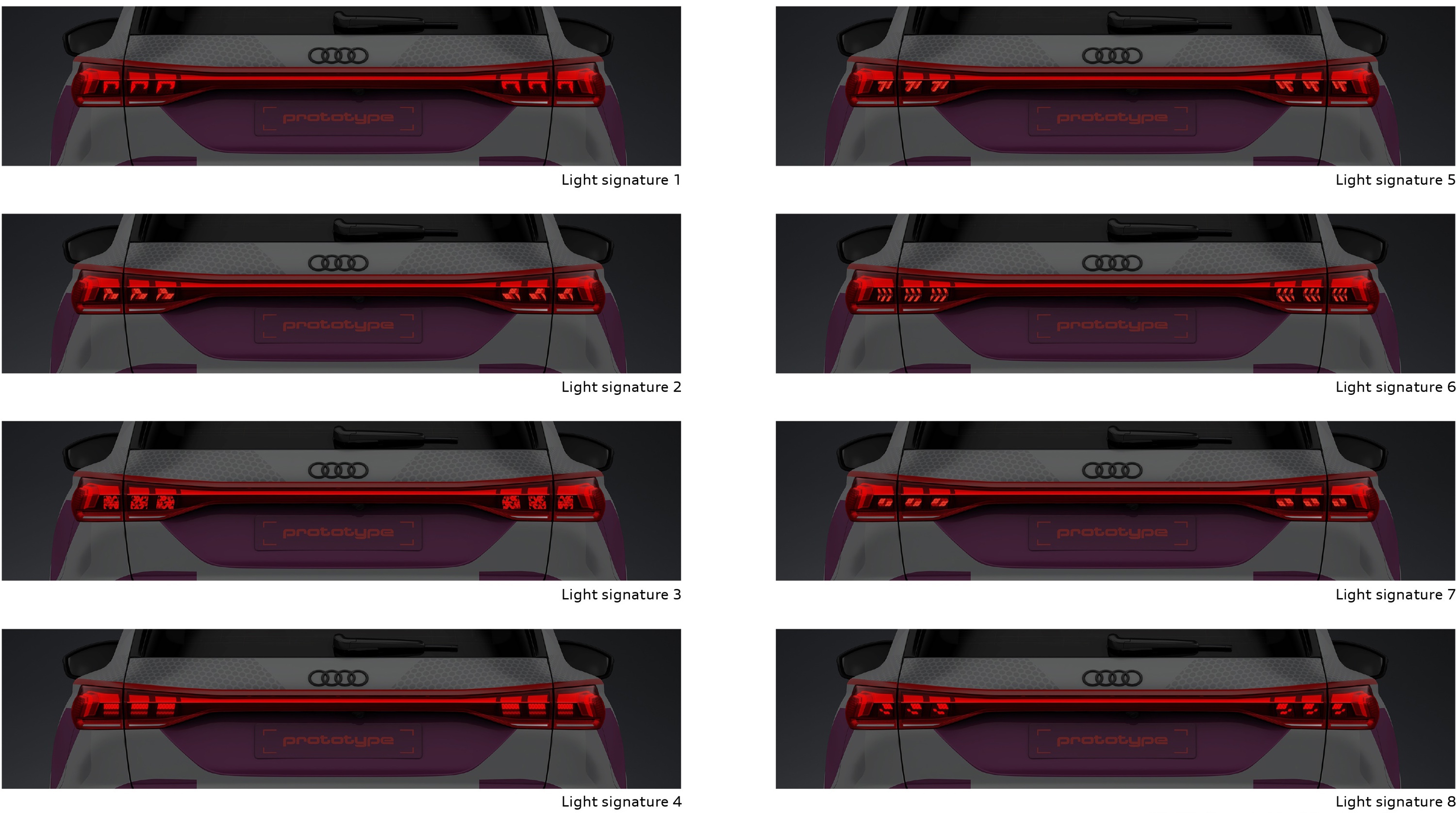
Dynamic welcome and departure sequences normally run while the vehicle is stationary. Continuous animation while driving is much more restricted because other road users rely on steady and flashing conventions with established meanings.
Communication light can add a specific warning graphic to the normal signature. Audi describes a Q6 e-tron function that displays approved warning symbols for accidents or breakdowns and a proximity indication when another road user approaches a stationary vehicle. Such graphics supplement the regulated lamps; they do not create a universal language understood in every market.
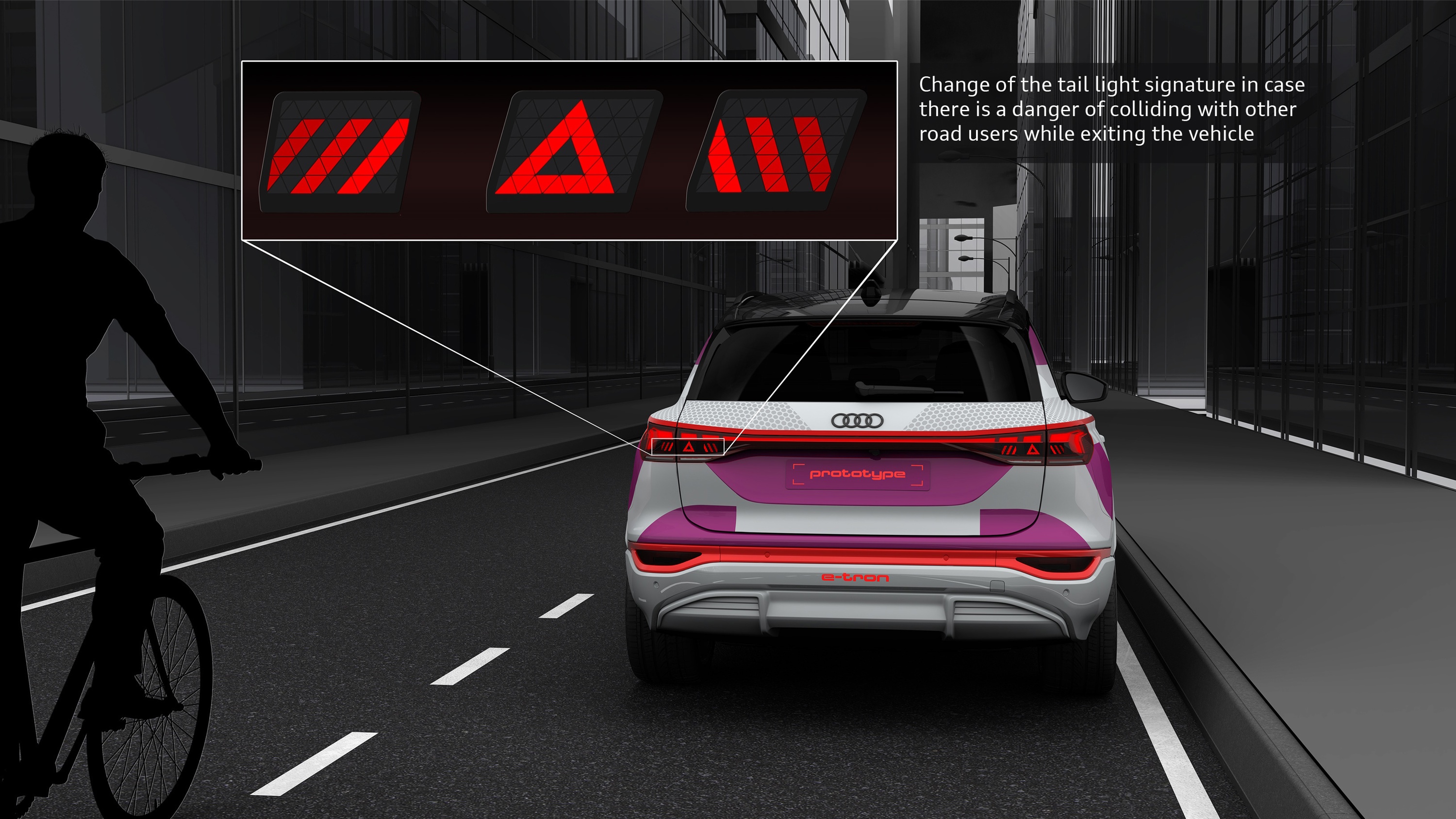
More expressive systems can display coarse graphics.

The safety question is not whether the lamp can draw a symbol. It is whether road users recognize the message quickly, whether the symbol works across languages and visual abilities, and whether mandatory stop, turn and hazard signals remain unmistakable. Standardization is essential before external messages can be relied upon.
EV-specific status lighting
EVs often add charge-port lamps or exterior indicators for charging state, connector locking and vehicle-to-load operation. These are useful while parked, especially when the same port uses color and animation to distinguish waiting, charging, complete and fault states.
Status lighting needs a clear fallback in the app, instrument display or charge equipment because color alone can be ambiguous. It should also minimize parked low-voltage drain and avoid colors or flashes that could be mistaken for emergency or traffic signals.
Exterior grilles and badges can now contain pixel displays because an EV needs less cooling aperture than many combustion vehicles. That packaging opportunity does not exempt the display from lighting rules. Brightness, color, animation and operation while moving remain market-dependent.
Failure, moisture and collision repair
A partially failed LED signature may still look illuminated while no longer meeting its approved output or area. The driver should respond to bulb-out warnings and periodically inspect every function from outside. Brake and indicator checks need a second person, a safe reflection or a controlled recording.
Temporary internal mist can be a normal result of a ventilated housing cooling in humid air. Persistent droplets, standing water, corrosion or repeated segment failures need repair. Cracks and dark tint films can reduce intensity and change the regulated color.
Rear lamp assemblies integrated into a tailgate, quarter panel or bumper can be costly after a low-speed impact. Some split designs need communication between body-mounted and movable lamp sections so the signal remains visible when the tailgate is open. Replacement parts must match the exact market specification and may require coding.
The engineering chapter covers condensation, serviceability and retrofit approval: Lighting engineering, regulation and ownership.
What buyers and owners should check
- Confirm that tail, stop, center stop, left and right indicators, hazards, reverse, rear fog and license-plate lamps work.
- Verify indicator color and animation on the exact market version rather than a global launch vehicle.
- Observe stop-lamp behavior during mild and strong regenerative deceleration in a safe test.
- Check signal visibility with the tailgate open if the vehicle has lamps on a movable panel.
- Look for failed segments, inconsistent color, persistent moisture, cracked lenses or dark aftermarket film.
- Learn the rear-fog and lighting tell-tales before driving in poor visibility.
- Ask whether a damaged lens, OLED panel or LED module is separately serviceable or requires the complete assembly.
- Treat charging colors and communication graphics as vehicle-specific symbols, not universal traffic signals.
Example
Audi's demonstration below explains its digital OLED construction and selectable rear graphics. Feature availability depends on equipment and market.
Return to the series overview: Automotive lighting in electric vehicles.
Sources
- UNECE: UN Regulation No. 48 — installation of lighting and light-signalling devices
- UNECE: UN Regulation No. 148 — light-signalling devices
- UN Regulation No. 13-H: braking signal requirements for passenger cars
- U.S. Federal Motor Vehicle Safety Standard No. 108
- NHTSA: effectiveness of amber rear turn signals for reducing rear impacts
- NHTSA: center high-mounted stop-lamp effectiveness research
- Audi MediaCenter: Q6 e-tron digital OLED and communication lighting