
Level 2 vs Level 3: Who Is Driving?
Level 2 and Level 3 can look similar from the driver’s seat, but the decisive difference is who must monitor the road and provide the immediate response to hazards. At Level 2 the human is driving; at Level 3 the automated driving system drives inside a limited domain while a fallback-ready user remains available.
Level 2 is supervised assistance
A Level 2 feature performs lateral and longitudinal control at the same time. It can combine adaptive cruise control, lane centering, assisted lane changes and navigation-guided maneuvers.
The driver still performs object-and-event detection and response. In plain language, the driver must watch the road, judge whether the system is behaving correctly and intervene whenever necessary. The feature can be hands-free and still require eyes on the road.
Driver monitoring is therefore part of the safety design, not evidence of autonomy. Camera-based systems can track gaze and head position more directly than steering-wheel torque alone. Strong safeguards also use escalating alerts, an emergency slowdown and restrictions that prevent immediate reactivation after repeated misuse.
Independent testing by IIHS has shown wide differences between Level 2 safeguards. Its rating evaluates monitoring, attention reminders, emergency procedures, cooperative steering and whether core safety features remain active. The test does not turn the highest-rated system into an automated-driving system; it assesses how well a driver-support feature manages its human dependency.
Level 3 changes the driving role
When a Level 3 feature is engaged inside its approved domain, it performs the complete dynamic driving task, including monitoring the environment and responding to traffic.
The person in the driver’s seat becomes a fallback-ready user. They may direct attention to an activity permitted by the manufacturer and local law, but they must remain receptive to a request to intervene. They cannot sleep, leave the seat or assume the system will continue outside its domain.
The Level 3 system must recognize that it is approaching a limit and issue a takeover request with enough time for the user to regain situational awareness. If the user does not respond, the vehicle needs a risk-reduction strategy rather than an abrupt handoff.
This is why Level 3 features usually have narrower conditions than mature Level 2 assistants. The manufacturer must support the full driving task and a managed transition, not simply hold the lane.
Hands-free, eyes-on and eyes-off
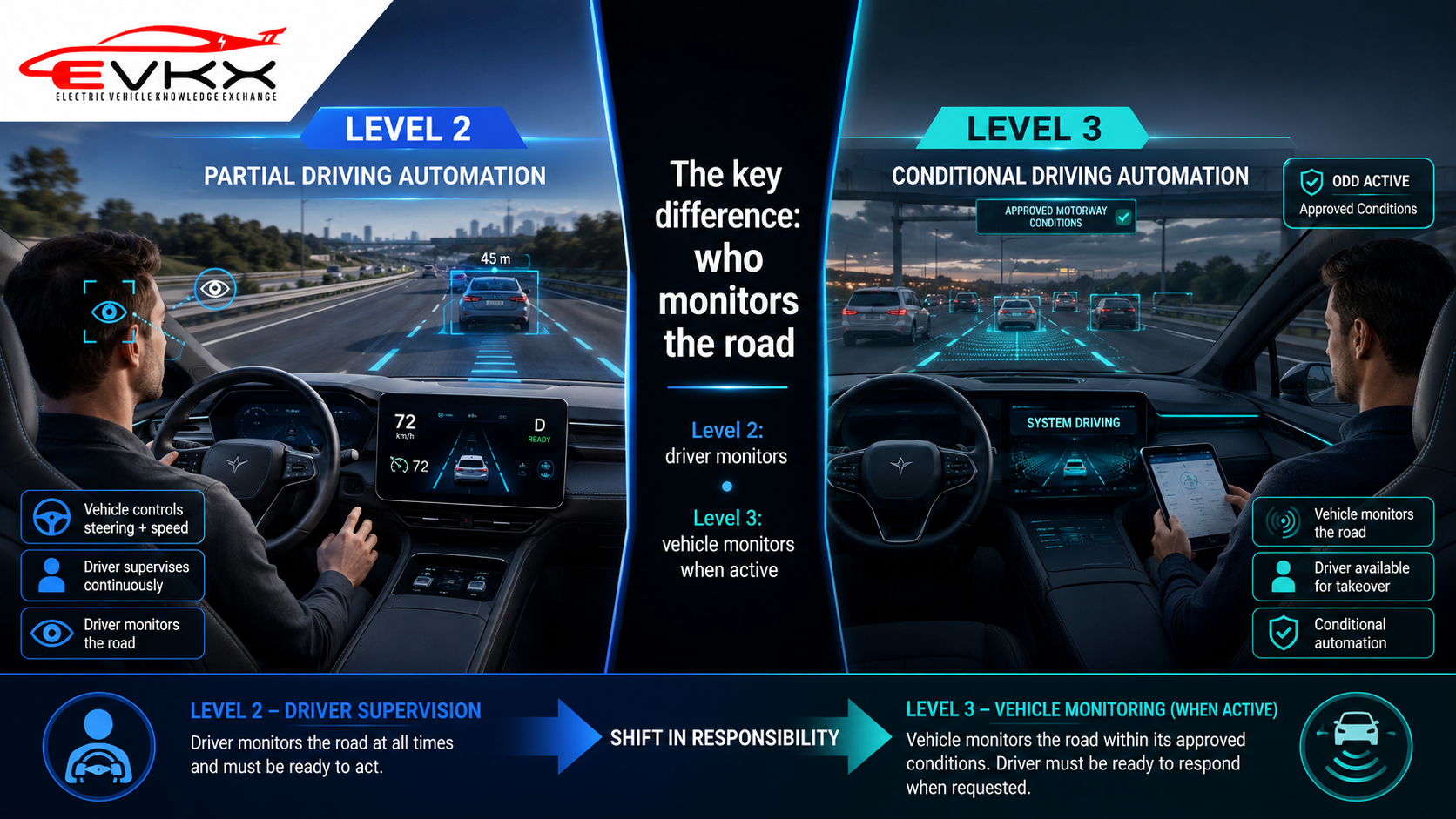
These labels describe the human interface more clearly than many product names:
- Hands-on, eyes-on: the driver supervises and maintains steering-wheel contact or torque.
- Hands-free, eyes-on: the driver may release the wheel but must monitor the road continuously. This is still Level 2.
- Hands-free, eyes-off: the user may divert attention while the system performs the driving task inside its domain. Current production examples are Level 3.
- No driver required: a Level 4 system completes both the driving task and fallback inside its domain.
“Eyes-off” is not permission to ignore system instructions. A Level 3 user must be able to respond to a takeover request. The permitted secondary activities also depend on the vehicle instructions and local law.
A takeover is not a normal disengagement
At Level 2, the human is already supervising. If the feature reaches a limit, the driver should be ready to intervene immediately. A warning may help, but responsibility for monitoring never left the driver.
At Level 3, the user may need time to stop a secondary activity, look at the road, understand the scene and take physical control. A safe transition therefore depends on:
- early detection of an approaching domain boundary;
- clear visual, audible and haptic alerts;
- monitoring that the user is available;
- sufficient transition time for the situation;
- a defined response if the user does not take over; and
- an interface that makes the active mode unmistakable.
The hardest case is a transition prompted by deteriorating conditions. A system should not wait until it has already lost the ability to perceive or control the scene.
Technical role is not the same as legal liability
It is common to say that “the manufacturer becomes responsible” at Level 3. That is too broad. SAE J3016 allocates roles in the driving task; it does not determine civil, criminal or insurance liability.
Liability depends on the jurisdiction, the approved system, whether it was used inside its domain, the condition of the vehicle, event data and the conduct of the user and manufacturer. Level 3 creates a different legal and evidential problem because the system was driving while engaged, but the outcome is not decided by the SAE number alone.
What buyers should verify
Before paying for either type of feature, check the exact vehicle, model year, hardware generation, software version and market. Then ask:
- Is the feature Level 2 eyes-on or approved Level 3 eyes-off?
- On which roads and at what speeds can it engage?
- Which weather, light and traffic conditions exclude use?
- How does the system monitor the driver or fallback-ready user?
- What happens after ignored alerts or a failed takeover?
- Is the capability included, subscription-based or only promised for later?
The correct comparison is not a feature-name contest. It is a comparison of human role, domain, fallback and evidence.