
Lucid Cosmos - What do we know
Lucid Cosmos - What do we know
Lucid revealed the Cosmos on March 12, 2026, at its first Investor Day event. The Cosmos is a midsize electric crossover aimed squarely at the high-volume segment occupied by the Tesla Model Y, Rivian R2, and BMW iX3. It is the first vehicle built on Lucid's new midsize platform, with a starting price under $50,000 and production planned for late 2026. Alongside the Cosmos, Lucid also introduced the Earth (a boxier variant) and the Lunar robotaxi concept, all sharing the same architecture.
What has been confirmed
Lucid shared a substantial amount of technical detail at the Investor Day event and a follow-up media preview, though some key specs remain undisclosed.
The confirmed headline figures: efficiency to deliver 300 miles of range from just 69 kWh of energy, peak efficiency of 4.5 miles per kWh, 0-60 mph in 3.5 seconds in all-wheel-drive form, and a drag coefficient of 0.22 Cd. Charging on the 800-volt architecture can add over 200 miles of range in 14 minutes. The starting price is under $50,000.
Platform and size
The Cosmos rides on a new midsize platform distinct from the larger architecture used by the Air sedan and Gravity SUV. Lucid describes it as a continuation of its efficiency-first philosophy, now scaled down and simplified for higher-volume production.
The exterior has a coupe-like roofline with proportions that recall a smaller Gravity. The front is short and curvaceous, with illuminated Lucid emblems, matrix headlamps, and angled daytime running lights. A front-facing lidar sensor is integrated into the front for future autonomy capability. The rear has a sportback taper that Lucid's design chief Derek Jenkins described as "a three-dimensional puzzle" balancing headroom, cargo space, rear visibility, and aerodynamic efficiency.
Despite the compact footprint, Lucid claims class-leading interior space: 8 percent more second-row legroom, 10 percent more couple distance, and 4 percent overall more passenger space than the closest competitors. Exact exterior dimensions and cargo volume have not been disclosed.
Door handles are manual flush-mount with carved-out recesses, a departure from the electronic pop-out handles used on the Air and Gravity.
Battery, charging, and drivetrain
The central efficiency claim is that the Cosmos needs only 69 kWh of energy to cover 300 miles. That is not a confirmed battery size — it is an efficiency figure. Lucid has not disclosed the actual battery capacity. The point Lucid is making is that superior efficiency allows a smaller, lighter, and cheaper battery to match the range of competitors with much larger packs. Since batteries account for roughly 30 to 40 percent of an EV's total cost, that efficiency advantage is what makes the sub-$50,000 price possible.
Lucid confirmed two battery chemistry options: LFP (lithium iron phosphate) for durability and lower cost, and NMC (nickel manganese cobalt) for higher energy density. The pack uses a structural design, with power electronics housed under the rear seats for easier serviceability.
The 800-volt architecture supports fast DC charging, with 200 miles of range added in 14 minutes. The charge port is NACS, positioned at the rear left. Bidirectional charging is included as standard, supporting V2H (vehicle-to-home), V2L (vehicle-to-load), V2V (vehicle-to-vehicle), and V2X (vehicle-to-everything).
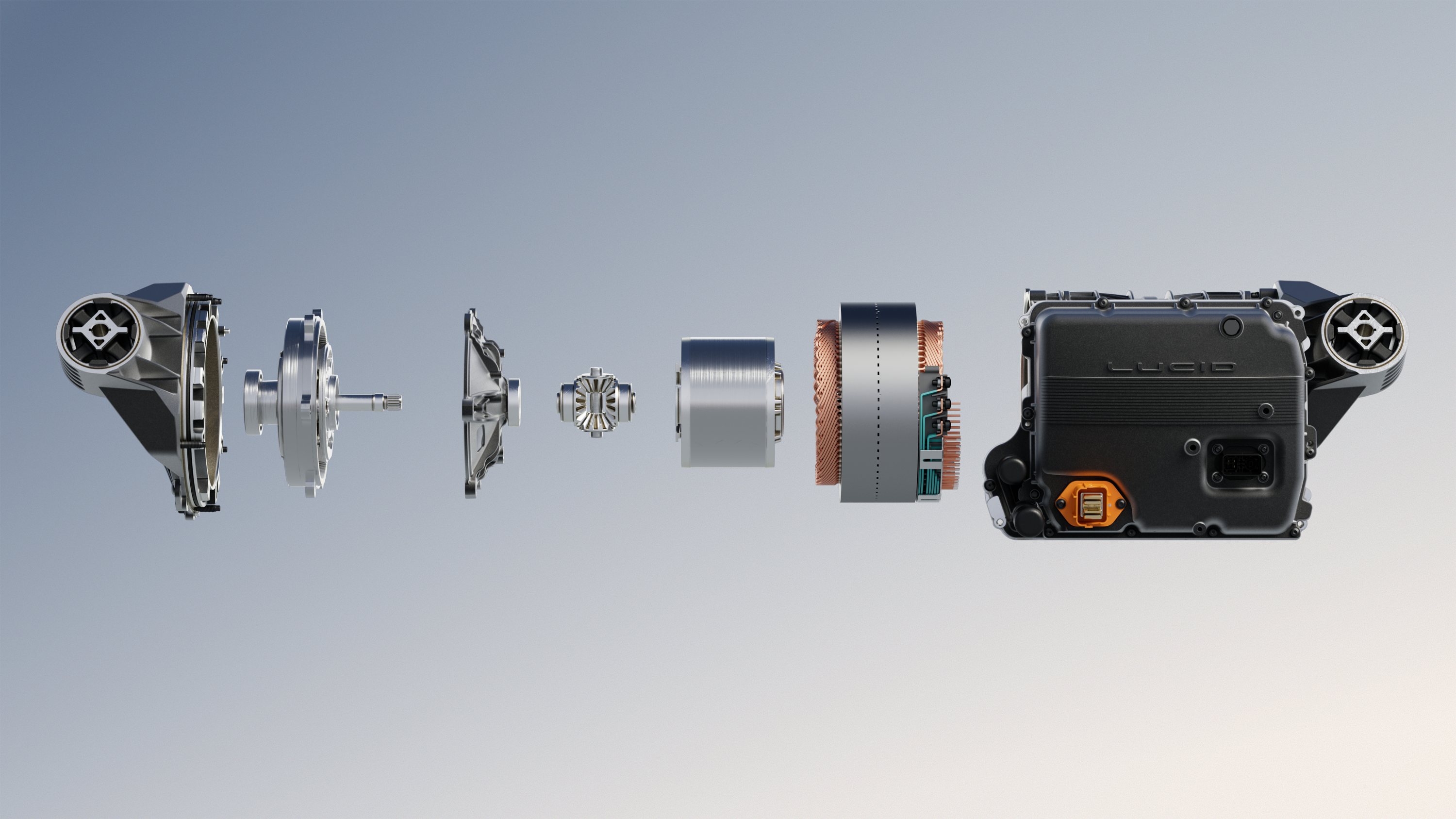
The new Atlas drive unit replaces the Zeus motors used in the Air and Gravity. Lucid says Atlas has 30 percent fewer parts, a 37 percent lower bill of materials, and is 23 percent lighter. Front and rear units are identical, simplifying manufacturing. Lucid claims 40 percent better power density and 10 percent better energy efficiency than the Tesla Model Y's drive unit. Both AWD and RWD configurations will be offered, with the RWD variant optimized for range.
Electrical architecture
One of the more notable engineering details is the centralized electrical architecture. The Cosmos uses only three ECUs, compared to around 12 in the Gravity. Total wiring is 0.6 miles (roughly 1 km), which Lucid says is less than the Model Y (0.8 miles) and the Xiaomi SU7 (1.4 miles). Fewer control units and less wiring means simpler assembly, lower cost, and easier software updates over time.
Body construction
Lucid deliberately avoided full gigacasting for the Cosmos. Instead, the body uses a mix of smaller steel and aluminum castings plus extrusions, with megacasting limited to the wheel arches at all four corners. The rationale is practical: avoiding large single-piece castings lowers insurance costs and makes repairs after minor collisions significantly cheaper. The crash structure uses a multi-stage crumple zone, with a first layer absorbing minor impacts and a second layer handling serious collisions.
Interior and technology
The cabin is built around a single wide curved display that stretches from the driver side to the passenger side, replacing the dual-screen arrangement used in the Gravity. The screen is 36 inches across and is offset slightly toward the driver. Physical buttons are retained for climate and volume.
Seating materials are a mix of fabric and non-leather surfaces, with recycled materials used on the door panels. Lucid describes the interior as a "democratic experience" designed to support future autonomy features and shared cabin interaction, though the company has not detailed what that means in practice.
The steering wheel carries over from the Gravity. No details have been shared about the infotainment software, ADAS feature set, or specific comfort features beyond the display and controls.
Launch timing and production
Lucid plans to start production at AMP-2, its factory in King Abdullah Economic City near Jeddah, Saudi Arabia, by the end of 2026. That plant will primarily serve the Middle East, Europe, and other global markets, but initial batches will also be shipped to North America.
A second production line at a new Arizona factory is expected to come online six to twelve months after the Saudi plant begins output, providing dedicated capacity for the North American market.
Lucid also confirmed that the midsize platform vehicles will be deployed on Uber's ride-hailing network at a scale similar to the existing Gravity robotaxi agreement.
What is still unknown
Several key details remain undisclosed:
- Actual battery capacity (the 69 kWh figure is energy needed for 300 miles, not confirmed pack size)
- Exact exterior dimensions, wheelbase, and curb weight
- Cargo volume (frunk and rear)
- Specific trim levels and option packages
- Detailed ADAS and autonomy feature list
- Infotainment software platform details
- Towing capacity
- Exact pricing by configuration
- EPA or WLTP rated range (the 300-mile figure appears to be an internal estimate)
- Availability dates by region
This article will be updated as more details are released.