
Ferrari Luce - What do we know
Ferrari Luce - What do we know
The Ferrari Luce is Ferrari's first fully electric production car. Announced at the brand's Capital Markets Day on October 9, 2025, the Luce is a four-door grand tourer with all-wheel drive, over 1,000 cv, and a 122 kWh battery on an 880-volt architecture. Ferrari is positioning it not as a compliance car or a cautious first step, but as a new type of Ferrari — one that combines serious performance with GT usability and a cabin experience designed from scratch with LoveFrom, Jony Ive's design studio.
The exterior reveal is scheduled for May 2026, with production deliveries expected in early 2027. Pricing starts north of $535,000.
What has been confirmed
Ferrari has been more forthcoming than expected with technical details. The confirmed headline figures: over 1,000 cv in boost mode, 0-100 km/h in 2.5 seconds, top speed of 310 km/h, and range above 530 km on the WLTP cycle. The battery is a 122 kWh NMC pack developed in-house with cells from SK On, running an 880-volt electrical architecture. DC fast charging peaks at 350 kW, with 10 to 80 percent taking about 18 minutes.
The car has a 2,960 mm wheelbase and weighs around 2,300 kg. It seats four in a two-row layout.
Platform and size
The Luce is a four-door grand tourer — larger and more practical than a traditional mid-engined Ferrari, but not an SUV. The 2,960 mm wheelbase is long, placing it in full-size GT territory. At around 2,300 kg, it is heavy by Ferrari standards but competitive for a large battery-electric performance car.
The two-row, four-door layout signals that Ferrari intends the Luce to cover distance and carry passengers, not just deliver lap times. This is a broader-appeal GT rather than an ultra-low-volume track special.
Battery, charging, and drivetrain
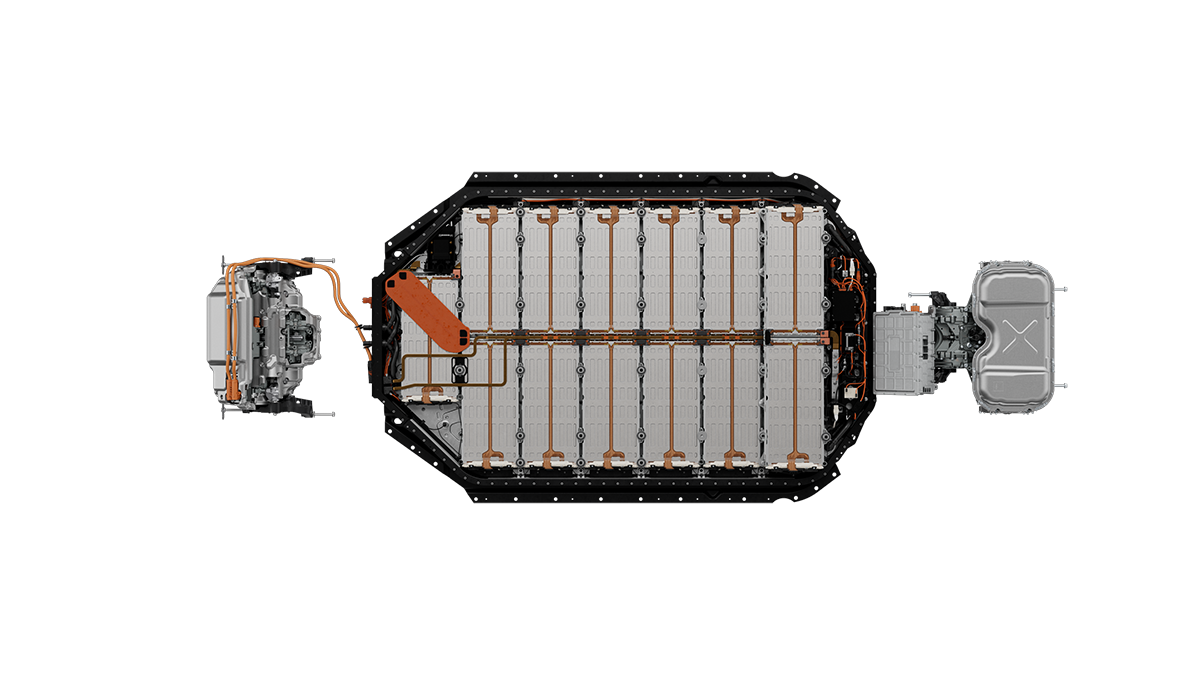
The 122 kWh NMC battery pack is developed in-house by Ferrari, using cells from SK On. The 880-volt architecture is among the highest in the industry and enables fast DC charging at up to 350 kW, with Ferrari claiming a 10 to 80 percent charge in about 18 minutes.
Range is stated as above 530 km on the WLTP cycle. For a car weighing 2,300 kg with over 1,000 cv available, that implies strong efficiency work despite the performance focus.
The drivetrain uses four separate electric motors — two on the front axle and two on the rear — driving all four wheels. Ferrari says the front axle is fully developed in-house, delivering 210 kW total output with 93 percent efficiency at peak power and a power density of 3.23 kW/kg. The front motors spin at up to 30,000 rpm, the rear motors at up to 25,500 rpm. Those rotational speeds are well above what most EV manufacturers target and suggest Ferrari is treating motor development as a defining technical area rather than a commodity component.
Interior and technology
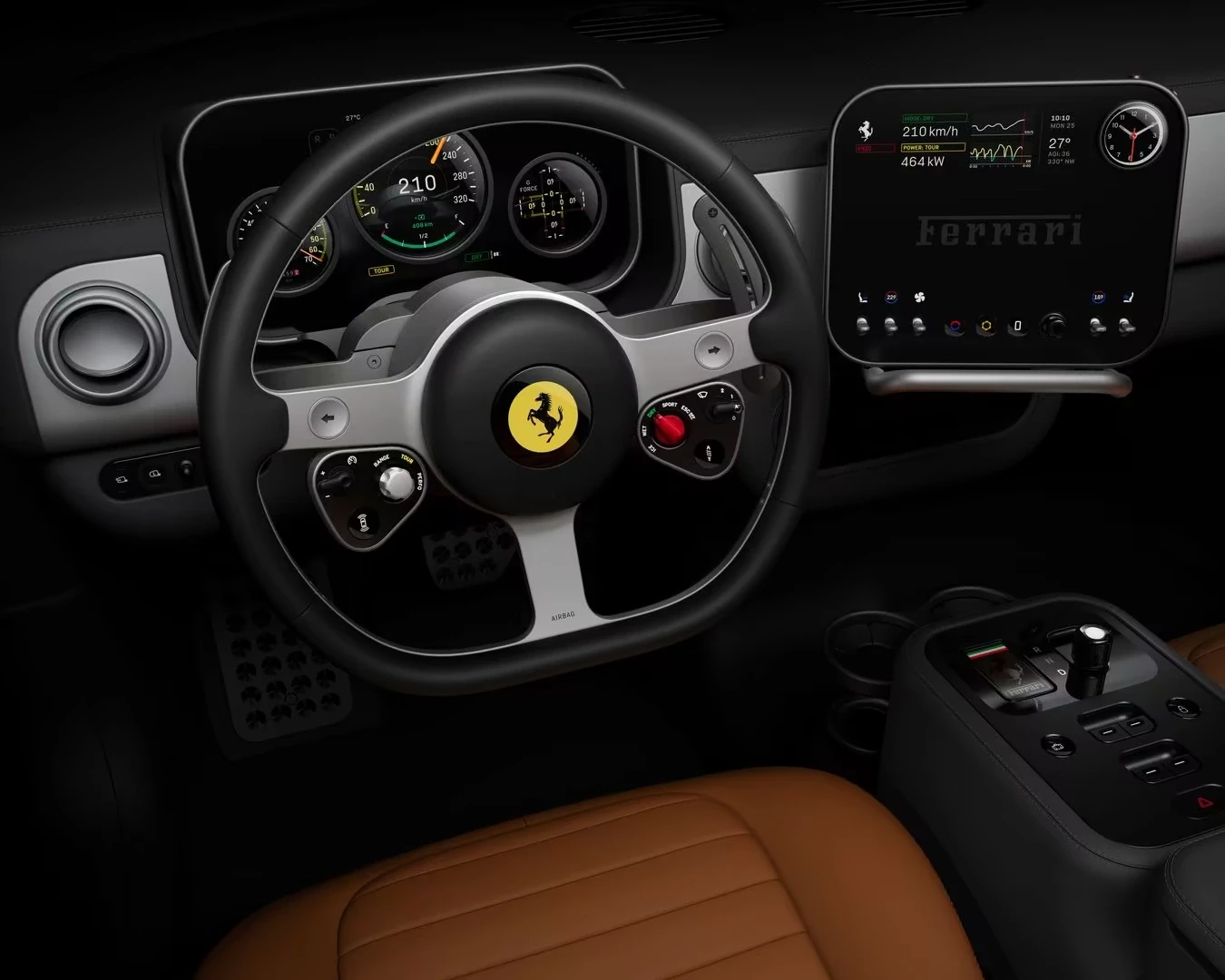
The interior is one of the most distinctive aspects of the Luce and the part that sets it furthest apart from other electric GTs. Ferrari developed the cabin and interface in collaboration with LoveFrom, and the result deliberately avoids the large-touchscreen approach that dominates most modern EVs.
The instrument cluster uses dual overlapping Samsung OLED displays, and their movement is synchronized to the steering wheel's rotation. Below the dashboard is a ball-and-socket mounted center control unit featuring what Ferrari calls a mechanical "multigraph" — a motorized assembly with an analog clock and compass. Physical controls are prioritized throughout. The steering wheel is a three-spoke design made from 19 pieces of recycled aluminum, roughly a pound lighter than a standard Ferrari wheel, with a button layout inspired by Formula One.
Even the key is a design object: it is made from Corning Fusion5 Glass with an integrated E Ink display, and it triggers a choreographed cabin light sequence when docked.
Ferrari's stated goal is to make the interior feel tactile and specific rather than digital and generic. Whether that translates to everyday usability as well as it does to visual drama remains to be seen once the full exterior and cabin are shown in May.
Launch timing and pricing
The exterior reveal is scheduled for May 2026. Production deliveries are expected in early 2027. Ferrari has confirmed pricing north of $535,000 (approximately €460,000), placing the Luce firmly in the ultra-luxury segment alongside models like the Rolls-Royce Spectre rather than the broader performance EV market.
What is still unknown
- Full exterior design (only teasers and spy shots so far)
- Exact power output per motor (front and rear individually)
- Exact dimensions beyond wheelbase
- Cargo volume
- Suspension details
- Individual motor torque figures
- Detailed ADAS features
- Trim levels and option packages
- Confirmed market availability by region
- Full interior material and color options
Below are videos from Ferrari about the design process behind the Luce.
This article will be updated as more details are released.