
Climate systems in electric vehicles
An electric vehicle's climate system is a comfort system, a visibility system, an air-handling system and a significant auxiliary electrical load. Understanding those roles explains why a heat pump can matter in winter, why demisting may switch on the air-conditioning compressor and why climate control can affect a slow trip more than the same distance driven quickly.
What the climate system has to do
HVAC stands for heating, ventilation and air conditioning, but the system has four practical jobs:
- keep occupants within a comfortable temperature range;
- control humidity and clear condensation, frost and ice from the glass;
- bring in, recirculate and filter air;
- distribute conditioned air to the places that need it.
These jobs overlap. Cooling the evaporator also removes moisture from the air. Heating that dried air and directing it at the windshield can clear mist faster than heat alone. A car may therefore run its air-conditioning compressor during cold-weather demisting even though the cabin is being heated.
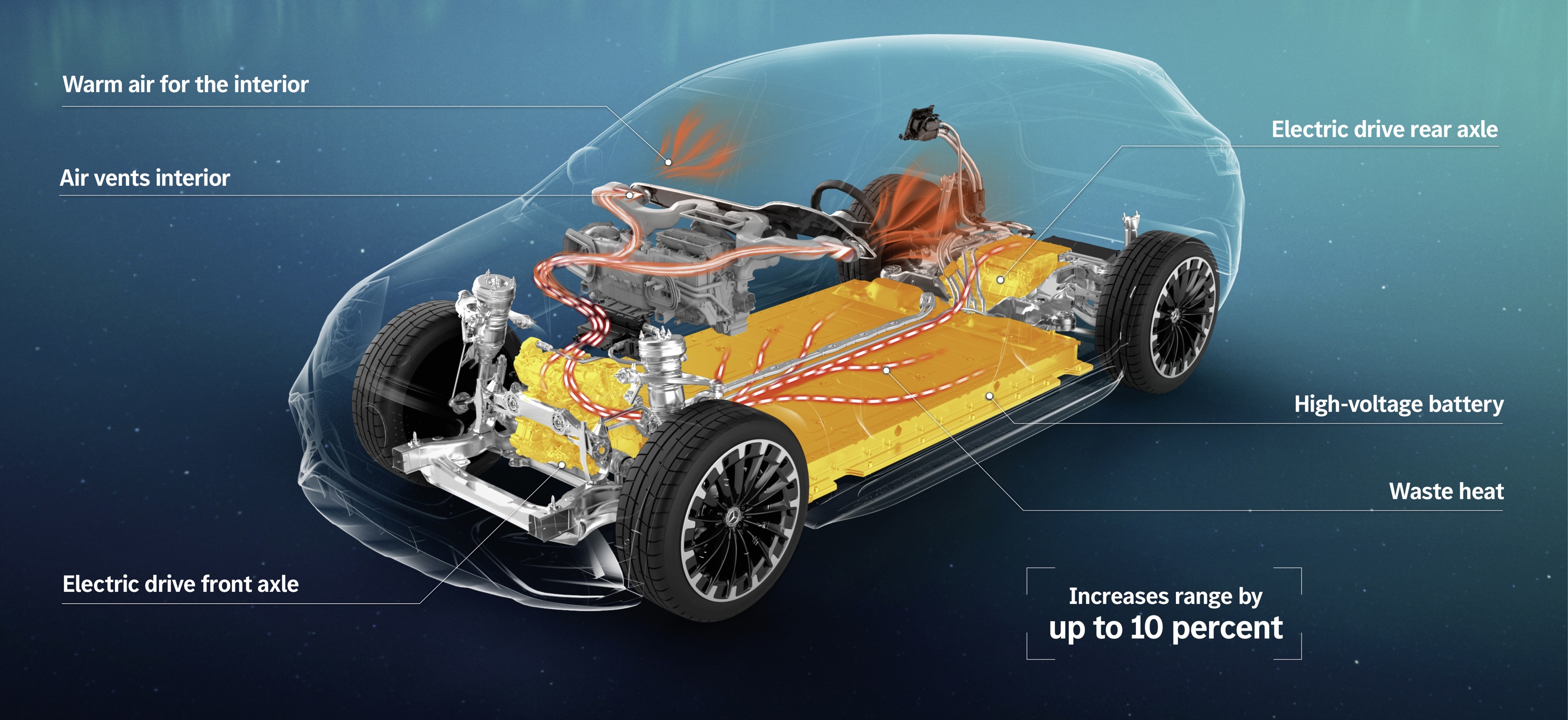
An EV adds another layer. The cabin system draws electrical energy from the same high-voltage battery that propels the car. Cabin conditioning, battery conditioning and power-electronics cooling are different control tasks, but modern EVs may connect them through shared refrigerant or coolant circuits. The exact architecture determines which heat sources can be recovered and where energy can be moved.
How air and heat move through the car
In cooling mode, an electrically driven compressor raises the pressure and temperature of a refrigerant. The outdoor heat exchanger rejects heat, an expansion device lowers the refrigerant's pressure, and the evaporator inside the HVAC housing absorbs heat from cabin air. Moisture condenses on the cold evaporator and drains outside the vehicle.
A blower pushes air through the cabin filter and HVAC housing. Flaps or doors then mix warm and cool air and route it to the dashboard, footwell, rear-cabin and windshield outlets. The driver can select outside air or recirculate cabin air; automatic systems change that mix according to temperature, humidity, air-quality and visibility demands.
Cooling and heat-pump systems use a specific refrigerant and service procedure. In the European Union, mobile air-conditioning systems in new passenger cars have been required to use a refrigerant with a global-warming potential no higher than 150 since 2017. R-1234yf is widely used, while some systems use carbon dioxide under the designation R-744. They are not interchangeable, and R-744 operates at much higher pressure. The refrigerant label under the hood and the owner's manual identify the correct system.
Resistance heating and heat pumps
An electric resistance heater converts electrical energy directly into heat. It is mechanically simple, produces heat regardless of whether useful heat is available elsewhere and has a coefficient of performance close to 1: roughly one unit of heat is delivered for each unit of electricity consumed.
A heat pump uses the compressor and refrigerant circuit to move heat into the cabin. It can collect energy from outside air and, where the vehicle's thermal architecture allows it, from the battery, motor, inverter or onboard charger. Because the compressor is moving existing heat rather than creating all of it electrically, the coefficient of performance can be greater than 1.
That advantage is conditional, not absolute. Heat-pump efficiency changes with ambient temperature, humidity, refrigerant, heat-exchanger size, available waste heat, cabin setpoint and control strategy. Frost on the outdoor heat exchanger may require a defrost cycle. At very low temperatures, the heat pump may be unable to meet the full cabin and battery demand, so many EVs combine it with a resistance heater.
A 2024 U.S. Department of Energy analysis illustrates the boundary. In one comparison at 20°F (-6.7°C), a vehicle combining a heat pump and resistance heater used 38% less total HVAC power than the resistance-only comparison vehicle. At 0°F (-17.8°C), the heat pump contributed much less and resistance heating supplied most of the demand. These are results from the tested vehicles and conditions, not a universal efficiency rating for every heat pump.
Zones, vents and automatic control
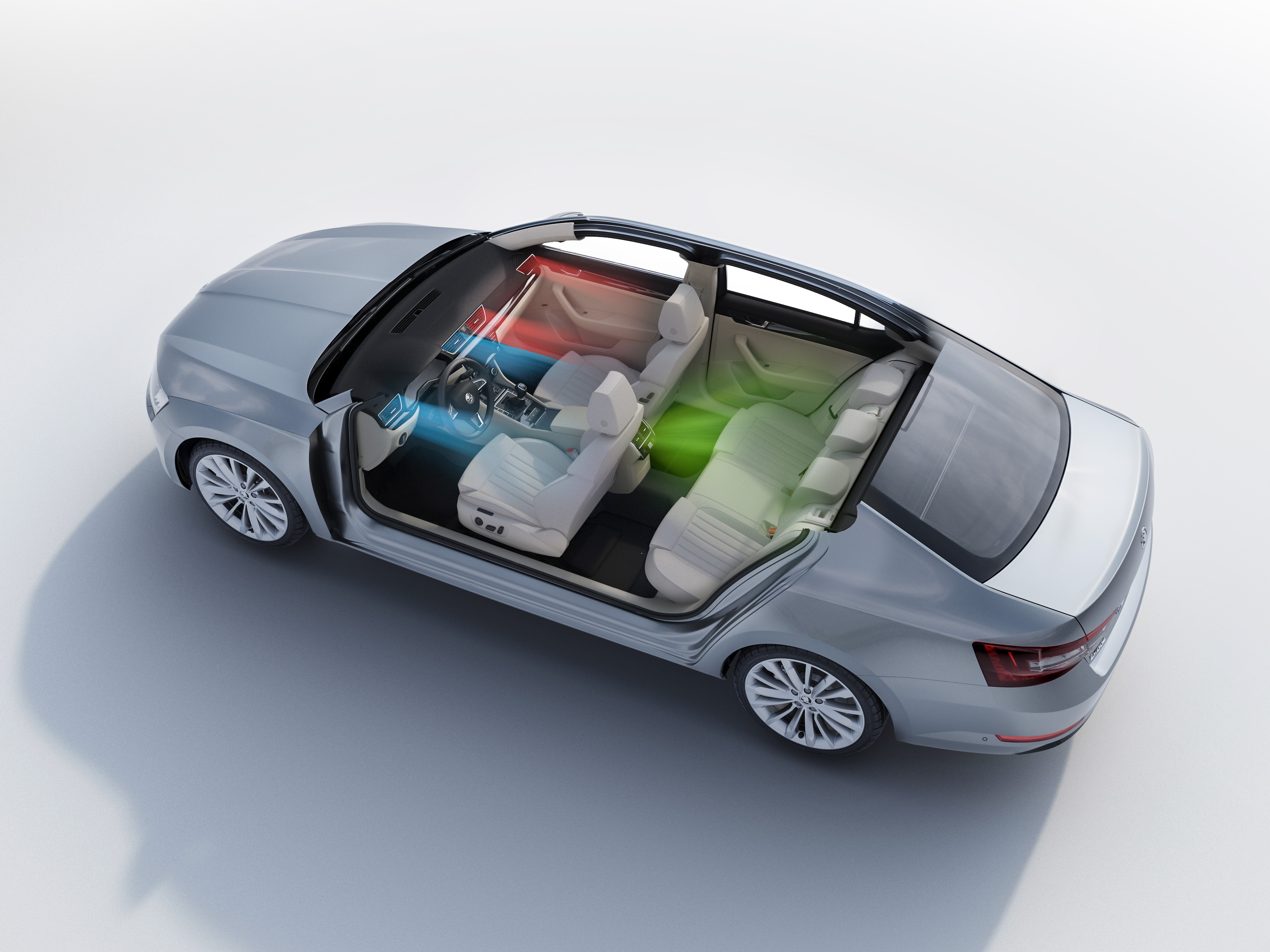
A climate zone is an independently adjustable temperature area, not a sealed bubble with its own complete air-conditioning system. Most multi-zone systems share the compressor, evaporator, heater and much of the ductwork, then use temperature flaps and airflow control to create different conditions.
Common labels usually mean:
- one zone: one cabin temperature setpoint;
- two zones: separate front-left and front-right setpoints;
- three zones: two front zones plus a rear setting;
- four zones: separate left and right settings in both front and rear.
The implementation varies. A rear temperature control does not by itself prove that every rear seating row has dedicated vents, and rear vents do not necessarily mean the rear is a separate zone. Large cabins also need enough airflow to reach the third row, something a zone count does not reveal.
Automatic climate control uses sensor data to adjust compressor speed, valves, blower speed, recirculation and air distribution. Depending on the vehicle, inputs may include cabin and outside temperature, solar load, humidity, windshield temperature, seat occupancy and measured pollutants. The displayed temperature is a target for the control system, not the temperature of the air leaving a vent.
Vent placement and adjustment
The visible outlet is only the last part of the airflow path. Inside the HVAC housing, upstream mode doors decide whether air is sent toward the windshield, face-level outlets or footwells, while blend doors regulate how much air passes through heating and cooling sections. The outlet that an occupant can see and touch then shapes the final direction, spread and velocity. An automatically controlled blend or mode door does not necessarily mean that the visible vent is motorized.
Outlet placement reflects several different jobs:
- windshield outlets run along the base of the glass and spread air across the windshield for demisting and defrosting;
- side-window demist outlets sit near the ends of the dashboard or A-pillars and direct air toward the front side glass;
- dashboard outlets aim face-level air at front occupants and are normally split between center and side positions;
- footwell outlets deliver warm air low in the cabin and help establish upward natural convection;
- rear-console outlets provide a shorter path to second-row passengers than front dashboard vents;
- under-seat outlets can move air toward rear footwells, but their effectiveness can be reduced by luggage, floor mats or the seat position;
- B-pillar, door or roof outlets can improve upper-body airflow in long cabins and give second- or third-row passengers a more direct supply.
Placement alone is not enough. Long or narrow ducts add pressure loss, bends and small outlets can increase noise, and a high-velocity jet may cool quickly while feeling draughty. A vent that works well for an adult may blow into a child seat or miss a reclined third-row passenger. The useful questions are therefore where the outlets are, how much air reaches them, whether each outlet can be closed and redirected, and how quietly the system delivers that air.
Manual outlet adjustment
The traditional solution uses horizontal and vertical louvers, a rotating nozzle or a small thumbwheel. The occupant moves the visible parts by hand to aim, spread or shut off the airflow. This is separate from selecting face, floor or windshield distribution on the climate panel.
Manual adjustment is direct, tactile and easy to understand. It usually retains its position, needs no actuator or software command and can be changed without opening an on-screen menu. Its limitations are equally clear: the car cannot normally restore a preferred direction from a user profile, automatically aim at an occupied seat or move a vent that the occupant cannot reach. Closing one manual vent also does not create a new climate zone; it mainly changes resistance and airflow within the shared duct system.
Electronic and hybrid outlet adjustment
A motorized outlet uses small actuators to change the final airflow direction or spread. It can be coordinated with automatic climate control, seat occupancy and stored profiles, and it enables concealed or louvre-free designs. Porsche's Taycan implementation, for example, electronically controls the vents and offers focused, diffused and individual airflow settings. Tesla's Model 3 uses touchscreen air waves to direct a face-level outlet and can split one indicated stream into two, while noting that each split stream is weaker than a single stream.
Electronic control can make repeatable profiles and automatic occupant targeting possible, but it adds actuators, wiring, calibration and software. It can also add input latency and new failure modes. A touchscreen representation may show the intended setting without making the physical airflow immediately obvious, and adjusting it while driving may require more visual attention than moving a familiar louver.
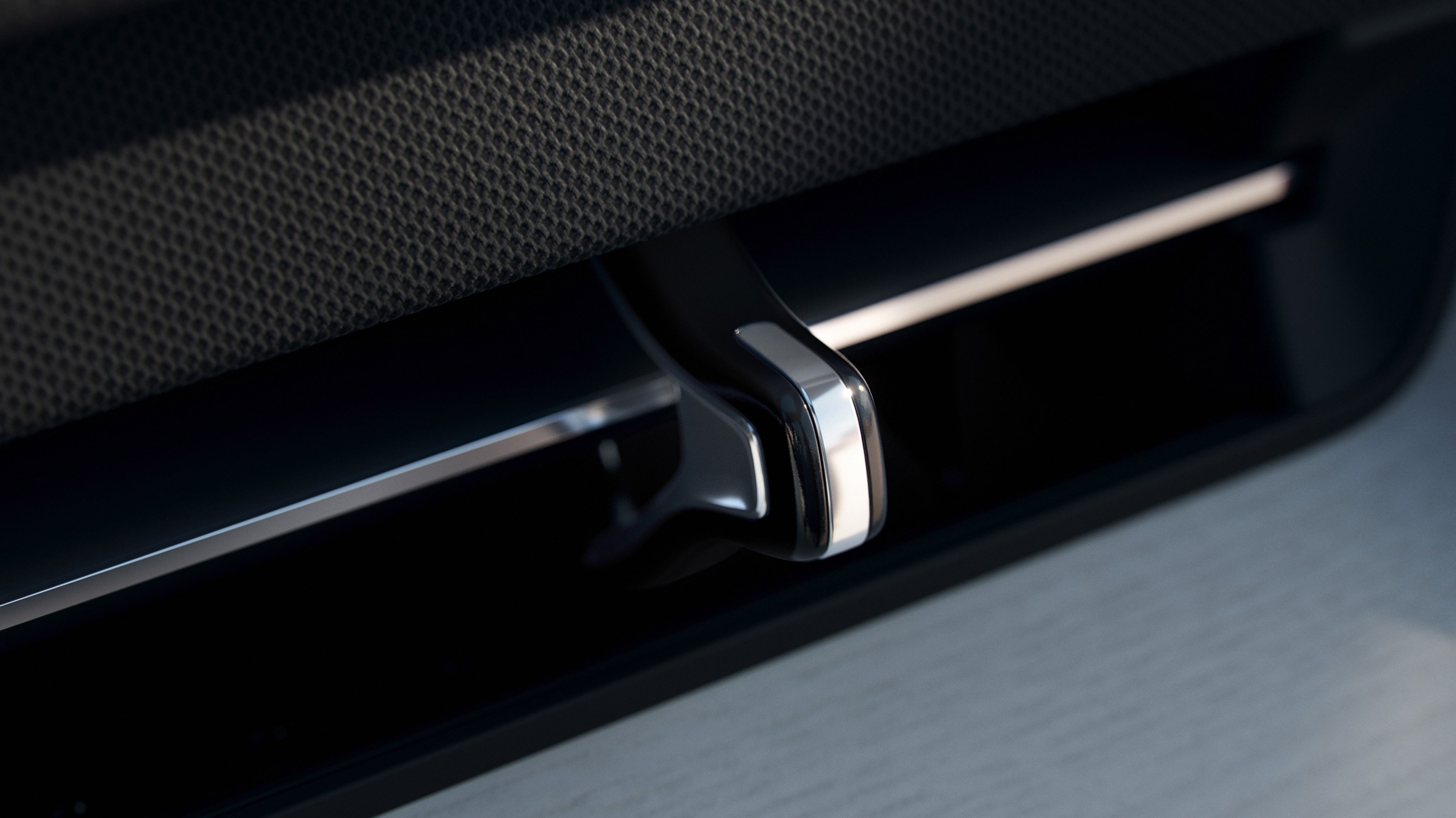
The two approaches are not mutually exclusive. Volvo's EX90, for example, opens and closes selected vents through the center display but uses physical knobs to redirect the airflow. Such a hybrid separates a software-controlled shutoff function from a tactile direction control.
For any design, usability matters more than whether the mechanism is marketed as manual or digital. The control state should be understandable, common adjustments should be convenient while driving, and essential windshield demisting must not depend on precisely aiming a face-level outlet.
Air quality, recirculation and clear glass
Cabin filters differ substantially. A basic particle filter can catch dust and pollen; activated-carbon layers can reduce some gases and odors; high-efficiency systems can remove smaller particles more effectively. A marketing name such as "HEPA" is useful only when the manufacturer states the tested filter class, particle size and operating mode.
Recirculation reduces the amount of outside air entering the cabin. It can lower the heating or cooling load and, together with effective filtration, reduce exposure to outside smoke and particles. It also retains moisture and carbon dioxide produced by occupants. The U.S. Environmental Protection Agency's 2026 wildfire-smoke guidance therefore recommends recirculation to reduce smoke exposure, but warns that carbon dioxide can build up during extended recirculation in a closed, occupied car. Automatic systems may periodically admit outside air to balance these demands.
Visibility takes priority over small energy savings. A maximum-demist mode commonly selects windshield outlets, a high blower speed, heat, dehumidification and at least some outside air. Electrically heated windshields and rear windows can add direct glass heating. Drivers should use the vehicle's demist function rather than forcing recirculation when the glass is fogging.
Heating the occupant instead of the whole cabin
Seats, steering wheels, armrests, panels and other contact or radiant surfaces can make occupants comfortable before all the cabin air and interior materials have warmed. That can let the main HVAC system use a lower airflow or temperature setting. NREL testing has shown that combining zonal airflow with local heaters can reduce cabin-heating energy while maintaining measured occupant comfort, although the result depends on the vehicle and test cycle.
The Lexus RZ is one production example: available radiant panels warm the driver and front passenger around the lower legs. The panels supplement the climate system; they do not replace the airflow needed to manage humidity and keep the windows clear.

Seat ventilation also needs careful wording. Many ventilated seats use fans to move cabin air through the seat and do not refrigerate it. A genuinely cooled seat may use thermoelectric elements or air supplied by the climate system.
ZF has demonstrated a heated seat belt with conductors woven into the webbing. The supplier presents it as a way to warm the upper body directly and reduce demand on the main cabin heater when combined with heated seats and a heated steering wheel. It is a supplier-developed technology, not evidence that a particular production EV includes the feature.
Why climate-related range loss is easy to misread
Traction energy is normally expressed per distance, such as kWh/100 km. Climate control is primarily a power load over time:
climate energy (kWh) = average climate power (kW) × operating time (hours)
That distinction makes speed and trip length important. Consider a deliberately simplified car that uses 18 kWh/100 km for traction while the climate system averages 2 kW:
- At an average of 50 km/h, 100 km takes two hours. Climate control uses 4 kWh, bringing total energy to 22 kWh. With a fixed battery, theoretical range is 18.2% lower than without the climate load.
- At an average of 100 km/h, the same distance takes one hour. Climate control uses 2 kWh, bringing total energy to 20 kWh. The theoretical range reduction is 10%.
The example holds traction consumption and climate power constant only to expose the time effect. A real car normally uses more traction energy at high speed, and HVAC power is not constant: it is often highest during initial warm-up or cooldown, then falls as the cabin approaches its target. Solar radiation, humidity, wind, glass area, insulation, occupant count, door openings and battery-conditioning demand all change the result.
This is why a single claim that climate control "costs 20% range" is incomplete. The answer must specify the vehicle, ambient and cabin temperatures, trip duration, average speed, starting temperatures, test cycle and whether the battery and cabin were preconditioned.
Preconditioning and efficient use
Preconditioning heats or cools the cabin before departure. When the car is connected, some or all of that energy can come from the charger instead of stored battery energy. It also reduces the large initial cabin load after departure. In the DOE analysis, preconditioning reduced battery energy use by 9–20% in a 7.5-mile (12 km) regulatory city cycle at 20°F (-6.7°C). The result is specific to that short cold-weather test, but it demonstrates why departure scheduling is most valuable before short trips.
Cabin preconditioning and battery preconditioning should not be treated as synonyms. A vehicle may warm the cabin without preparing the battery for rapid charging, or may heat the battery for a fast-charging stop without making a visible change to the cabin. The owner's manual should state what a scheduled departure, remote-climate command or charger-route command actually does.
Practical ways to reduce climate energy without compromising visibility include:
- precondition while connected when the vehicle supports it;
- use automatic climate control and a moderate setpoint instead of repeated maximum heating or cooling;
- use seat and steering-wheel heating to reach comfort sooner;
- enable occupant-based or zonal modes when unused areas can be conditioned less;
- keep the cabin filter within its service interval and keep air intakes clear of snow and debris;
- use shade and cabin pre-cooling to reduce the initial summer heat load.
Stationary climate and pet modes
A pet mode—called Pet Mode by Tesla and Pet Comfort by Rivian—is a controlled parked state that keeps the cabin climate running after the driver leaves. It differs from remote preconditioning, which prepares the vehicle for a future departure and may stop after a short timer. A dedicated pet mode is intended for a brief unattended stop, normally keeps the vehicle secured and tells people outside that active climate control is maintaining the cabin temperature.
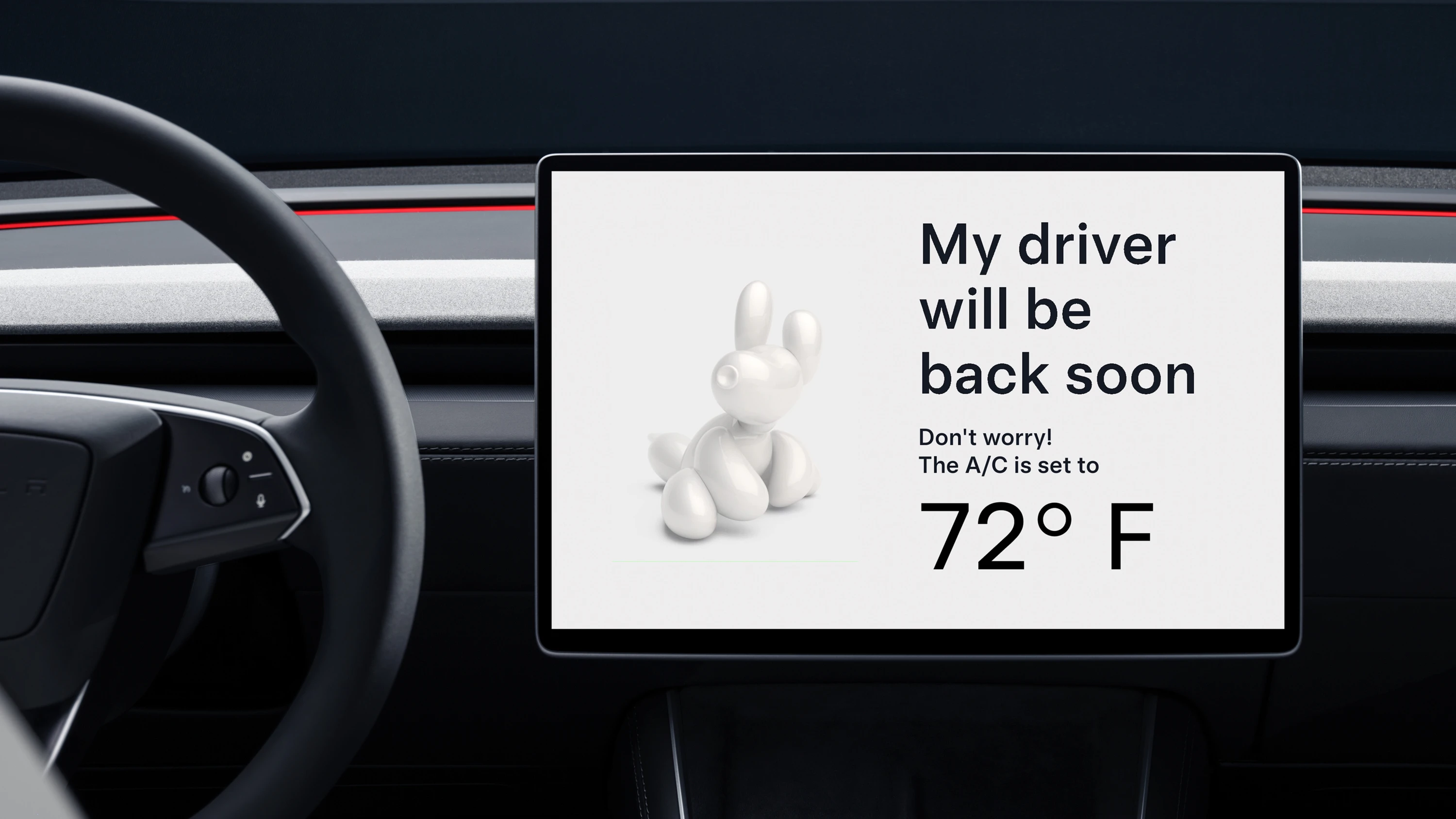
Tesla's current Model 3 manual says Pet Mode requires the owner to stay nearby and monitor the cabin actively and frequently through the mobile app. Both the phone and vehicle need cellular connectivity. The center display shows the cabin temperature, the windows are disabled, software updates are blocked, and the app warns about a significant temperature change, a climate-system fault or shutdown. Pet Mode stops when the battery falls below 20%.
Rivian's Pet Comfort illustrates a different implementation. It can be enabled only in Park with more than 50 miles (80 km) of indicated range. It disables the cabin movement sensor, blocks over-the-air updates, shows the current and target temperatures on the center display and uses the app for status and fault notifications.
These examples show why a credible pet mode is more than leaving the air conditioning switched on. It must coordinate the high-voltage battery, low-voltage supplies, climate controller, locks and windows, interior alarm, display, connectivity, notifications and software-update state. It also needs defined responses to low energy, a sensor or compressor fault, lost connectivity, an opened door and temperatures moving outside the intended range.
Why an automaker may not offer pet mode
Automakers seldom publish a reason for omitting pet mode, so it would be misleading to assign the same motive to every brand. Comparing the official implementations above with ordinary remote-climate systems nevertheless exposes several product and engineering considerations:
- Failure handling carries unusual consequences. The feature is used precisely when an animal is unattended and cannot leave the cabin. A temperature setpoint without fault detection, energy reserves and a clear shutdown strategy can create false reassurance.
- It crosses several vehicle systems. Climate control alone is insufficient; the vehicle must define alarm behavior, door and window behavior, display messaging, battery thresholds, app monitoring and software-update conflicts.
- Duration and energy are difficult to guarantee. Solar load, ambient temperature, battery charge, thermal-system condition and cellular coverage change during the stop. A manufacturer must decide when the mode may start, when it must warn and when it must stop.
- Animal-welfare advice and local rules vary. Tesla explicitly tells owners to check local laws and keeps responsibility with the owner. Norway's Food Safety Authority warns that parked cars can heat rapidly, even in cloudy weather, and that rising humidity makes it harder for a panting dog to cool itself.
- Validation and support extend across trims and markets. Hardware, sensors, modem services, app availability and legal wording can differ by vehicle and country. Supporting a named pet-safety feature therefore requires more validation and long-term software support than a generic climate timer.
Some manufacturers instead offer bounded remote climate. Ford, for example, documents remote-start durations of five, ten or fifteen minutes, with an extension limit of 35 minutes on supported vehicles. A timer limits energy use and the unattended operating state, but it is not a pet mode: it does not by itself promise continuous operation, pet-specific monitoring, an exterior-facing message or a safe response if climate control stops.
These factors explain why an automaker may decide that time-limited preconditioning is a better-defined product than a named pet mode. That is an evidence-based engineering inference from the documented system requirements, not a public explanation issued collectively by manufacturers that omit the feature.
No pet mode makes leaving an animal risk-free. The owner must understand the exact battery threshold, timeout, warning path and connectivity requirement; remain close enough to return immediately; and follow local animal-welfare guidance. Pet modes are never intended for unattended children.
What buyers should check
The presence of a heat pump is only the first question. Buyers in cold climates should check whether it is standard or optional on the exact trim and market, what backup heater is fitted and how the vehicle performs in independent low-temperature testing. They should also verify:
- remote and scheduled preconditioning, including what happens while plugged in;
- stationary climate or pet mode, including its battery threshold, timeout, alerts and connectivity requirements;
- the actual outlet placement for every seating row, not just the advertised zone count;
- whether each outlet can be shut off and redirected independently;
- whether vent direction is manual, motorized or hybrid, and how easy it is to adjust while driving;
- whether electronic vent settings survive a restart or follow the active user profile;
- airflow, noise and draught at the second and third rows, including around any child seat;
- heated seats, steering wheel, windshield and other local-heating equipment;
- cabin-filter specification, replacement cost and air-quality modes;
- how quickly the system clears mist during a damp test drive;
- whether essential climate functions remain easy to operate while driving.
A well-engineered climate system is not simply the one with the most zones or the highest peak heating power. It keeps the glass clear, occupants comfortable and cabin air acceptably clean while using the vehicle's thermal resources intelligently across the conditions in which the car will actually be driven.
Sources
- U.S. Department of Energy: Impact of Cold Ambient Temperature on BEV Performance
- National Laboratory of the Rockies: Light-Duty Vehicle Thermal Management
- NREL: Climate Control Load Reduction Strategies for Electric Drive Vehicles in Cold Weather
- Hyundai Motor Group: EV Heat-Pump Waste-Heat Recycling
- Lexus: How the RZ 450e Uses Radiant Heating
- ZF: Heat Belt for Electric Vehicles
- U.S. EPA: Wildfire Smoke—A Guide for Public Health Officials
- European Commission: Mobile Air-Conditioning Systems
- U.S. EPA: Acceptable Motor-Vehicle Refrigerants and Their Impacts
- Tesla Model 3 Owner's Manual: Pet Mode
- Rivian: Pet Comfort
- Ford: Remote Start and Climate Duration
- Norwegian Food Safety Authority: Do Not Leave a Dog in a Hot Car
- Tesla Model 3 Owner's Manual: Adjusting the Front and Rear Vents
- Volvo EX90 Owner's Manual: Adjusting Air Vents
- Porsche: Taycan Virtual Airflow Control