
EV brakes: friction braking, brake blending and brake-by-wire
Friction brakes give electric vehicles predictable deceleration when the battery or motors cannot accept more energy, at very low speeds, during emergency stops, and whenever the stability systems need wheel-by-wheel control.
This guide focuses on friction brakes and the systems that operate them; energy recovery, one-pedal driving, and selectable regeneration are covered in the separate EVKX regenerative braking series.
The braking system, not just the brake hardware
A modern EV uses several systems to turn a request for deceleration into a controlled stop:
- The driver or an assistance system requests deceleration. The request can come from the brake pedal, automatic emergency braking, adaptive cruise control, or a stability-control intervention.
- The brake-control system decides how to produce it. Depending on the vehicle and conditions, it can use the drive motor, the friction brakes, or both.
- The foundation brakes create friction at the wheels. These are the discs and pads, or drums and shoes, that convert kinetic energy into heat.
- The tyres transmit braking force to the road. Once a brake can exceed the available tyre grip, larger discs or more pistons do not by themselves shorten a single emergency stop.
The service brake, parking brake, anti-lock braking system (ABS), and electronic stability control (ESC) have different jobs. ABS controls wheel slip under hard braking, while ESC can brake individual wheels to stabilize the car. EVKX explains these systems separately in Anti-lock braking system (ABS) and Electronic stability control (ESC).
Braking regulations are based on vehicle performance, not on a prescribed rotor material or caliper design. The test programs cover stopping distance, hot-brake performance, partial failures, loss of power assistance, parking-brake holding, and—in EVs—failures involving regenerative braking or an electrically transmitted brake command. UNECE Regulation No. 13-H, Revision 4: passenger-car braking NHTSA FMVSS 135 light-vehicle brake test procedure
Why speed, mass, and tyres matter
The energy that must be removed in a stop is the vehicle's kinetic energy:
E = ½mv²
Adding mass increases that energy in direct proportion. Doubling speed multiplies it by four. A heavy EV therefore asks its brakes to absorb more heat than a lighter vehicle at the same speed, and high-speed stops are far more demanding than the size of the speed increase suggests.
In an ideal grip-limited stop, mass largely cancels from the basic deceleration equation. In the real world, tyre load sensitivity, weight transfer, brake balance, suspension, road surface, temperature, tyre condition, and ABS calibration all matter. The brakes must generate enough torque and manage enough heat, but the tyre-road contact ultimately limits how much force reaches the road. Continental guide to braking distance and tyre condition
Under braking, load transfers toward the front axle. That is why many EVs use larger, better-ventilated front brakes even when their static weight distribution is close to 50:50.
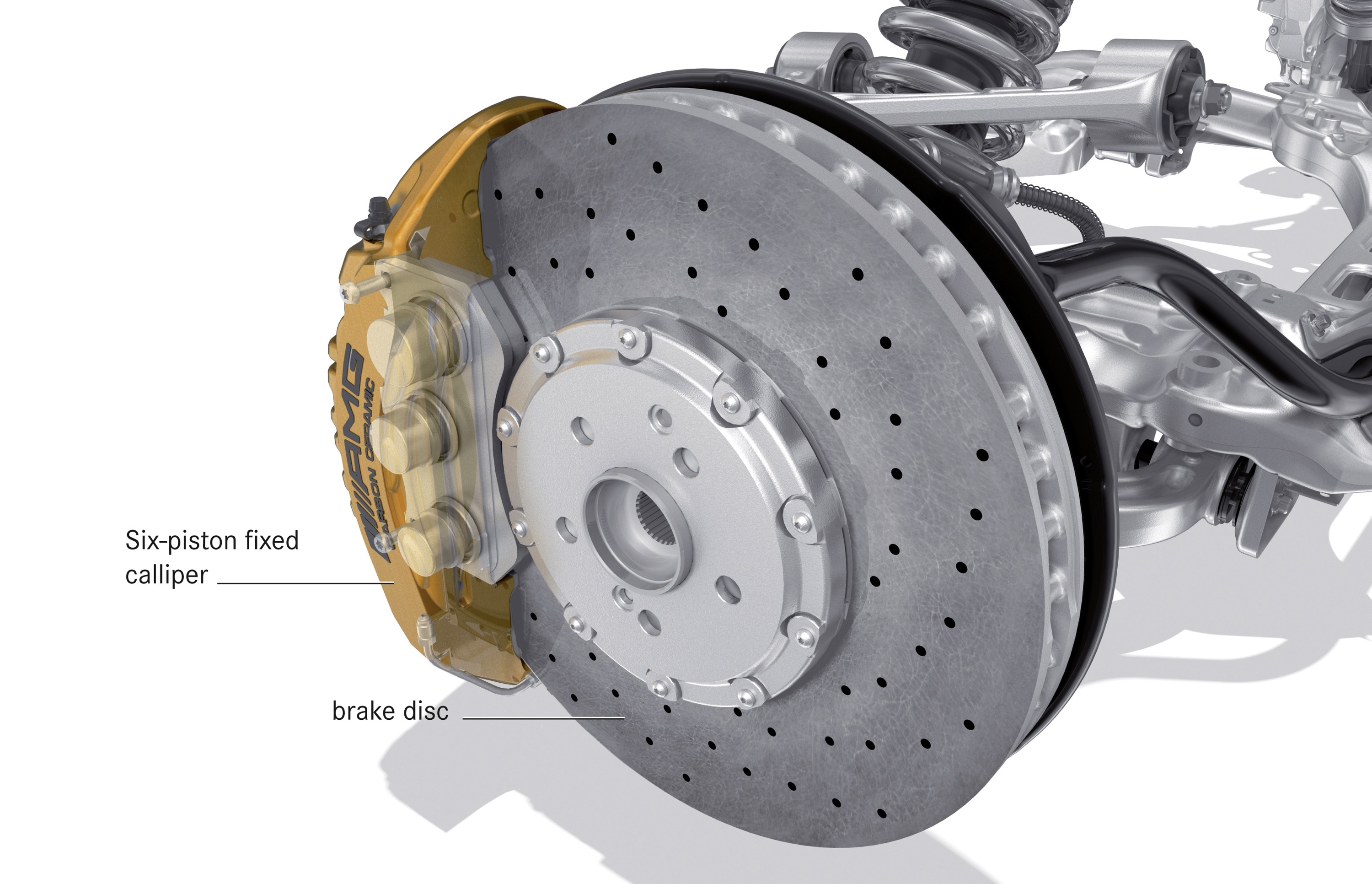
Disc brakes
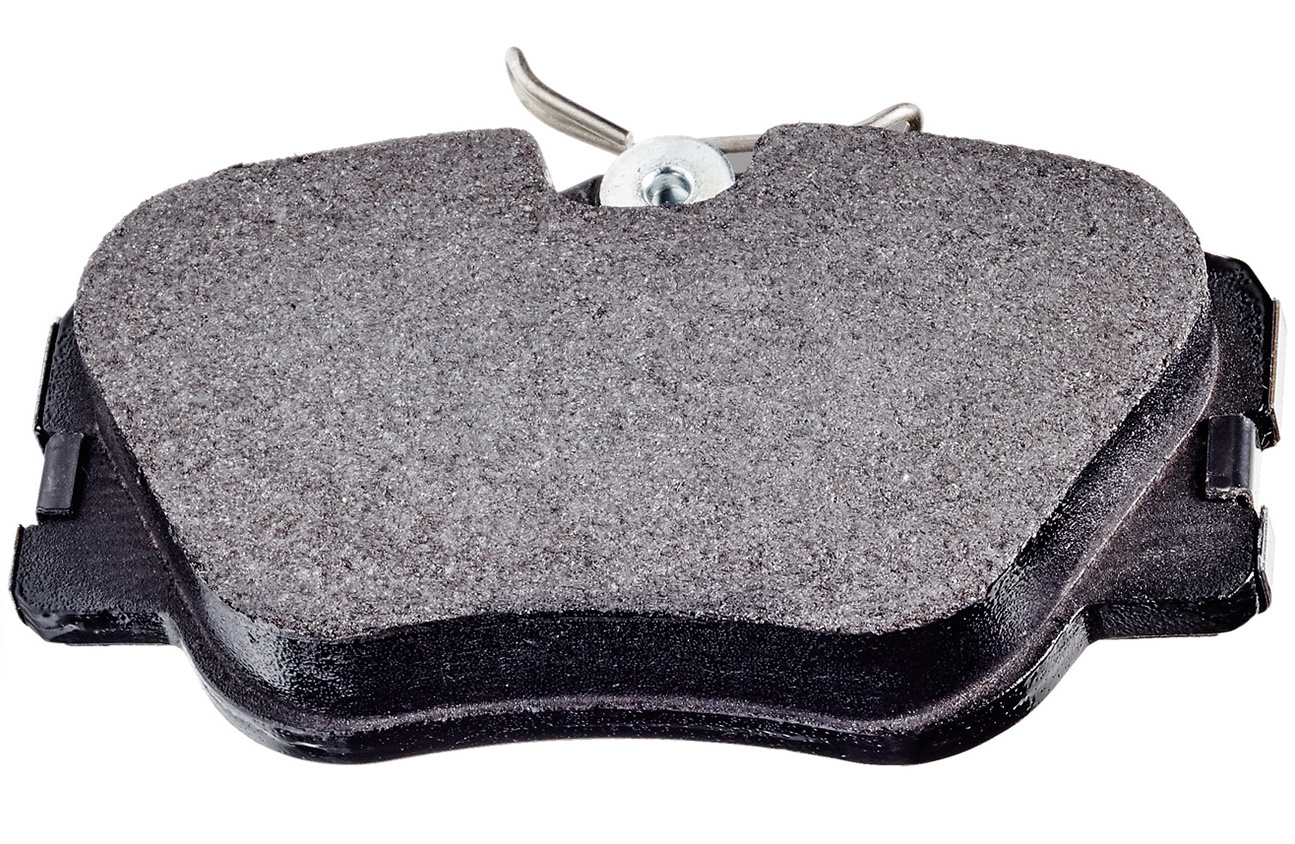
A disc brake has a rotor attached to the hub, a caliper mounted around the rotor, and a pad on each side. Hydraulic pressure—or, in an electromechanical brake, an electric actuator—forces the pads against the rotating disc. Friction creates brake torque and changes the vehicle's kinetic energy into heat.
Brake torque depends mainly on clamping force, the friction between pad and rotor, and the effective radius at which that force acts. Rotor diameter, pad area and shape, caliper stiffness, cooling, pedal system, software, tyres, and axle balance all matter. Piston count alone is not a measure of braking performance.
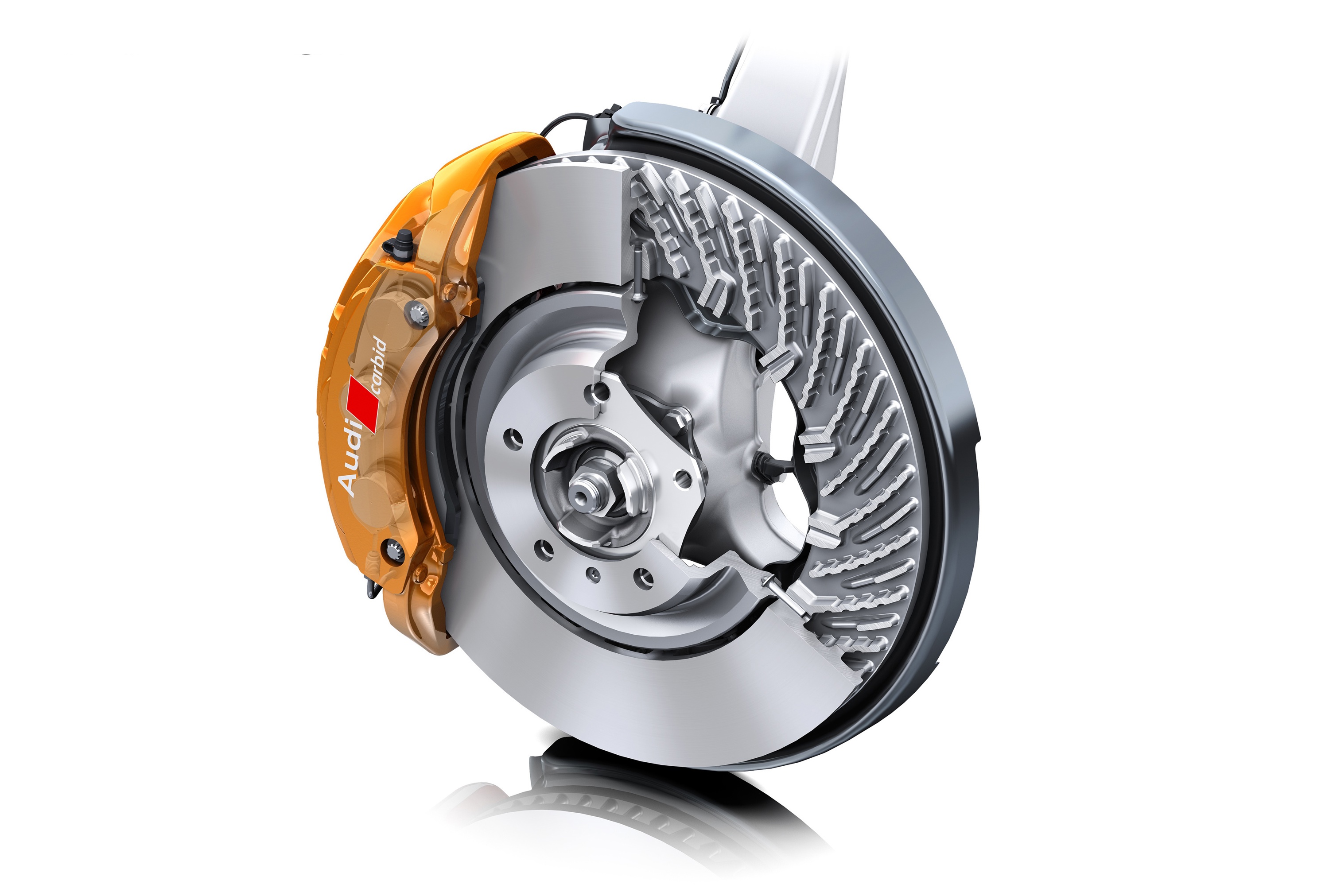
Grey cast-iron discs
Most road-car brake discs are made from grey cast iron, even though they are often casually called “steel brakes.” Cast iron provides stable friction, good heat capacity, useful thermal conductivity, and relatively low cost.
Front discs are commonly ventilated: internal vanes pump air through the rotor as it turns. Rear discs may be solid when their thermal load is lower. A larger diameter can increase brake torque, while greater thickness and more effective ventilation add thermal capacity and cooling; all can also add cost and unsprung mass. Drilling and slotting can help water clearance, pad conditioning, cooling, or gas evacuation in a specific design, but they are not a universal indication of better stopping performance.

Coated cast-iron discs
An iron rotor can be protected with a hard surface treatment or coating to reduce corrosion and wear. These solutions are especially relevant to EVs because light everyday braking may leave an ordinary rotor wet or salty for long periods.
Porsche's Surface Coated Brake is one well-documented example. It applies a tungsten-carbide layer to a grey-iron disc to resist rust, wear, and brake-dust formation. A coated iron disc should not be confused with a carbon-ceramic disc: the base material, manufacturing process, thermal behavior, repair cost, and matching pads are different. Porsche Surface Coated Brake technical explanation
Carbon-ceramic discs
Road-car carbon-ceramic discs normally use carbon-fibre-reinforced silicon carbide. Compared with a similar cast-iron rotor, they can cut rotor mass substantially and offer high resistance to corrosion, wear, heat, and fade. Lower rotating and unsprung mass can also benefit steering and suspension response.
The trade-offs are high manufacturing and replacement cost, model-specific pads and service procedures, and performance characteristics that must be engineered for road use. Their main case is repeated high-energy braking and weight reduction in performance vehicles—not an ability to “handle the heat from regenerative braking,” because regeneration sends energy to the electrical system rather than the friction brakes. Brembo carbon-ceramic brake-disc technology

Floating and fixed calipers
A floating, or sliding, caliper usually places one or more pistons on the inboard side. When they press the inner pad against the disc, the caliper body slides on guide pins and pulls the outer pad into contact. This compact and cost-effective design is common on road cars. Its guide pins and boots must remain clean, lubricated, and free to move.
A fixed caliper is rigidly mounted and uses opposing pistons on both sides of the rotor. Its greater stiffness and more even pressure distribution can improve pedal consistency, pad wear, and heat management under repeated heavy use. It is also larger, more complex, and more expensive.
A six-piston caliper is not automatically stronger than a four-piston design. Total piston area, hydraulic pressure, caliper stiffness, pad geometry, effective rotor radius, thermal capacity, and tyre grip are more informative than piston count by itself.
Why some EVs use rear drum brakes
A drum brake uses curved shoes inside a rotating drum. Hydraulic wheel cylinders push the shoes outward against the inner surface, and return springs retract them when braking ends.
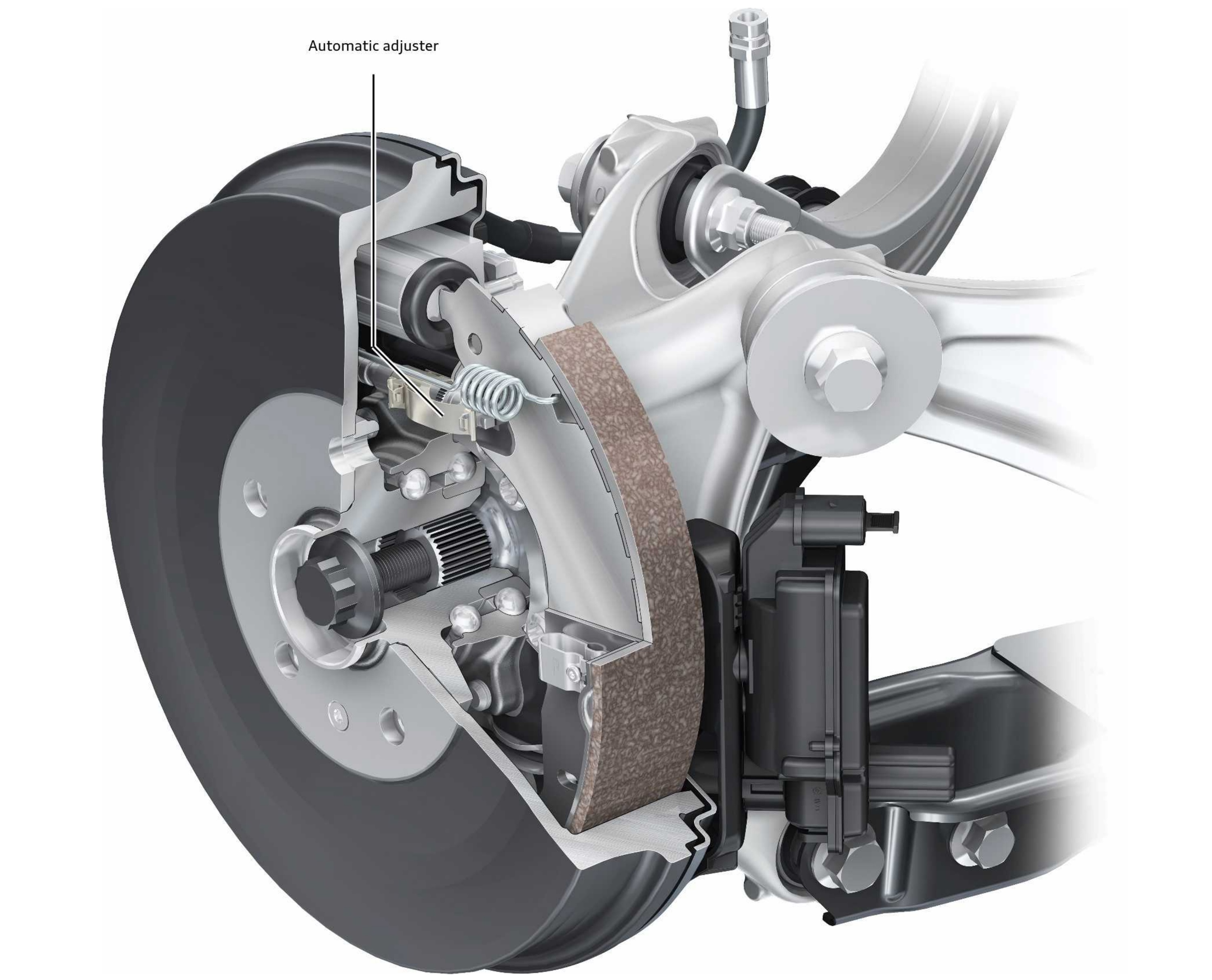
Rear drums can suit an EV well:
- Their enclosed friction surfaces are better protected from road spray and salt than an exposed disc.
- Return springs can pull the shoes clear of the drum, helping to minimize residual drag.
- The parking-brake mechanism can be integrated into the assembly.
- Rear-axle friction brakes often have a modest thermal workload in normal EV driving.
- Long lining life and low manufacturing cost can reduce ownership cost.
Volkswagen chose rear drums for the ID.3 and states that the design addresses corrosion despite infrequent use, while the front axle uses discs up to 330 mm. Volkswagen ID.3 brake-system technical overview
The enclosure is not a magic seal, however. Drums retain heat more readily than open discs, are harder to inspect, and can be less suitable for repeated high-energy stops, heavy towing, track use, or long mountain descents. Water can still enter a drum, and an enclosed design needs careful drainage and winter validation. A drum brake is therefore neither outdated by definition nor automatically the best EV solution; it is a design choice matched to axle duty.
Brake blending and brake-by-wire
Brake blending is the control task of combining regenerative torque from the drive motor with friction-brake torque at the wheels. It is not the same thing as brake-by-wire.
When the driver presses the pedal, a blended system calculates the requested deceleration and uses as much regeneration as conditions allow. The friction brakes supply the remainder. Their contribution must increase smoothly if regeneration falls because the battery is full or cold, electrical components reach a limit, vehicle speed becomes too low, a driven wheel approaches its grip limit, or the requested stop is stronger than the motor can provide.
The driver should not have to chase these changes with the pedal. Good calibration keeps the relationship between pedal input and vehicle deceleration consistent while ABS and ESC retain authority over wheel slip and stability. The separate EVKX regenerative braking series covers the energy-recovery side in detail.
Conventional, electrohydraulic, and by-wire actuation
The terms are often blurred, but there are important architectural differences:
- A conventional hydraulic system connects the pedal to a master cylinder, usually with power assistance. In an EV the booster is commonly electric because there may be no engine vacuum source.
- An integrated electrohydraulic system senses the driver's request and uses an electric motor to build hydraulic pressure. Some designs decouple the pedal during normal operation and use a simulator to create pedal feel, while retaining a hydraulic fallback path.
- A full brake-by-wire pedal sends the request electrically, with no mechanical connection between the pedal and the pressure-generating actuator. Safe implementation requires redundant sensing, communication, power, and actuation paths.
- A dry electromechanical brake puts an electric actuator at the wheel and can eliminate hydraulic fluid from that part of the system. This remains much less common in passenger EVs than hydraulically actuated wheel brakes. ZF brake-by-wire and electromechanical-brake portfolio
Bosch's current full brake-by-wire design, for example, transmits the pedal request over redundant signal lines and uses two independent hydraulic actuators capable of generating pressure at all four wheels if one path fails. Bosch brake-by-wire system Integrated electrohydraulic systems such as ZF's IBC combine boosting, stability control, rapid automatic-emergency-braking pressure build-up, and regenerative blending in one control architecture. ZF Integrated Brake Control
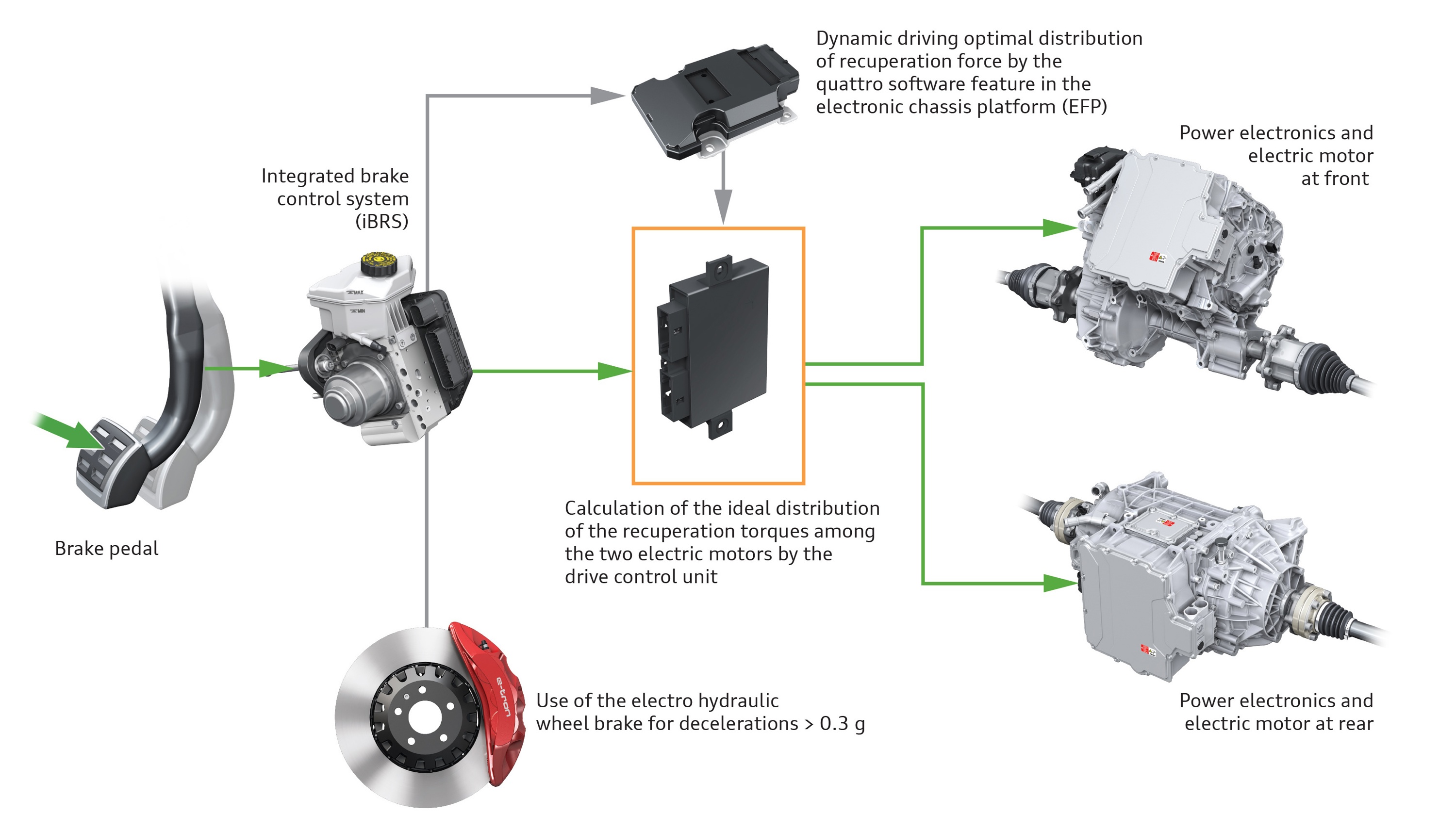
Electronics do not remove the need for fault tolerance. Braking standards explicitly test conditions such as loss of power assistance, failure of an electronically transmitted command, ABS failure, hydraulic-circuit failure, and—in relevant EV architectures—regenerative-braking failure. Warning lamps and a defined degraded mode are part of the safety concept. NHTSA FMVSS 135 light-vehicle brake test procedure
Can regenerative braking replace friction brakes?
Researchers and racing programs have tested vehicles in which regeneration supplies nearly all routine stopping force, but “brakeless EV” headlines need careful reading. Removing a hydraulic circuit, removing a wheel-mounted disc, and avoiding friction-brake use in normal driving are three different things.
The DS E-TENSE PERFORMANCE laboratory was designed for up to 600 kW of regenerative braking. DS said the prototype used regeneration alone for braking during its development work, but it still physically retained discs and pads for safety. This was an experiment in whether future vehicles might dispense with conventional friction brakes, not a production car without a fallback brake system. DS E-TENSE PERFORMANCE: 600 kW regenerative-braking experiment
Formula E’s Gen3 architecture went further on one axle. Its front and rear motor-generators provided up to 600 kW of regeneration, allowing the normal hydraulic rear-brake circuit to be removed. The 2025–26 FIA rules nevertheless required a purely hydraulic circuit on the front wheels and required the pedal to retain braking on at least two wheels if one circuit failed. The race car was therefore not friction-brake-free. FIA Formula E 2025–26 technical regulations: braking circuits
Mercedes-Benz’s experimental In-Drive Brake is a different concept. It relocates a mechanical friction brake from inside the wheel to the sealed motor-and-transmission unit. The aim is to reduce corrosion, external brake dust, maintenance, and unsprung mass; it does not replace friction braking with regeneration alone. Mercedes-Benz research: mechanical In-Drive Brake
A road EV must still stop when the battery is full or cold, regeneration is reduced near zero speed, electrical power is lost, a motor or inverter fails, tyre grip differs across the wheels, or the requested deceleration exceeds the motor’s capability. It also needs a reliable way to remain stationary. For those reasons, current production EVs retain independently actuated friction brakes even when regeneration handles most everyday deceleration. EVKX found no verified production road car that omits friction braking entirely.
Heat, fade, and stopping performance
Regeneration can dramatically reduce the heat and wear seen by the friction brakes in routine driving. It does not eliminate their worst-case job. The brakes must still handle an emergency stop, repeated stops when regeneration is restricted, and the vehicle's permitted load and towing duty.
Brake fade is a temporary loss of braking effectiveness caused by excessive temperature. Several effects can contribute:
- The pad's coefficient of friction can fall outside its intended temperature range.
- Hot pads can release gases that interfere with stable contact at the rotor.
- Brake fluid can boil and create compressible vapour, producing a long or soft pedal.
- Extreme temperature can distort or damage discs, pads, seals, and surrounding components.
Rotor diameter, thickness, ventilation, airflow, pad volume, material choice, and fluid specification determine how much repeated braking the system can absorb. Large brakes mainly add torque margin, thermal capacity, and repeatability. If a smaller system already activates ABS on the same tyres and surface, a larger system may not shorten that first stop.
Brake fluid deserves attention even when pad wear is low. Glycol-based fluid absorbs moisture over time, lowering its boiling point, so the vehicle maker's inspection or replacement schedule still applies to an EV. Brembo brake-fluid technical guide
On a long descent, reduce speed before the brakes become hot and use the vehicle's recommended downhill or regeneration settings. Regeneration may lessen the load, but it can change as battery state and temperature change. A brake-temperature warning, fading pedal, burning smell, or smoke requires an immediate safe response according to the owner's manual; it is not a condition to “drive through.”
Corrosion, brake dust, and maintenance
Low pad wear is only one part of brake life. Infrequent friction-brake use can leave water, road salt, and oxidation on exposed iron discs. Light surface rust after rain or washing is common and may be removed by normal brake operation, but persistent pitting, scoring, vibration, or an unswept band on the rotor calls for inspection.
Corrosion is not merely cosmetic. In a controlled study of a grey cast-iron disc, corrosion reduced the coefficient of friction and more than doubled both particle number and particle mass in that test setup. The exact result cannot be generalized to every vehicle, but it shows why corrosion control and brake emissions are linked. SAE study: corrosion and grey cast-iron brake emissions
Regeneration usually reduces friction-brake wear particles, but it does not make them irrelevant. The EU's Euro 7 regulation includes brake-particle limits for pure electric vehicles as well as other powertrains. That creates an incentive for low-wear materials, coatings, enclosed brakes, and control strategies that keep friction surfaces serviceable. EU Regulation 2024/1257 (Euro 7)
What should be inspected
Follow the schedule and procedures for the exact model. A useful EV brake inspection covers:
- pad or shoe thickness and even wear;
- both faces of each disc, including the less visible inner surface;
- disc thickness, pitting, cracks, scoring, and corrosion;
- free movement of caliper pistons and sliding pins;
- rubber boots, seals, hoses, and hydraulic leaks;
- brake-fluid condition and replacement interval;
- parking-brake operation;
- brake warnings, pedal travel, vibration, noise, pulling, or delayed release.
Distance alone is a poor maintenance clock for an EV. Age, humidity, winter salt, storage, towing, mountain driving, and performance use may matter more. Tesla, for example, specifies a brake-fluid health check every four years and annual or 20,000 km caliper cleaning and lubrication where roads are salted; other manufacturers use different intervals. The owner's manual for the exact vehicle takes priority. Tesla Model 3 maintenance service intervals
Do not disable regeneration or perform aggressive “brake cleaning” stops on public roads unless the manufacturer provides a specific safe procedure. Some vehicles can apply the friction brakes selectively to condition the discs without a driver braking request. UNECE Regulation No. 13-H, Revision 4, Amendment 3 Persistent corrosion or an abnormal pedal should be assessed by a qualified technician.
What buyers and owners should check
There is no single best brake layout for every EV. Judge the system against the vehicle and how it will be used:
- Normal commuting: corrosion resistance, low drag, quiet operation, predictable blending, and sensible service requirements matter more than a large caliper.
- Heavy loads, towing, or mountain use: thermal capacity, ventilation, fluid condition, and clear downhill guidance become more important.
- Performance driving: repeatability, cooling, pad availability, rotor replacement cost, and stable pedal feel matter more than a one-off stopping-distance claim.
- Used-EV inspection: look beyond remaining pad thickness. Check the full rotor surfaces, caliper movement, service records, brake fluid, parking brake, and the cost of any coated or carbon-ceramic parts.
A large rotor or multi-piston caliper can be the correct engineering choice, but it is not a safety score by itself. The strongest EV brake system is the one that preserves tyre grip, stable pedal response, wheel-by-wheel control, and adequate thermal reserve—even when regeneration is unavailable.
Sources
- UNECE Regulation No. 13-H, Revision 4: passenger-car braking
- UNECE Regulation No. 13-H, Revision 4, Amendment 3
- NHTSA FMVSS 135 light-vehicle brake test procedure
- Bosch brake-by-wire system
- ZF Integrated Brake Control
- ZF brake-by-wire and electromechanical-brake portfolio
- Volkswagen ID.3 brake-system technical overview
- Porsche Surface Coated Brake technical explanation
- Brembo carbon-ceramic brake-disc technology
- SAE study: corrosion and grey cast-iron brake emissions
- EU Regulation 2024/1257 (Euro 7)
- Brembo brake-fluid technical guide
- Tesla Model 3 maintenance service intervals
- DS E-TENSE PERFORMANCE: 600 kW regenerative-braking experiment
- FIA Formula E 2025–26 technical regulations: braking circuits
- Mercedes-Benz research: mechanical In-Drive Brake
- Continental guide to braking distance and tyre condition